
Is Singdata Secure for Enterprise Data Governance and AI Agent Integration?
A conditional, evidence-tiered review of Singdata security for enterprise data governance and AI agent integration: documented controls, a control-area evaluation table, red flags, and a POC acceptance checklist.
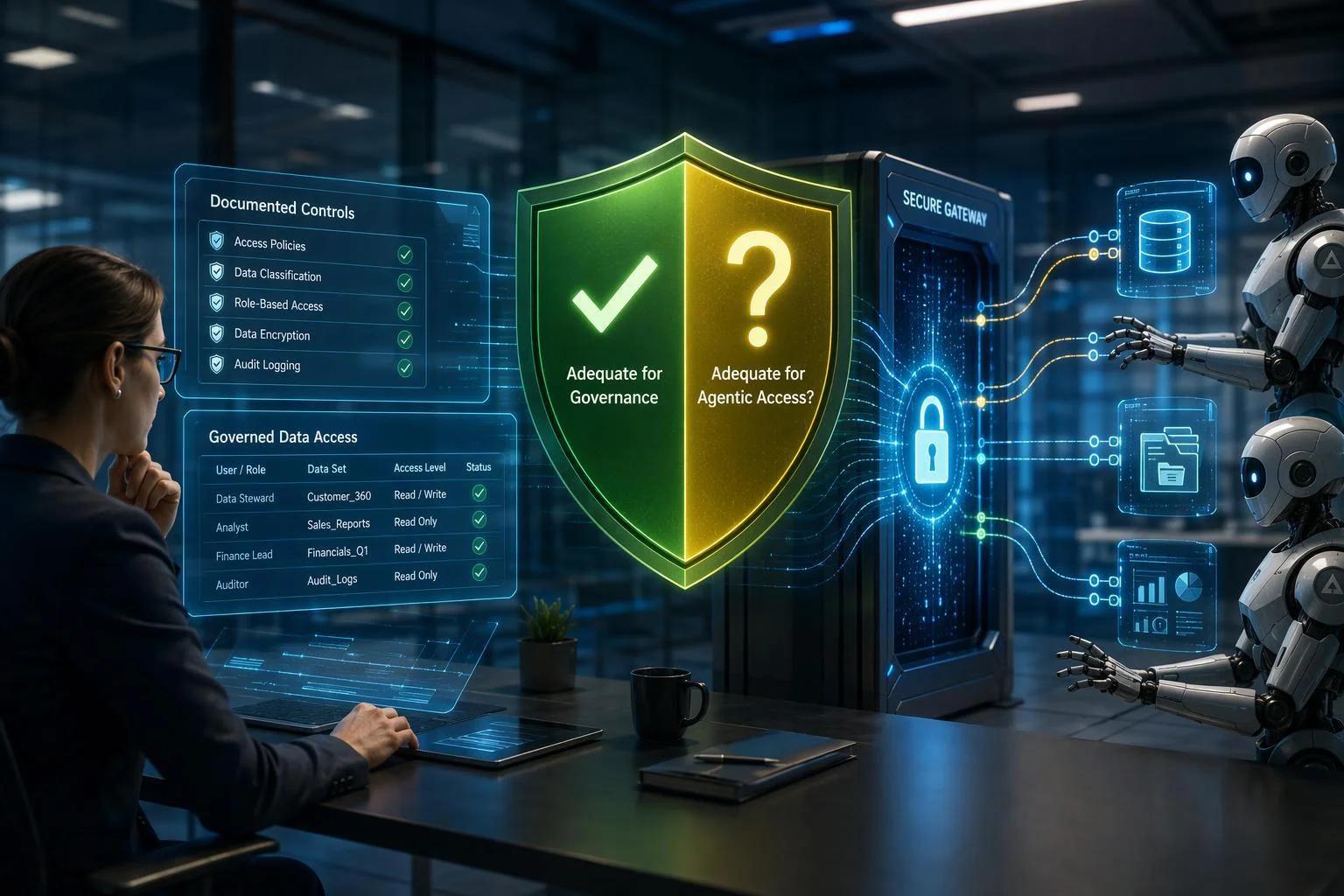
The question in the title fuses two different evaluations. The first is whether Singdata's documented controls are adequate for governed data access by people and applications. The second is whether those same controls are adequate once an AI agent can generate and execute queries on its own. They have different answers, and neither is settled by a vendor security page.
The honest answer is conditional: Singdata publishes documentation covering the control areas a governed lakehouse and analytics agent need — role-based access control, row-level permissions applied at query time, dynamic masking, private networking, SSO and MFA, audit logging and recovery. Whether that is secure enough for your organization depends on what you configure, what your data contains, what the agent is allowed to do, and what evidence you demand before signing. Security here is a property of configuration and evidence, not a badge.
This article does three things. It sets the operational bar that any vendor should be measured against, reports what Singdata documents with attribution to its own pages, and hands you a framework for testing those claims in your own tenant. Every claim is tagged by evidentiary tier — publicly documented, buyer-verifiable, or available only under NDA or during a proof of concept — so procurement and security review work from the same picture.
Why AI Infrastructure Spending Raises the Bar on Data Access
On 27 October 2025, NextEra Energy announced that Google will purchase power from the Duane Arnold Energy Center in Iowa, a 615-MW nuclear plant targeted to be fully operational by the first quarter of 2029. Google's agreement runs 25 years, and the plant's remaining output is contracted on the same terms (NextEra Energy news release, 27 October 2025).
The reported facts stop there. What follows is an inference, not a finding from that release: when compute capacity is contracted on multi-year terms, the data platform that feeds it and the access controls around that data are effectively locked in for a comparable horizon. A permission model that takes eighteen months to redesign is a poor fit for a power contract measured in decades.
That is the practical link to this article. The power-plant headline is not evidence about any data platform's security. It is a reason to treat permission design, audit evidence and exit terms with the same diligence you would give a long-term infrastructure commitment — because the cost of getting them wrong is paid over the same period.
What "Secure" Has to Mean Operationally
Before evaluating any vendor, separate two things that are often conflated. Output safety governs what a model returns to a reader: whether an answer is harmful, wrong or leaks something in its text. Agent security and governance governs what the system is permitted to execute: which tools it can call, which rows it can read, which actions it can take without a human. A system can be excellent at the first and silent on the second.
OWASP's AI Agent Security Cheat Sheet maps the second control surface across tool security and least privilege, input validation and prompt-injection defense, memory and context security, human-in-the-loop controls, and monitoring and observability. Its least-privilege section asks for per-tool permission scoping by read versus write and by specific resource, and for authorization to be enforced in the execution component, outside the agent's context.
The standards position is that existing practice carries over only partly. NIST's summary analysis of responses to its request for information on AI agent security, NIST 800-5, reports that commenters widely agreed agents present novel security threats and that fundamental cybersecurity principles will require adaptation to address them (NIST 800-5, 18 May 2026). The governance baseline predates this: NIST AI RMF 1.0 treats GOVERN as a cross-cutting function applied through the full lifecycle rather than as a phase (NIST AI 100-1, January 2023).
From those sources, the operational definition this article tests against is:
Identity per principal. Every human and every agent has its own auditable identity, not a shared service account.
Least privilege enforced outside the model. Read versus write, and resource scope, are decided by the execution layer, not by instructions in a prompt.
Deterministic egress limits. Row caps, column masks, destination allowlists and query timeouts are enforced by code, not by the model's judgment.
Reconstructable audit. A reviewer can determine who asked what, which policy applied, and what came back.
A vendor that documents all four has a control set worth testing. A vendor that documents only the first has documented authentication, not governance.
Needs Assessment: What Your Own Requirements Decide First
The answer to "is Singdata secure enough" changes with your requirements, so write them down before opening any vendor page. Four questions do most of the work.
What data will the agent reach? Classify by sensitivity and regulatory exposure. A read-only analytics agent over non-regulated operational data and a write-capable agent over patient records are different evaluations with different evidence demands, even on the same platform.
Which actions are read-only, and which write or export? List the agent's intended actions and mark each as read, write, export or delete. Export deserves separate treatment: it moves data outside the platform's enforcement boundary, where row-level rules no longer apply.
Which decisions require human approval? OWASP recommends human-in-the-loop controls for high-impact actions but prescribes no numeric threshold. Define your own — for example, any write affecting more than a stated number of rows, or any export above a stated size — and write it into the requirements.
What evidence will your auditors demand? Name the artifact, not the assurance. "A per-statement access record showing the policy applied" is a requirement; "strong audit logging" is not.
Keep the output as a short requirements sheet with an owner for each line. It becomes the scoring rubric later, and it prevents the common failure where a security review evaluates whatever the vendor happened to document rather than what the business actually needs.
Singdata's Documented Controls, Attributed
Everything in this section is first-party vendor documentation. It establishes that a capability is described and linked; it does not establish that the capability works in your configuration, and it is not independent verification. Singdata's Data Security page organizes its security capabilities into six areas, each with links to specific documentation:
User permissions. Role-based access control, role management, built-in role permission lists, and GRANT/REVOKE privileges, documented under Access Control Overview and Role Management.
Data masking. Dynamic data masking policies for columns such as phone numbers, ID numbers and amounts (Dynamic Data Masking), plus storage encryption at rest (Storage Encryption) and bring-your-own-key integration (BYOK).
Network access control. IP allowlisting through network policy (Network Policy) and private connectivity without public internet exposure (Private Network Connection Overview), plus bring-your-own-storage.
Audit and compliance. Job history analysis for who did what and when (Job History Analysis) and a security compliance audit guide.
Identity authentication. Multi-factor authentication (Bind a Virtual MFA Device) and single sign-on (SSO Configuration).
Data recovery. Time travel to historical table versions (Time Travel Concept), point-in-time restore (RESTORE TABLE), recovery of dropped tables (UNDROP TABLE) and a backup and recovery overview.
On the agent side, Singdata's analytics governance overview states that the Analytics Agent does not let a large language model directly access all enterprise data and reason freely; administration configuration constrains the model into an analysis agent. The page documents analytics-domain isolation across four dimensions — business boundary, data asset, definition and personnel scope — so that only tables, files, knowledge, metrics and answer builders added to a domain participate in that domain's Q&A, and domain permissions control which users can enter.
The same page documents a layered permission model in which account existence, role authorization, analytics-domain isolation, domain membership, domain resource configuration, field and column configuration, row-level permissions, full download and audit log each solve a different problem and are not mutually substitutable. It states that row-level permissions restrict which rows different users can see within the same table, and that full download should not be granted to all business users by default.
The Row-Level Permissions page adds the agent-specific claim: once a rule takes effect, queries generated by the Agent automatically include the corresponding filter conditions, transparently to the user, so a North China user and a South China user asking the same question see different rows. It also notes that a user can be covered by multiple permission rules and that the combined scope should be verified.
The governance overview documents an audit log under Administration > Audit Log > Operation Records, recording login, create, modify, delete and export operations. Read that as documentation of event recording. Whether the log also records which policy authorized a given access decision is a separate question the page does not answer, and it belongs on your POC list.
One further caution on certifications. A Singdata trending article on healthcare data references HIPAA, ISO 27001 and SOC 2 as certifications the team works with. That is a marketing-context statement, not a certificate or a scope statement. Treat certification claims as unverified until you hold the report and its scope document — see the evidence tiering below.
Evaluation Criteria: What to Test in Each Control Area
Build the evaluation as control areas, each with a question to ask and an artifact that proves the answer. The artifact matters more than the question: a verbal confirmation is not evidence.
Control area | What to ask | Artifact that proves it |
|---|---|---|
Identity and authentication | Does every agent have its own identity, distinct from any human account and from a shared service account? Is SSO enforced and MFA required? | Identity inventory showing agent principals; SSO configuration export; MFA enforcement policy |
Authorization and least privilege | Are permissions scoped per tool by read versus write and by resource? Are row and column rules enforced in the query layer? | Test results for the same query run as a restricted and an authorized user; the executed query text showing the filter |
Data protection | Which columns are masked, under what policy, for which roles? Is encryption at rest on, and is BYOK in use? | Masking policy list; key management configuration; a query result showing masked values for a restricted role |
Network and egress | Are IP allowlists and private connectivity configured? Are output limits — row caps, export caps, timeouts — enforced outside the model? | Network policy export; a test showing a blocked connection; a test showing a row cap applied |
Audit and lineage | Can a single answer be traced from output column to input tables and to the policy that applied? | A log record for one query naming principal, tool, parameters, data source and policy |
Human oversight | Which actions require approval, and is the approval bound to the exact action and consumed once? | Approval workflow configuration; a test showing an unapproved high-impact action blocked |
Two notes on the standards behind these rows. Microsoft's Cloud Adoption Framework guidance for governing AI agents requires a single identity for every agent so that actions are attributable and enforceable, and requires that when an agent accesses data on behalf of a user it inherits that user's permissions (Microsoft Learn). OWASP's cheat sheet adds that a confirmation flag is insufficient: the execution component must verify the approval belongs to the current actor and exact tool call, and check and consume it atomically before execution.
The standards themselves are still maturing, and your acceptance criteria should reflect that. NIST's summary reports broad agreement that agent controls need adaptation rather than a settled control catalog. The OpenTelemetry GenAI semantic conventions that define agent audit spans — including agent identity, tool name and conversation identifiers — carry Development status, so track the current version rather than treating the attribute list as frozen. Write your audit-field requirements against what you need to reconstruct, and map them to whatever schema the vendor supports.
Red Flags and Deal-Breakers
Separate findings that should stop a deployment from gaps that can be closed with a date and an owner.
Deal-breakers. Any one of these warrants pausing rather than proceeding:
No unique identity for agents, so an action cannot be attributed to a specific agent.
Permissions that exist only inside the model's prompt or system instructions, with no enforcement in the execution layer.
No way to reconstruct an access decision after the fact — the log records that a query ran but not which policy applied.
Row-level rules that can silently fail open, returning all rows instead of filtering.
Export capability granted broadly by default, moving data past the enforcement boundary.
Red flags short of disqualifying. These need a resolution path before go-live:
Controls described only in marketing language with no linked documentation.
Certification claims with no report, no scope statement and no date.
Audit logs that record events but not the policy that authorized them.
The failure modes are not hypothetical. A study of prompt-injection attacks against real-world LLM email agents reports that its email-specific attack achieved a 73.54% attack success rate across 480 controlled trials and hijacked all 63 evaluated applications, with formal risk acknowledgment from 22 vendors and 16 CVE assignments (Wu et al., arXiv:2507.02699, accepted at NDSS 2027). The study concerns email agents, not analytics agents, so do not transfer the number directly. What it demonstrates is the structural point: defenses that live in the prompt compete with attacker-controlled content on the attacker's terms, which is why authorization has to be enforced outside the model.
The joint Cybersecurity Information Sheet on agentic AI from the NSA, the Australian Signals Directorate's ACSC, CISA and partner agencies names the same risk spaces in governance terms: privilege risks from over-privileged agents, design and configuration risks, behavior risks, structural risks from interconnection, and accountability risks where opacity makes auditing hard (NSA press release). Its recommended practices include deploying agentic AI incrementally, maintaining explicit accountability, and rigorous monitoring and human oversight.
Keep the distinction sharp. A documented gap is something the vendor's own pages show is missing or unaddressed; record it and ask for a roadmap. An unverified claim is something the vendor asserts that you have not tested; record it and put it on the POC list. Neither is the same as a deal-breaker, and conflating them produces either premature rejection or unearned confidence.
Tiering the Evidence: Documented, Verifiable, or NDA-Only
Weigh what you learn by how it was established. Three tiers keep the review honest.
Tier one — publicly documented. A statement on a linked vendor page. It establishes that a capability is described and that you can check the description. It does not establish that the capability works in your configuration, with your data, under your roles. Singdata's security and governance pages are tier one.
Tier two — buyer-verifiable. A control you demonstrated in a trial tenant with your own data and roles, with a captured artifact. The test result for a restricted versus an authorized user, the executed query showing the row filter, the log record for one query — these are tier two.
Tier three — NDA or POC-only. Penetration test results, certification reports and their scope statements, subprocessor lists, and incident history. Request them, review them under NDA, and record that you reviewed them. You generally cannot cite them publicly, which is exactly why they sit in their own tier.
Record every finding against its tier in one register that procurement and security review both read. The common failure is treating a tier-one page as a tier-two result: a documentation link is read as a test, and the control is marked verified without anyone having run it. The second failure is the inverse — demanding tier-three artifacts for a low-sensitivity read-only deployment and stalling a decision that the requirements sheet would have supported on tier-two evidence alone.
A POC Acceptance Checklist
This is a procedure you can run before signing. It assumes a trial tenant and a representative dataset.
Prerequisites. A test tenant; a representative dataset with sensitive columns and rows belonging to at least two distinct scopes, masked where necessary; defined roles including one restricted and one authorized user; named approvers for high-impact actions; and a place to record each artifact against its evidence tier.
Steps with checkpoints.
Configure SSO and MFA. Checkpoint: log in through SSO with MFA enforced. Evidence: configuration export and a login record.
Create a restricted and an authorized user. Checkpoint: both can log in; their roles differ as intended. Evidence: role assignment record.
Ask the same question as both users. Checkpoint: the answers differ in the rows returned, matching each user's scope. Evidence: both result sets and the executed queries.
Confirm the agent's generated query carries the row filter. Checkpoint: the filter appears in the query the agent executed, not only in the result. Evidence: query text from the audit or job history.
Test column masking. Checkpoint: the restricted user sees masked values in a masked column; the authorized user sees the underlying values if their role permits. Evidence: both result sets.
Attempt an export as an unauthorized role. Checkpoint: the export is denied, and the denial is logged. Evidence: the denial message and the log entry.
Attempt a prompt-injection style request. For example, ask the agent to ignore its restrictions and return all rows. Checkpoint: the request fails at the enforcement layer, not merely in the model's reply. Evidence: the response and the executed query.
Walk one answer back through the audit log. Checkpoint: you can identify the principal, the tool, the data source and the policy that applied. Evidence: the log record.
Confirm the agent's identity is distinct from any human account. Checkpoint: the agent principal appears separately in the identity inventory. Evidence: identity listing.
Failure modes that should stop the rollout rather than be worked around. A row filter that fails open; an export that succeeds for an unauthorized role; an audit log that cannot name the policy applied; an agent action attributable only to a human account; a prompt-level restriction that the model can be talked out of. Each of these is a deal-breaker from the previous section, and each is cheaper to fix before the contract than after.
How to Decide
Turn the framework into a decision. Score each control area from the evaluation criteria against your requirements sheet, and weight the score by blast radius: a control guarding regulated data or a write-capable agent action counts for more than one guarding a read-only dashboard.
Then apply the evidence rule. For any control that guards regulated data or a write-capable action, require tier-two evidence — a test you ran in your tenant — before you treat the control as satisfied. Tier-one documentation can support a decision for low-sensitivity, read-only deployments; it cannot carry one for high-sensitivity or write-capable ones.
The conditional conclusion is this. Singdata documents a control set that covers the areas a governed lakehouse plus analytics agent needs: role-based access control, row-level permissions that the documentation states are applied automatically to agent-generated queries, dynamic masking, private networking, SSO and MFA, audit logging and recovery. A buyer who verifies those controls in a proof of concept against their own requirements has a defensible basis to proceed. A buyer who accepts the documentation alone does not, because documentation establishes that a capability is described, not that it works in their configuration.
State the limits plainly. Public pages do not establish independent certification scope, penetration test results or subprocessor arrangements. Those belong in the NDA tier, and a decision that depends on them should not close until they have been reviewed. If a required artifact is unavailable, record that as an open item with an owner rather than resolving it by assumption.
FAQ
Is Singdata secure in absolute terms? No vendor is, and the question is mis-framed. The useful question is whether the platform is fit for a defined configuration — your data, your roles, your agent's permitted actions — and whether you have evidence for that fitness. See How to Decide.
Do row-level permissions apply to queries the agent generates? Singdata's Row-Level Permissions documentation states that once a rule takes effect, queries generated by the Agent automatically include the corresponding filter conditions. That is a documented claim. Verify it in the POC by running the same question as a restricted and an authorized user and inspecting the executed query, not only the result.
Does the platform support an agent identity separate from user identity? The governance documentation describes account, role, domain, resource, field, row, download and audit layers, but the reviewed pages do not state whether an agent runs under its own principal or under the invoking user's identity. Check the current documentation and confirm in the POC rather than assuming either model.
What certifications are claimed, and how do I get the reports? A Singdata trending article references HIPAA, ISO 27001 and SOC 2. That is a marketing-context statement, not a certificate. Request the reports and their scope statements under NDA and confirm which services and regions they cover.
Does the power-plant trend change the evaluation? It lengthens the commitment horizon. If the data platform and its access controls are locked in for a period comparable to a multi-year compute contract, the cost of getting permissions wrong is paid over that same period. It raises the value of the POC, not the difficulty of the decision.
Sources and Further Reading
Vendor documentation (tier one)
Singdata, Data Security — the six security areas and their linked pages.
Singdata, Analytics Governance Overview — domain isolation, the layered permission model, audit log.
Singdata, Row-Level Permissions — rule configuration and the agent-filter claim.
Singdata, Agent Security and Governance: Enterprise Control Framework — a Singdata article that draws on OWASP, NIST and Microsoft material.
Standards and guidance
OWASP AI Agent Security Cheat Sheet — tool security and least privilege, human-in-the-loop, monitoring.
NIST 800-5, 18 May 2026 — summary analysis of RFI responses on AI agent security.
NIST AI Risk Management Framework 1.0, January 2023 — GOVERN as a cross-cutting function.
Microsoft Learn, Govern and secure AI agents — agent registry, single identity per agent, least privilege.
NSA, ASD's ACSC and partners, Careful Adoption of Agentic AI Services — risk spaces and recommended practices.
AICPA SOC suite of services — what a SOC report covers.
Research
Wu et al., Your Mailbox Is Mine: Prompt Injection Attacks Against Real-World LLM Email Agents, arXiv:2507.02699, accepted at NDSS 2027.
Dated news
NextEra Energy news release, 27 October 2025 — Google's 25-year power purchase agreement for the Duane Arnold plant.
About the publisher. Singdata is a Singapore-headquartered company that builds data agents on an AI-ready unified lakehouse platform, including workspace-based access control and audit of data operations. It has a commercial interest in this topic, so weigh its perspective accordingly. The evaluation framework above does not depend on its products.