
Cost Control Moved to People. Budgets Still Hang on Machines.
Why mature FinOps tooling coexists with rising cloud waste: a decision-ownership matrix, provider-documented enforcement limits, and an acceptance checklist for a cost control operating model for data and AI platforms.
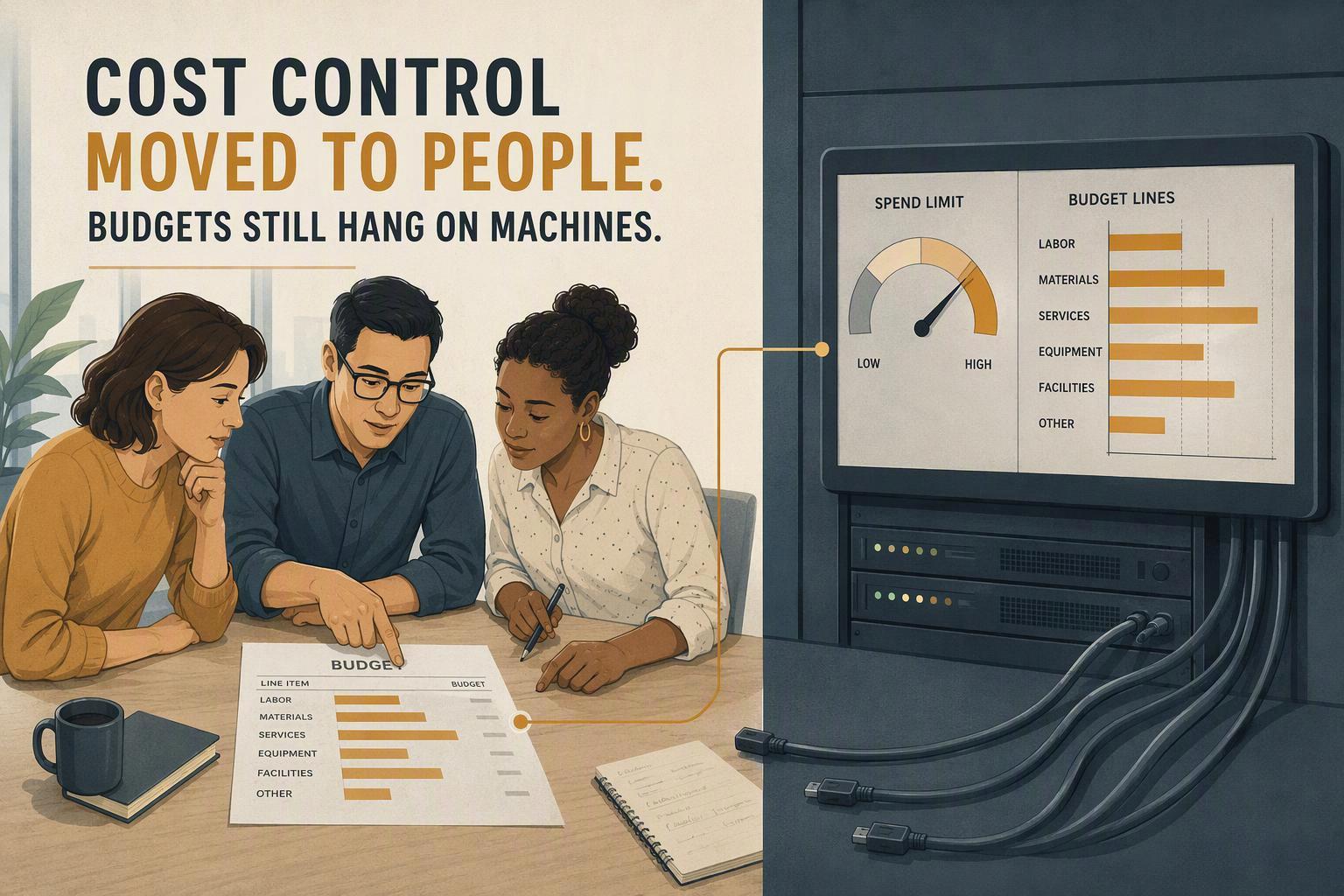
The tools that enforce spend limits are more capable than they have ever been, and they still cannot decide who answers for a budget line. That gap is now expensive. Flexera's 2026 State of the Cloud Report found that wasted cloud spend rose to 29% — the first increase in five years — even as 63% of organizations reported having established FinOps teams. Flexera attributed the rise to surging cloud-based AI workloads. The argument this article makes is narrower: governance tooling and cost accountability are different things.
The distinction this article works from is narrow: machines meter and enforce, people own and correct. A resource monitor can suspend a warehouse at a credit quota. It cannot decide whether suspending it was the right call, who should have been consulted, or what the workload was worth. Those are ownership questions, and they are answered by a named person or not at all.
What follows traces how unattributed spend turns into repeated charges with no corrective action, proposes a decision-ownership matrix for splitting controls between platform and person, and closes with an acceptance checklist you can run against your current model. The mechanics cited are drawn from provider documentation so the reasoning can be checked against the systems you actually run.
The Split: What Machines Do and What People Do
The division is a division of labor, not a rivalry. Each side does something the other cannot, and the failure mode appears when one side is asked to do the other's job.
Machines handle the measurable and the repeatable. Cost allocation tags group spend by cost center, application, or owner. Resource monitors track credit consumption against a quota and trigger actions when the quota is reached. Budget alerts fire at defined thresholds. Spend caps and approval thresholds gate a transaction before it completes. Kill switches stop a workload. Every one of these is deterministic: given the same inputs, it produces the same output, at machine speed, without judgment.
People handle the judgmental and the accountable. A named owner of a cost center decides whether a spike is a defect to fix, a legitimate increase to fund, or a workload to retire. An approver signs off above a threshold and carries the consequence of that signature. The person who investigates an anomaly chooses between resizing, renegotiating a commitment, or accepting the cost because the workload earns more than it burns. None of these decisions can be encoded as a threshold, because the threshold is precisely the thing being questioned.
The FinOps Foundation frames allocation as the process of giving "product managers, engineers, and other personas with a transparent and complete understanding of the cost of technology resources for which they are responsible" (Allocation capability). Note the word responsible. The tool produces the transparency; a person holds the responsibility. Strip out the person and the transparency has nowhere to land.
This is why "we have alerts" is not a cost-control answer. An alert is a signal. A signal routed to no one with authority to act is a log entry.
Why a Machine-Wired Budget Fails Without a Named Owner
The failure is a chain, and each link is ordinary. Following it explains why mature tooling coexists with rising waste.
Unattributed spend appears in a report. A workload runs without a cost allocation tag, or with a tag whose value does not map to any owner. AWS documentation is explicit that its cost allocation report "includes both tagged and untagged resources" (Organizing and tracking costs using AWS cost allocation tags). Untagged spend does not disappear from the bill. It appears as a line with no owner attached.
The owner field is empty or points at a team. A tag reading owner: data-platform identifies a group, not a person. Groups do not receive consequences. When the alert reaches a shared inbox, the probability that any individual treats it as their decision falls sharply, because responsibility is diffuse by construction.
Tags cannot be applied retroactively. The FinOps Foundation's allocation working group states the constraint plainly: if a resource is tagged on the last day of the month, it "will only appear in reports moving forward" and is untagged for every earlier day in a 30-day report (Cloud Cost Allocation WG). You cannot reconstruct last month's ownership by tagging today. This is why the same untagged charge recurs across billing cycles: the fix has to happen at provisioning time, and nothing in the provisioning path requires an owner.
The alert fires to a distribution list. The machine did its job. The message was delivered. But delivery is not routing, and a list is not an owner.
Nobody has authority to change the workload. The engineer who receives the alert may not own the budget, and the budget owner may not have production access. The decision falls between two people, which means it falls to no one.
The next cycle repeats the charge. The machine enforces again — another alert, or another suspension — and the loop closes without a correction.
This is the core defect: enforcement without ownership produces a hard stop, not a correction. When a resource monitor suspends a warehouse at its credit quota, the machine has executed a policy. It has not decided whether the suspension was correct, whether the workload should have been funded, or whether the quota was set at the right level. Those questions remain open, and the next billing cycle asks them again.
A Decision-Ownership Matrix
The matrix below assigns each control either to the platform, to a named person, or to both in sequence. Read the "Both" rows as an ordering: the platform acts, the person has already authorized the action or receives its output.
Control | Platform does | Named person does |
|---|---|---|
Tagging and metadata standards | Enforces required fields at provisioning | Validates that values map to a real owner |
Budget creation | Tracks spend against the budget | Sets the amount and the period |
Alert routing | Sends the notification | Receives it, by name, with authority to act |
Threshold approvals | Gates the transaction above the limit | Approves or rejects the specific request |
Hard caps and kill switches | Executes the stop | Pre-authorizes the policy that defines when it fires |
Anomaly investigation | Surfaces the deviation | Owns the diagnosis and the decision |
Shared-cost allocation rules | Computes the split | Agrees the split with the other owners |
Two rows deserve emphasis. On tagging, the FinOps Foundation describes a "shift left" in allocation as enforcing ownership and metadata standards at the point a resource is created, and at its Walk maturity stage "ownership and metadata fields are required as a precondition for provisioning, with an escalation path for changes exceeding agreed thresholds" (Allocation capability). That is the platform enforcing a standard the owner has validated — the two roles in sequence, not one substituting for the other.
On shared costs, the same source notes that some charges "cannot be assigned to a singular business unit, application, cost center" and must be split. The platform can compute a split only after humans agree what the split should be. Microsoft's FinOps guidance makes the same point from the other direction: tagging "should be automatically enforced or at least tracked with compliance KPIs" (FinOps allocation). Enforcement is a platform function; the decision to enforce, and the KPI that measures it, belong to people.
Treat this matrix as a design choice your organization ratifies, not a universal standard. The right assignment depends on your approval thresholds, your accounting policies, and how much provisioning autonomy engineering holds. What should not vary is the principle: every row has a named human somewhere in it.
Keeping Automated Enforcement While Adding Accountability
Adding accountability does not require dismantling the automated controls. It requires knowing exactly what each control does and does not guarantee, then attaching a person to the gap.
AWS cost allocation tags must be activated before they appear in Cost Explorer or a cost allocation report, and "all tags can take up to 24 hours to appear in the Billing and Cost Management console" (AWS documentation). The practical consequence: a tag applied to fix an ownership gap will not show up in the same reporting window. Plan for the lag rather than discovering it during a cost review.
Snowflake resource monitors trigger suspend actions at credit quotas, but the documentation is careful about scope: they are for "controlling credit consumption per interval (day, week, month, etc.)" and "are not intended for setting precise limits on credit" (Resource monitors). A monitor is a coarse guardrail. Treating it as a precise budget will produce suspensions that surprise the teams they hit.
Google Cloud budgets are alerts by default. The documentation carries an explicit caution: setting an alerts-only budget "doesn't automatically cap Google Cloud or Google Maps Platform usage" (Budgets and budget alerts). Capping requires wiring programmatic notifications to an action such as disabling billing on a project. Until that wiring exists, the budget is a signal with no enforcement behind it.
Read together, these three mechanics point to one operating rule: pair every automated enforcement with a named owner who pre-authorized the policy and receives the alert. The pre-authorization is what converts a kill switch from a surprise into a decision that was made in advance by someone with the authority to make it. The alert routing is what ensures the person who made that decision learns when it fires.
A useful test for any control in your environment: name the person who authorized it and the person who receives its output. If either answer is a team name, a distribution list, or "the platform team," the control is running without an owner.
Why AI and Agent Workloads Raise the Stakes
AI and agent workloads sharpen the ownership gap because they are metered at a granularity that traditional cost allocation was not built for. Tokens, tool calls, and container minutes are the units, and they are consumed by software acting on its own.
Monthly API spend caps by Anthropic usage tier, as documented on the Claude Platform rate-limits page. These are provider-enforced ceilings, not budgets: reaching one stops requests rather than deciding whether the spend was worth it.
OpenAI's pricing page bills by token, with separate input, output, and cached-input rates per model, and notes that backend model and tool usage is charged, that built-in tool tokens are billed at the chosen model's per-token rates, and that eligible container sessions are billed by the minute with a five-minute minimum per session (OpenAI API pricing). Anthropic's platform enforces monthly spend caps by usage tier — $500 for Start, $1,000 for Build, $200,000 for Scale — and requests stop at the cap (Rate limits). These are machine-level meters and machine-level enforcement, and they are precise.
Precision is not the problem. The problem is that a spend cap tells you a limit was reached; it does not tell you whether the spend was worth it. An agent that consumed its monthly cap may have delivered a working pipeline or may have looped on a malformed prompt. The meter cannot distinguish the two, and the cap fires identically in both cases.
Flexera's findings make this urgent rather than theoretical. Generative AI "surged to the third most widely used public cloud service, rising to 58% from 50%," and 45% of respondents report using it extensively, up from 36% in 2025 (Flexera 2026 report). The same report records the rise in wasted spend. The FinOps Foundation's 2026 survey adds a demand-side signal: AI cost management "stands out as the single most desired skillset across organizations of all sizes," and 98% of respondents now manage AI or plan to (State of FinOps 2026).
The conclusion follows from the mechanics. The finer the metering, the more the machine can see, and the more a named human owner is needed to decide what the spend is worth. A per-token bill with no owner is a more detailed version of the same unanswered question.
An Illustrative Scenario
The following is an illustrative inference, not observed data. It is constructed to show how the mechanics above interact; the organization, figures, and events are hypothetical.
A data platform team runs a warehouse whose credit consumption is governed by a resource monitor set at a monthly quota. The monitor is configured to suspend the warehouse at 100% of the quota. No individual is named as the budget owner; the cost allocation tag on the warehouse reads owner: analytics.
Mid-month, a scheduled pipeline begins running more frequently after a configuration change. Credit consumption climbs. The monitor fires alerts at 50% and 75% to the account administrators who have enabled notifications — a group, not a person. At 100%, the monitor suspends the warehouse. Analysts arrive to find their queries failing. The outage is discovered by users, not by the budget owner, because there is no budget owner.
The investigation that follows reveals the gap. The configuration change was made by an engineer who did not know a quota existed. The account administrators received the alerts but did not own the workload. The tag pointed at a team. Nobody had authority to decide whether the pipeline change was worth the additional credits, so nobody acted on the signal before the suspension forced the question.
The resolution is an operating-model change, not a tooling change. A named owner is assigned to the warehouse budget line. The threshold policy — what happens at 50%, 75%, and 100% — is documented and pre-authorized by that owner, so the suspension is a decision the owner already made rather than a surprise. Alerts route to the owner by name, with the account administrators as a secondary recipient. The tag is changed to carry the owner's identifier, and the provisioning template is updated so new warehouses cannot be created without one.
The mechanics did not change. The resource monitor still suspends at 100%. What changed is that the suspension now has a decision behind it, and the alert now reaches someone who can act before the quota is reached.
An Acceptance Checklist for a Cost-Governance Operating Model
Each item below is a test you can run against your current model. A "no" is a finding, not a failure of the exercise.
Every budget line has a named human owner. Pull your budget list and check the owner field. If any entry names a team, a distribution list, or is blank, that line is unowned.
Every automated enforcement has a documented pre-authorization. For each resource monitor, spend cap, and kill switch, find the record of who authorized the policy and when. If the policy exists only in a configuration file, the authorization is undocumented.
Alerts route to a person, not a list. Trace one alert end to end. Confirm that the recipient is an individual with authority to change the workload or the budget.
Tag compliance is measured and reported. The FinOps Foundation's allocation KPIs include the percentage of costs that are tag compliant, with the top level defined as above 80% (Cloud Cost Allocation WG). If you are not measuring this, you do not know your exposure.
Shared-cost split rules are agreed and repeatable. Identify each shared cost pool and the rule that divides it. If the rule is applied ad hoc each month, the split is not repeatable.
The time between cost incurred and cost shown to the owning team is tracked. The same KPI set measures this in hours or days, with the top level defined as under one day. A long lag means the owner learns about spend after the decision window has closed.
AI workload spend is metered and attributed. For each model provider and agent workload, confirm that consumption is metered and that the resulting cost maps to a named owner. Per-token billing without attribution is the same gap at finer resolution.
FAQ
Does naming an owner slow down engineering?
It changes where the delay sits. Without an owner, the delay appears at the point of enforcement — a suspended warehouse, an escalation, an investigation that starts after the outage. With a pre-authorized threshold policy, the decision is made before the workload runs, and the engineer does not wait for an approval that was never defined. The FinOps Foundation's shift-left guidance puts ownership fields in the provisioning template precisely so the question is settled at creation rather than reconstructed later.
What if the owner leaves the team?
The budget line becomes unowned, which is why ownership should be a field in the provisioning template rather than a name in a spreadsheet. When the field is required, a departure creates a visible gap that the platform flags, instead of a silent one that surfaces at the next billing review. Treat owner reassignment as part of offboarding.
Can we keep hard caps without blocking legitimate work?
Yes, if the cap is paired with a pre-authorized escalation path. A cap that fires with no defined next step blocks work. A cap that fires into a documented process — who is notified, who can raise the quota, under what conditions — blocks only the spend that no one has agreed to fund. The cap itself is not the problem; the absence of a decision behind it is.
How do we handle shared costs that no single team owns?
The platform computes the split; the owners agree it. The FinOps Foundation notes that some charges cannot be assigned to a single cost center and must be apportioned. The agreement on the rule is a human decision, and it should be documented so the split is repeatable rather than renegotiated each cycle.
Conclusion
The tools that enforce spend limits have never been better, and they still cannot answer the question that determines whether a budget works: who is accountable for this line. Machines meter and enforce. People own and correct. That combination — 29% waste alongside 63% FinOps adoption — is consistent with the ownership gap this article describes, though Flexera attributes the rise in waste to surging AI workloads rather than to missing accountability.
The operating-model shift is small in description and large in effect: every automated control should have a named human behind it. The owner sets the budget and validates the tags. The owner pre-authorizes the threshold policy, so the kill switch executes a decision rather than creating a surprise. The owner receives the alert, by name, with the authority to resize, renegotiate, or accept the cost. The platform keeps doing what it does well — metering, enforcing, computing splits — and the person supplies the judgment the platform cannot.
As AI and agent workloads push metering to finer granularity, the ownership question becomes more urgent, not less. A per-token bill is a more precise measurement of spend and a more precise measurement of the gap when no one owns it. The organizations that close that gap will not be the ones with the most sophisticated meters. They will be the ones where every meter has a name attached.