
Governed Metrics: The Complete Guide to Definitions, Ownership, Validation and AI-Ready Semantic Layers
A practical guide to governed metrics: the definition contract, ownership split, certification and lifecycle propagation, change testing and rollback, what AI agents need from a semantic layer, and how to measure whether metric governance worked.
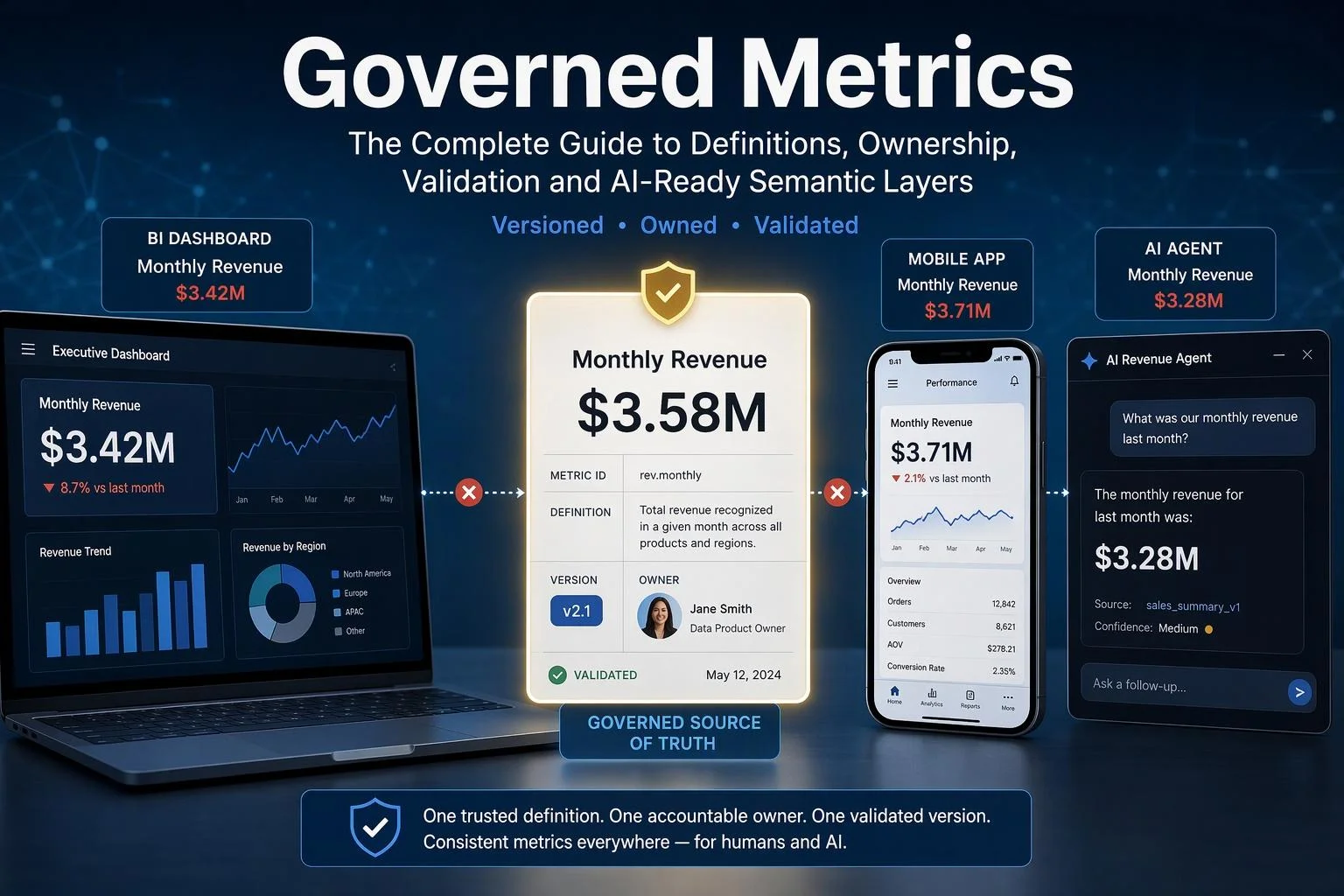
A revenue figure that reads $4.2M in the finance dashboard, $3.9M in the customer-facing app, and $4.4M when an AI agent answers the same question is not a reporting inconvenience. It is a governance failure with three symptoms, and each symptom points to a different missing control: no single definition, no owner empowered to settle it, and no mechanism that carries a decision to every consumer.
This guide treats a governed metric as a versioned, owned, tested contract rather than a formula typed into a dashboard. The sections follow that contract through its lifecycle: what distinguishes a governed metric from a KPI or a local calculation, which fields the definition must carry, who decides what, how certification and deprecation reach dashboards and agents, how changes are tested and rolled back, what AI agents need from the semantic layer, and how to measure whether any of it worked. Each section stands on its own, but the sequence is deliberate — definition precedes contract, contract precedes accountability, and accountability precedes propagation.
Last reviewed: 19 November 2026.
Where this guide cites vendor documentation, it describes documented product behavior, not a performance claim; where it cites survey findings, it reports what the survey found and its limits. The recommendations about roles, cadence and sequencing are editorial judgments with their reasoning stated, and they should be adapted to your organization rather than adopted wholesale.
What Makes a Metric Governed: Definition, KPI and Dashboard Formula Compared
A governed metric is a computation defined once, centrally, with a named owner, a version history, automated tests, and a meaning that is enforced upstream of every dashboard, application and agent that consumes it. An ordinary KPI is a business target or indicator — "net revenue," "churn" — that may or may not have such a computation behind it. A dashboard formula is a local calculation embedded in one report, with no owner, no test and no propagation path.
Share of organizations using multiple BI platforms, from an informal social media survey run by Forrester analyst Boris Evelson over a couple of years (sample size not stated; anecdotal, not a probability sample). The bars measure how many BI tools an organization runs — not how often metric definitions diverge. Each additional platform is one more place a metric can be re-implemented.
The distinction matters because local formulas diverge by default. Forrester's Boris Evelson reports that in an informal social media survey run over a couple of years, 25% of organizations use 10 or more BI platforms, 61% use four or more, and 86% use two or more. Evelson labels this anecdotal evidence, supported by client interactions rather than a probability sample — but the direction is consistent with what most data teams observe. Every additional platform is another place where someone re-implements revenue, and another place where the re-implementation can drift.
dbt's documentation makes the same argument from the engineering side: defining metrics within each disparate interface "leads to workflow inefficiencies and introduces data quality risk," because when a calculation changes, updating it across multiple endpoints and reports "is often unrealistic," and teams end up with different definitions of the same concept (dbt Labs). A central definition does not merely save typing; it removes the opportunity for divergence.
Governance, then, is a property of the definition and its lifecycle — not of the tool that displays it. A metric rendered in a well-governed BI tool is still ungoverned if its formula lives only in that tool. A metric defined centrally and queried by a spreadsheet is governed, because the meaning travels with the query.
The Metric Definition Contract: Fields Every Governed Metric Must Carry
If a governed metric is a contract, the contract needs fields. The table below specifies what each field must contain, whether it is required, and the specific failure it prevents. The field set is grounded in documented semantic-layer practice — dbt's metric parameters and semantic-model requirements, and the meta config for arbitrary metadata — and extended with the operational fields (freshness, null handling, caveats) that documentation leaves to the implementing team.
Field | Required | What it records | Failure it prevents |
|---|---|---|---|
Name | Required | Unique reference name; dbt restricts it to lowercase letters, numbers and underscores | Two metrics with the same display label and different logic |
Description | Optional in dbt; treat as required | Plain-language meaning and intended use | A metric whose purpose is known only to its author |
Type | Required | One of | A ratio computed as an average of ratios |
Label | Optional | Display value in downstream tools | Tool-specific renaming that breaks the link to the definition |
Filter | Optional | A WHERE-clause-style restriction applied during computation | Inclusion of test orders, internal accounts or refunded rows |
Aggregation time dimension | Required on the semantic model | The time column metrics aggregate over ( | A metric rolled up on the wrong date field |
Grain and time window | Required | Native grain, roll-up behavior, offsets | Year-to-date figures that silently reset or double-count |
Numerator and denominator | Required for ratios | The two component metrics | Division of one population by another |
Source models and entities | Required | Upstream models and join keys | A metric that joins on a non-unique key |
Owner | Required by policy | Accountable person or role | A metric nobody is empowered to change or defend |
Refresh cadence and freshness SLA | Required | Expected data age | A dashboard that looks current but is not |
Null and exclusion handling | Required | Treatment of nulls, refunds, duplicates | Silent value drift after an upstream schema change |
Accepted caveats | Required | Known limitations and valid interpretations | Over-reading a number outside its scope |
Certification metadata | Required by policy | Status, certifier, review date | Deprecated logic still in active use |
Worked example from the article: two segments with different session volumes. The ratio of sums (44 ÷ 1,010 ≈ 4.36%) is the correct overall conversion rate; the average of the two segment rates (22%) is not. Values are the illustrative figures used in the text, not observed data.
dbt's metric specification documents the first five fields directly: name and type are required, description, label, config and filter are optional, and config supports meta, group, tags and enabled (dbt metrics overview). Semantic models require a time dimension — "only agg_time_dimension is supported" — along with entities and dimensions (dbt semantic models). In the latest spec, ratio metrics carry numerator and denominator as direct keys on the metric (dbt latest metrics spec). The meta config accepts arbitrary key-value pairs, is compiled into manifest.json, and appears in generated documentation, which is what makes owner and certification attributes machine-readable rather than decorative (dbt meta reference).
The worked example that shows why the contract must encode computation rules, not just labels, is conversion rate. Suppose 1,000 sessions produce 40 orders in one segment and 10 sessions produce 4 orders in another. The correct overall rate is the ratio of sums: 44 ÷ 1,010 ≈ 4.36%. The average of the two segment rates — (4.0% + 40%) ÷ 2 = 22% — is a different and wrong number. A contract that records only the label "conversion rate" leaves that choice to whoever builds the chart. A contract that records type ratio with explicit numerator and denominator removes the choice.
Who Owns a Metric: Splitting Accountability Between Business Owner, Data Steward and Approver
"The data team owns the metrics" is the sentence that produces unowned metrics. Accountability needs to be split, because the decisions involved are genuinely different: what a metric should mean, how it is implemented and kept working, and whether it is trustworthy enough to certify.
The split below is a recommended model, not a universal rule. It reflects a judgment that separating meaning from implementation prevents both the business owner who cannot read the SQL and the engineer who cannot settle a definitional dispute.
Business owner. Accountable for meaning. Decides what the metric represents, which populations are in scope, and which caveats are acceptable. Accepts or rejects proposed definitional changes. Does not write the SQL and does not approve their own changes to certified metrics.
Data steward. Maintains the implementation: the definition file, the tests, the lineage declarations, the freshness monitoring. Executes changes approved by the business owner and prepares the evidence the approver reviews. Does not unilaterally redefine a certified metric.
Approver. Certifies, decertifies and deprecates. Often a governance council or a domain lead with authority across teams. Reviews the evidence — tests passing, lineage checked, caveats documented — and makes the call. Does not author the definitions it approves, which is the separation-of-duties principle a buyer's guide on semantic layers identifies as an enterprise governance requirement (Semantic Layer Buyer's Guide).
Two implementation anchors make the split concrete. dbt exposures require an owner with a name or email, which attaches a named owner to every declared downstream consumer (dbt exposures). And the meta field can carry certified_by, certified_date and review_frequency alongside the metric definition, so the accountability record travels with the code rather than living in a spreadsheet (dbt meta reference).
On cadence, tie review frequency to criticality. Executive and financial metrics warrant a scheduled quarterly review; operational metrics can run on a longer cycle; any definitional change triggers review regardless of schedule. The trade-off is real in both directions: review too often and every change waits on a committee, which pushes analysts back toward local formulas; review too rarely and definitions drift until the certification means nothing.
Propagating Certification and Lifecycle States to Dashboards, Applications and AI Agents
A certification decision that stays in the governance council's minutes has not propagated. It has to reach the dashboard, the embedded application and the agent's answer, or the consumer cannot tell a certified metric from an abandoned one.
A workable lifecycle has four states. Draft metrics are in development and should not appear in executive reporting. Certified metrics have passed review and may be used for decisions. Deprecated metrics still resolve but carry a warning and should not be used in new work. Retired metrics no longer resolve at all. The states need to be visible at the point of consumption, not only in a catalog.
Databricks Unity Catalog offers a documented example of state propagation through a governed tag. The system.certification_status system tag accepts two values, certified and deprecated; certified assets display a check mark in the workspace and deprecated assets display a restricted icon. The tag applies to catalogs, schemas, tables, views, metric views, volumes, functions, registered models, dashboards, Genie Agents, Databricks Apps, notebooks and Pages, and Databricks documents automating tag assignment across many objects by conditions such as query usage or asset age (Databricks documentation). Note the scope: this is documented behavior of one platform's governance layer, not a claim that certification is enforced identically everywhere.
dbt exposures handle the dependency side. An exposure declares a downstream use — type dashboard, notebook, analysis, ml or application — with a required owner and an optional maturity of high, medium or low, and exposes can be selected for runs and tests (dbt exposures). That gives the metric owner a queryable answer to "what breaks if I deprecate this?"
Together these support a forward-and-backward principle. Forward: a consumer sees the metric's state where the number appears. Backward: before deprecating, the owner lists every declared downstream consumer and notifies each. The gap worth naming is agents. State propagation to an AI agent only works if the agent queries through the semantic layer; an agent writing SQL directly against warehouse tables never sees the tag.
The Metric Change Process: Tests, Lineage, Pull-Request Review and Rollback
The most common governance failure is not a missing policy. It is a metric edit treated as a dashboard tweak — made directly in a report, unversioned, unreviewed, and discovered only when someone notices the number moved. The change process exists to make a metric edit behave like a code change.
Tests with severity and thresholds. dbt tests return a count of failing rows, and the severity, error_if and warn_if configs make the outcome conditional on that count: severity is error or warn, and both thresholds accept comparison expressions such as > 5 or between 5 and 10 (dbt severity reference). This lets a team tolerate one duplicate record as a warning while failing the build at ten. Tests catch silent value drift — the row count that halves after an upstream join changes.
Lineage-based impact analysis. Before a change lands, the owner checks which exposures depend on the metric. Lineage prevents a definitional fix in one domain from silently breaking a downstream dashboard in another.
Pull-request review with CI. dbt CI jobs default to dbt build --select state:modified+, which builds only new or changed models and their downstream dependents, and state comparison requires a deferred environment to compare against — by default the production environment (dbt CI jobs). The same page recommends adding dbt sl validate --select state:modified+ so semantic nodes downstream of model changes are validated too. PR review catches what tests cannot: a change that passes every test while altering what the metric means.
Rollback via version control. Because the definition lives in a versioned file, reverting is a revert commit. Rollback limits blast radius when a change passes review and still produces a wrong number.
A change checklist to adopt: (1) business owner approves the definitional change in writing; (2) tests added or updated for the new behavior; (3) lineage checked and downstream owners notified; (4) PR reviewed by someone other than the author; (5) CI build and semantic validation pass against the deferred environment; (6) change merged with a commit reference recorded; (7) post-merge value spot-checked against a system of record.
What AI Agents Need From Governed Metrics to Answer Reliably
An agent that writes SQL directly against a warehouse inherits every local inconsistency the warehouse contains, plus a new one: it will produce a confident, well-formatted answer from whichever definition it happened to generate. Cube's documentation states the problem plainly — without a semantic layer, "agents writing SQL against a warehouse end up with inconsistent metrics and ungoverned access" (Cube metrics concepts).
The documented alternative is an agent-facing interface that sits between the agent and the warehouse. Cube describes Semantic SQL as a Postgres-compatible interface extending SQL with a MEASURE function, where every query passes through the semantic layer runtime, is validated against the data model, and has access policies applied deterministically before reaching the warehouse. Its Meta API provides model introspection so agents can discover what is queryable (Cube).
Portability across tools is a separate problem, addressed by a vendor-neutral specification. The Open Semantic Interchange specification, now stewarded as Apache Ossie (incubating), defines "a vendor-neutral, extensible model for representing semantic layer constructs such as data sets, metrics, dimensions, relationships and contexts in a way that can be consistently interpreted across tools, platforms and agentic applications" (Snowflake; Apache Ossie). dbt Labs frames the division of labor: OSI provides the interchange format, while a semantic layer makes the definitions operational and executable (dbt Labs).
The concrete requirements for agent reliability follow from the governance model:
Machine-readable definitions the agent can resolve without guessing at column semantics.
Discoverable metadata — descriptions, grain, caveats — exposed through an API rather than buried in documentation.
Enforced access control applied at the semantic layer so the same policy governs agents, BI tools and embedded apps.
Certification state visible to the agent, so a deprecated metric is flagged rather than returned as authoritative.
A stable query interface that validates requests against the model instead of passing raw SQL through.
The emphasis belongs on governance and validation, not on model capability. A semantic layer standardizes interpretation; it does not make the underlying data accurate, and dirty source data will simply be consistently wrong (OvalEdge).
Measuring Whether Metric Governance Worked: Adoption, Duplication and Coverage
Governance programs fail quietly when nobody measures them. The indicators below each have a defined numerator and denominator, and each is attributed to its source so you can judge how much weight it bears.
Indicator | Definition | Attribution and caveat |
|---|---|---|
Metric coverage | Governed metrics ÷ total executive KPIs | Method from a community enterprise-patterns guide, which sets a 100% target for executive dashboard metrics (guide); the target is the author's, not a benchmark |
Adoption rate | Semantic-layer queries ÷ total queries, from query logs | Same guide, which proposes >80%; the threshold is a practitioner recommendation |
Duplication | Redundant reports ÷ total reports | Tasman Analytics research, as reported by Atlan, found organizations with more than 500 dashboards typically have 30%–40% redundancy across reports (Atlan); second-hand here; the source does not describe its methodology |
Time to metric | Request-to-production elapsed time, from ticket timestamps | Same community guide, which proposes under two days; a target, not an observed norm |
Accuracy | Validation queries matching a system of record | Same guide, which proposes >99.9% match with finance systems; the figure is an aspiration to set locally |
Two cautions on reading these. First, the duplication figure is a research finding reported second-hand about organizations above a dashboard-count threshold; it does not establish that your organization has 30%–40% redundancy, and the number should be measured locally before it is used to justify a program. Second, the coverage, adoption, time-to-metric and accuracy thresholds come from a practitioner guide rather than controlled research — useful as starting targets, not as external benchmarks.
Setting baselines matters more than picking targets. Instrument query logs, ticket timestamps and report inventories before the program starts, so the first measurement is a comparison rather than a claim. Avoid vanity metrics: a count of metrics defined says nothing about whether anyone queries them, and a rising adoption rate driven by redirecting all traffic through the layer says nothing about whether the numbers improved. Connect each indicator back to the contract — coverage measures how many KPIs have a complete contract, accuracy measures whether the contract's computation rules are producing the right values, and time to metric measures whether the change process is fast enough that analysts do not route around it.
Governed Metrics Acceptance Checklist
Use these yes/no checks to verify whether a metric governance program meets the standard described in this guide. Each item is verifiable from artifacts rather than opinion, and each cross-references the section that explains the underlying requirement.
Definition contract
Every certified metric has a unique name, a type, and a description a non-author can understand (see The Metric Definition Contract).
Every ratio metric declares an explicit numerator and denominator, and a spot check confirms it computes a ratio of sums rather than an average of ratios.
Every semantic model declares an aggregation time dimension, and the metric's grain and time window are recorded.
Null handling, exclusions and accepted caveats are written down for each certified metric.
Ownership
Every certified metric names a business owner, a data steward and an approver, and no individual holds all three roles on the same metric (see Who Owns a Metric).
A review cadence is assigned by criticality, and the last review date is recorded in metadata.
Certification and propagation
Lifecycle states (draft, certified, deprecated, retired) are defined and visible at the point of consumption (see Propagating Certification and Lifecycle States).
Every downstream dashboard, application and agent is declared as an exposure with a named owner.
Deprecating a metric produces a list of downstream consumers before the change lands.
Change process
Metric definitions live in version control, and a metric edit requires a pull request (see The Metric Change Process).
Tests exist for each certified metric with configured severity and thresholds.
CI builds and validates only modified models against a deferred production environment.
A rollback has been rehearsed, not just documented.
Agent readiness
Agents query through the semantic layer rather than the warehouse directly (see What AI Agents Need).
Access policies are enforced at the semantic layer and apply identically to agents and BI tools.
Certification state is exposed through the interface the agent uses.
Measurement
Coverage, adoption, duplication, time to metric and accuracy have baselines recorded before the program starts (see Measuring Whether Metric Governance Worked).
Each indicator has a named owner and a stated review date.
Frequently Asked Questions
The questions below are the ones that tend to surface after a team has drafted its first metric contract and started assigning owners. Each answer stays within the scope set earlier in this guide: the contract fields, the role split, the lifecycle states, the change controls, and the measurement indicators. Where the guide made a recommendation rather than a rule, the answer says so.
Is a semantic layer required for governed metrics, or does process alone suffice? Process alone can govern a small, stable metric set — a written contract, a named owner and a review step work without any tooling. What process alone cannot do reliably is enforce the definition at query time across every consumer, which is the failure mode described in the opening section. A semantic layer is the mechanism that makes enforcement automatic rather than advisory; treat it as the scaling path, not the entry requirement.
How should a metric that legitimately differs by business unit be handled? Define the shared computation once and make the unit-specific variation an explicit, named dimension of the contract rather than a separate metric with the same name. If the variation changes the formula rather than the filter, it is a different metric and should carry a distinct name and its own owner. The test is whether a reader can tell from the definition alone which version they are looking at.
What happens when a certified metric is found to be wrong? Deprecate or correct it through the change process rather than editing it in place, so that downstream consumers see the state change and can trace the version that produced earlier numbers. Record the discrepancy and its resolution, because the legacy logic that produced the old figure may still be embedded in spreadsheets that users trust. Correcting the definition without retiring the old one leaves two numbers in circulation.
Do governed metrics slow down self-service analytics? They can, if review is applied uniformly to every exploratory calculation. The trade-off stated earlier is the guide here: reserve certification and review for metrics that feed decisions, and leave disposable exploration outside the gate. Teams that gate everything get bypassed; teams that gate nothing get drift.
How should a small team sequence adoption when it cannot implement every control at once? Start with the contract and a named owner for the handful of metrics that appear in executive reporting, then add tests and change review for those metrics only. Certification propagation and agent readiness can follow once the first set is stable. For a broader view of how governed definitions sit inside a lakehouse architecture, see Singdata's guide to semantic views and governed semantic layers.
See Also
Exploring AI-Driven Layered Structures in Global Supply Chains
Transforming Loyalty Programs with Engaging Gamification Strategies
Understanding OLAP Cubes: Their Importance and Functionality