
Hive vs. Cloud Lakehouse: Performance Benchmark
Hive vs. Cloud Lakehouse: See benchmark results showing Cloud Lakehouse engines deliver faster analytics and lower latency than Hive for big data.
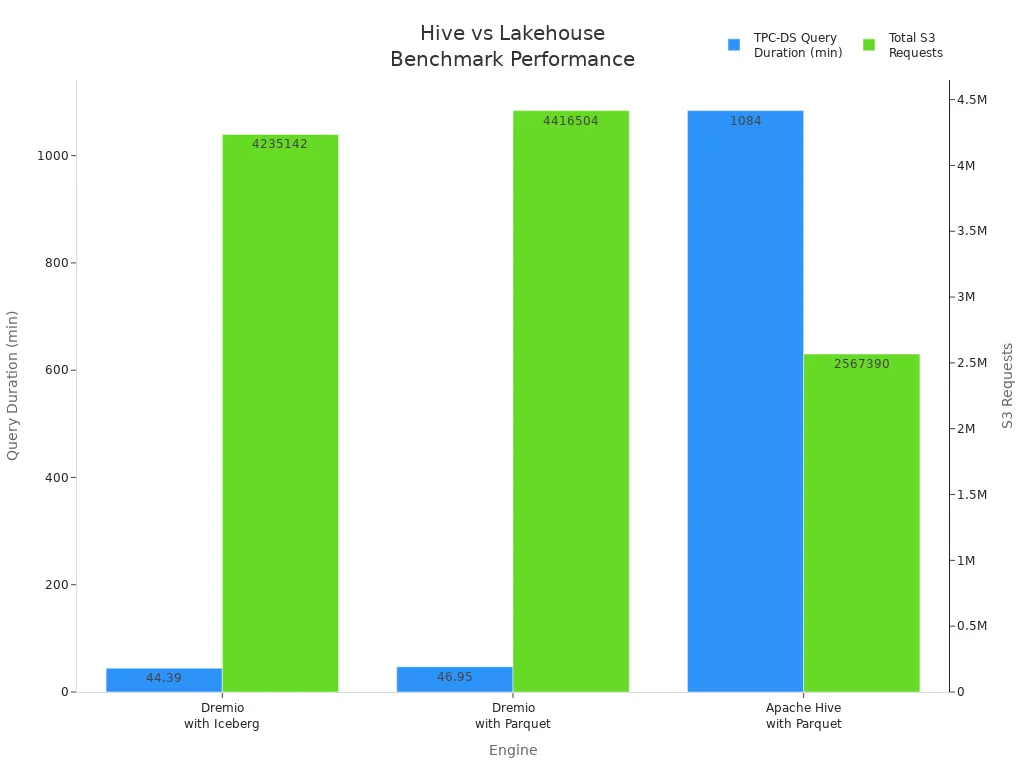
You want fast results for big data analytics. Benchmark tests show a clear winner in the Hive vs. Cloud Lakehouse comparison. Dremio with Iceberg finishes TPC-DS queries in just 44.39 minutes, while Hive takes over 1,000 minutes. The chart below shows how Dremio sends fewer slow S3 requests, which boosts speed.
Performance matters because you need to handle complex workloads, scale up, and support real-time dashboards. Choosing the right platform lets you meet future data needs and keep costs under control.
Key Takeaways
Dremio with Iceberg completes TPC-DS queries in just 44.39 minutes, significantly faster than Hive's over 1,000 minutes.
Cloud Lakehouse platforms offer lower query latency, especially with hybrid caching, making them ideal for real-time analytics.
Consider key metrics like governance, cost efficiency, and workload patterns when choosing between Hive and Cloud Lakehouse.
Modern table formats like Iceberg enhance performance and flexibility, allowing for efficient data management and faster queries.
For mixed workloads, Cloud Lakehouse platforms provide better scalability and speed, supporting both batch and interactive analytics.
Hive vs. Cloud Lakehouse: Benchmark Results

Performance Summary
You want to know which platform delivers faster results. The Hive vs. Cloud Lakehouse comparison shows a clear difference in speed. Dremio, a leading Cloud Lakehouse engine, completes TPC-DS benchmark queries in just 44.39 minutes. Hive takes over 1,000 minutes for the same workload. This means you can run complex analytics much faster with a Cloud Lakehouse solution.
The benchmark tests used 99 TPC-DS queries. Engineers ran these queries sequentially on both Starburst Enterprise and a Lakehouse platform. They averaged the results over four runs to ensure accuracy. Dremio’s performance stands out. It finishes queries up to 20 times faster than traditional Hive setups. You see this speed advantage in real-world scenarios, especially when you need quick answers for dashboards or reports.
You also notice differences in query latency. The table below shows how query times drop as you move from on-premises Hive to hybrid and hybrid caching architectures, which are common in Cloud Lakehouse environments.
Architecture | Query 1 Latency | Query 2 Latency |
|---|---|---|
on-prem | 41 s | 8.2 s |
hybrid | 4 s | 1.8 s |
hybrid caching | 2.5 s | 0.88 s |
Tip: If you need fast query results, Cloud Lakehouse platforms with hybrid caching offer the lowest latency.
Key Metrics Compared
When you compare Hive vs. Cloud Lakehouse, you should look at more than just speed. Several key metrics help you decide which platform fits your needs. The table below highlights important differences.
Metric | Iceberg Characteristics | |
|---|---|---|
Governance | Relies on Hive Metastore, which can slow down scaling and flexibility. | Uses a catalog abstraction, letting you choose governance strategies for multi-cloud setups. |
Cost Efficiency | May have hidden costs from compaction jobs and large partitions. | Uses fine-grained pruning and compact metadata to lower storage and query costs. |
Workload Patterns | Needs tuning for compaction and partition sprawl. | Unlocks efficiency with smart metadata and layout strategies. |
Team Expertise | Legacy systems often need specialized skills. | Modern systems use new tools and practices, which may require different expertise. |
Performance | Tuning can be reactive and time-consuming. | Proactive improvements come from optimized metadata usage. |
You see that Cloud Lakehouse platforms like Iceberg focus on metadata and layout strategies. These features help you get better performance and lower costs. Hive often needs manual tuning and can slow down as your data grows.
Hive 4.0.0 on MR3 2.0 supports both interactive and batch workloads. This design improves operational efficiency but does not match the speed of Cloud Lakehouse engines.
Dremio’s Cloud Lakehouse solution shows a major leap in query speed, making it a strong choice for teams that need quick insights.
You should consider these metrics when choosing between Hive vs. Cloud Lakehouse. Fast query times, lower costs, and easier scaling make Cloud Lakehouse platforms a better fit for most modern analytics needs.
Hive Architecture

Performance Factors
You need to understand how Hive works to see why it performs the way it does. Hive uses several key components that shape its speed and efficiency. The Hive Driver manages your queries from start to finish. It parses, compiles, and executes HiveQL statements. The Compiler translates your queries into MapReduce jobs or Tez tasks. This step helps Hive optimize your queries for better results. The Execution Engine creates a plan and runs your queries as tasks. The Hive Metastore stores metadata, which helps Hive find and organize your data quickly. HDFS, the distributed file system, gives Hive fault tolerance and high throughput. This setup lets Hive handle very large datasets.
Here is a table that shows the main parts of Hive and what they do:
Component | Description |
|---|---|
Hive Driver | Manages the lifecycle of a HiveQL query, responsible for parsing, compiling, optimizing, and executing the query. |
Compiler | Translates Hive queries into MapReduce jobs or Tez tasks, optimizing queries for better performance. |
Execution Engine | Converts user queries into actionable tasks, crafting a query plan and executing queries efficiently. |
Hive Metastore | Centralized metadata repository that manages metadata efficiently, ensuring optimal performance during query execution. |
HDFS | Distributed file system that provides fault tolerance and high throughput, essential for handling large-scale datasets. |
Note: Hive relies on batch processing. This means you may see delays when running queries, especially with very large data.
Strengths and Weaknesses
You want to know if Hive fits your needs. Hive offers strong scalability. You can process petabytes of data by adding more nodes. You do not need to change much when you scale up. Hive also supports parallel processing, which helps speed up big jobs.
However, Hive has some weaknesses. You may notice high latency when you run queries. Hive does not work well for real-time analytics. If you need instant data insights, Hive may not be the best choice. The table below summarizes Hive’s strengths and weaknesses:
Strengths | Weaknesses |
|---|---|
High latency in query execution | |
Minimal reconfiguration when adding nodes | Limited support for real-time processing |
Parallel processing capabilities | Less suitable for applications requiring immediate data insights |
When you compare Hive vs. Cloud Lakehouse, you see that Hive works well for batch jobs and large-scale data. You may struggle with speed and real-time needs. Hive’s architecture gives you reliability and scale, but you need to consider its limits for fast analytics.
Cloud Lakehouse Architecture
Modern Table Formats
You see big changes in how Cloud Lakehouse platforms manage data. Modern table formats like Iceberg and Delta Lake help you work with data in new ways. These formats support features that make your analytics faster and more reliable. You can update records, change your table’s structure, and even look back at older versions of your data. These features help you keep your data organized and easy to use.
Here is a table that shows how modern table formats improve your experience:
Category | How Modern Table Formats Help You |
|---|---|
Improved Data Warehouse Semantics | You get transactional updates, schema changes, and time-travel queries. |
Performance at Scale | You can rewrite small files and skip files you do not need, which speeds up queries. |
Improved Query Performance | You avoid slow listing operations and read less data, so your queries run faster. |
Tip: If you want to handle big data with less effort, choose a Cloud Lakehouse platform that uses these modern table formats.
Performance Advantages
You notice that Cloud Lakehouse architecture gives you several performance benefits over older systems like Hive. You process data more efficiently, and you can use open table formats that work well with cloud storage. You also get better support for changing data at the record level, which means you can update or delete specific rows without slowing down your system.
Here are some key advantages you get:
You can run upserts and deletes with transactional support.
You keep your data safe with ACID transactions.
You read data quickly and handle small files without wasting time.
The table below highlights how Cloud Lakehouse architecture stands out:
Performance Advantage | What This Means for You |
|---|---|
You finish jobs faster than with Hive. | |
Support for modern open table formats | You use formats like Iceberg and Delta Lake, which give you more features and speed. |
Enhanced handling of mutable data | You change records directly, not just whole partitions, so you save time and resources. |
When you compare Hive vs. Cloud Lakehouse, you see that Cloud Lakehouse platforms help you work faster and smarter. You get better performance, more flexibility, and easier ways to manage your data.
Benchmark Setup
Dataset and Queries
You need to know what data and queries help measure performance in big data platforms. Engineers use a mix of datasets to test how systems handle different workloads. You see blockchain analytics, financial market data, and scientific research datasets in many benchmarks. These datasets show how platforms work with real-world information. Teams also use large tabular data to test speed and reliability.
Here is a table that shows common dataset types and query styles:
Dataset Type | Query Type |
|---|---|
Blockchain and cryptocurrency analytics | Ad-hoc queries |
Financial market data analysis | |
Academic and scientific research datasets | Exploratory analysis |
Multi-organization data sharing and collaboration | Direct queries through catalog |
Large-scale tabular data | Real-time data access |
You see that benchmarks use ad-hoc queries to test flexibility. Performance benchmarking queries measure speed. Exploratory analysis checks how well you can find patterns. Direct queries through a catalog test how platforms share data. Real-time data access shows how fast you get answers.
Tip: When you compare Hive vs. Cloud Lakehouse, look at how each platform handles these datasets and queries. This helps you pick the right tool for your needs.
Metrics Used
You want to understand what numbers matter in a benchmark. Teams measure query latency to see how fast you get results. Throughput shows how many queries the system can handle at once. System stability tells you if the platform works well under heavy load.
Here are the main metrics you should watch:
Query latency
Throughput
System stability
You see that low latency means faster answers. High throughput lets you run many queries at the same time. Stable systems keep working even when you push them hard. These metrics help you decide which platform fits your analytics needs.
Detailed Results
Query Execution
You want to see how fast each platform runs complex analytics queries. Hive and Cloud Lakehouse engines show different speeds when you test them with real workloads. The table below compares how many queries finish in less than 30 seconds and less than 1 minute. You can see that both Hive and Impala handle short queries well, but Impala completes more queries in under 30 seconds.
Query Time Interval | Hive Queries Completed | Impala Queries Completed |
|---|---|---|
Less than 30 seconds | 20 | 22 |
Less than 1 minute | 32 | 26 |
You notice that Cloud Lakehouse platforms often use engines like Impala or Dremio. These engines process queries faster than Hive, especially for interactive analytics. If you need quick answers, Cloud Lakehouse solutions help you save time.
Tip: For dashboards and reports, choose a platform that finishes queries in seconds, not minutes.
Concurrency and Scale
You need your data platform to handle many users and large workloads. Hive vs. Cloud Lakehouse platforms show big differences when you test for concurrency and scale. Lakehouse solutions let you run more jobs at the same time. You also see shorter analytics cycles and lower costs. The table below highlights these improvements.
Metric | Traditional Systems | Lakehouse Solutions |
|---|---|---|
Data Engineering Team Reduction | N/A | |
Analytics Cycle Time | Days | Minutes |
Infrastructure Cost Reduction | N/A | 40–60% |
Workload Handling | Limited | Larger workloads |
You can reduce your team size and finish analytics tasks much faster with a Cloud Lakehouse. You also save money on infrastructure. This means you can scale up without worrying about slowdowns or high costs.
Resource Usage
You want to use your resources wisely. Hive often needs more hardware and manual tuning to keep up with demand. Cloud Lakehouse platforms use smart metadata and file pruning. This helps you run more queries with less effort. You see lower CPU and memory usage, which means you can support more users and bigger datasets.
You spend less time managing clusters.
You avoid bottlenecks during peak hours.
You keep costs low as your data grows.
Note: Efficient resource usage helps you scale your analytics without extra spending.
Performance Drivers
Metadata Management
You see big differences in how platforms manage metadata. Good metadata management helps you find and use data quickly. Hive uses a Metastore with a transactional SQL database. This setup helps Hive organize and track data. DuckLake improves this by keeping all file details in one place. You get faster query planning and better execution. Here are some ways metadata management affects performance:
Metadata management changes how fast you can access and use data.
Hive Metastore uses a SQL database to keep metadata organized.
DuckLake stores full data file details in a central Metastore. This solves slowdowns from poor metadata handling.
Tip: Fast metadata access means you spend less time waiting for queries to start.
Storage Optimization
You want your platform to use storage wisely. Cloud Lakehouse platforms handle storage better than Hive. They send more requests to S3 and finish queries faster. Modern table formats like Iceberg help you read less data and skip files you do not need. The table below shows how storage optimization changes performance:
Platform | S3 Requests per Second | Query Duration Comparison | Efficiency of Table Format |
|---|---|---|---|
Hive | 50 to 100 | Significantly slower | Parquet |
Lakehouse | 2,000 to 5,000 | Better performance | Iceberg (35% to 50% fewer) |
You see that Lakehouse platforms use Iceberg to cut down on wasted storage and speed up queries.
Query Optimization
You need smart query optimization to get fast results. Cloud Lakehouse engines use advanced techniques to plan and run queries. They skip unnecessary files and use metadata to find data quickly. Hive relies on batch processing and MapReduce jobs. This can slow down your analytics. Lakehouse platforms use engines that work with modern table formats. You get faster answers and better support for interactive analytics.
Note: Query optimization helps you run dashboards and reports without long delays.
Concurrency Handling
You want your platform to support many users at once. Cloud Lakehouse platforms handle more jobs at the same time. They use smart metadata and storage strategies to avoid bottlenecks. Hive struggles with concurrency, especially when working with cloud object storage. You may see slowdowns if too many users run queries. Lakehouse solutions let you scale up and keep performance high.
The Hive vs. Cloud Lakehouse comparison shows that Lakehouse platforms outperform Hive in metadata management, storage optimization, query planning, and concurrency. You get faster results and better scalability for your analytics needs.
Use Case Implications
Batch Processing
You often need to process large amounts of data for reports or historical analysis. Hive works well for batch processing because it connects with YARN. This connection helps you run big jobs efficiently. You can analyze old data and create reports without much trouble. Cloud Lakehouse platforms also support batch workloads. They unify storage for both structured and unstructured data. This means you can access all your data in one place, making your work easier.
Hive integrates with YARN for efficient batch analytics.
Lakehouse platforms unify storage, giving you consistent access to all data types.
Tip: If you want to run scheduled jobs or analyze past trends, both Hive and Lakehouse platforms can help. Lakehouse solutions make it easier to manage different data formats.
Interactive Analytics
You may need quick answers for dashboards or real-time decisions. Hive often struggles with fast query response times. Data lakes also face bottlenecks when you need low-latency analytics. Cloud Lakehouse platforms improve performance for interactive analytics. You get faster results and more flexibility.
Platform Type | |
|---|---|
Hive | Sluggish query response times in interactive analytics. |
Data Lakes | Performance bottlenecks in low-latency analytics. |
Lakehouse | Improved performance and flexibility for real-time analytics. |
Note: For instant insights, Lakehouse platforms give you the speed you need.
Mixed Workloads
You might run both batch and interactive jobs at the same time. Hive handles batch processing well but slows down with many users or real-time queries. Cloud Lakehouse platforms support mixed workloads better. You can run scheduled jobs and get quick answers for dashboards without delays. This flexibility helps you meet different business needs.
Lakehouse platforms let you scale up for big jobs and still deliver fast results for interactive queries.
You save time and resources by using one platform for all types of analytics.
Emoji: 🚀 Lakehouse solutions boost your analytics for every workload.
Recommendations
When to Choose Hive
You should choose Hive when your tasks have strict constraints or require specialized model selection. Hive works best in single-task and multi-task scenarios where you need reliable performance. If you handle complex multi-modal tasks, Hive helps you select tasks and manage the flow of thought. Hive light, with 8-bit quantized models and 7 billion parameters, gives you strong results even with limited resources. You may find Hive useful when you need:
Consistent performance for single-task and multi-task workloads
Effective handling of complex multi-modal analytics
Reliable results with limited hardware or budget
Tip: Hive fits batch processing and large-scale data analysis where speed is less critical.
When to Choose Cloud Lakehouse
You should pick Cloud Lakehouse when you need flexibility and scalability. Lakehouse platforms combine the best parts of data lakes and data warehouses. You can run advanced analytics and machine learning with ease. Lakehouses support real-time processing, which helps you get instant results. You also benefit from strong data governance and security features. Open table formats like Iceberg give you central storage, access control, and schema evolution. Choose Cloud Lakehouse if you want:
Greater flexibility and scalability for growing data
Real-time analytics and fast query response
Advanced governance, security, and compliance
Support for open table formats and modern data management
Emoji: ⚡ Lakehouse platforms help you meet modern analytics needs with speed and reliability.
Migration Considerations
If you plan to move from Hive to Cloud Lakehouse, you need to think about several factors. The table below shows what you should check before starting your migration:
Consideration Type | Key Points |
|---|---|
Regulatory Compliance | Make sure the platform meets rules like GDPR, HIPAA, CCPA, SOC 2. |
Data Lineage and Auditing | Track where your data comes from and how it changes. |
Access Controls | Use role-based access with tools like Unity Catalog. |
Data Masking & Encryption | Protect sensitive data both at rest and during transfer. |
Collaboration Across Teams | Involve leaders, engineers, analysts, IT, and business units early. |
Migration Effort | Decide between lift-and-shift or redesign. Check data volume, downtime, and migration tools. |
Cost Implications | Review license costs, data transfer fees, storage formats, and training needs. |
Toolchain Integration | Confirm compatibility with BI tools, ETL processes, version control, and data catalogs. |
Note: Careful planning helps you avoid problems and makes your migration smooth.
You can use this advice to decide between Hive vs. Cloud Lakehouse and plan your next steps with confidence.
You see that Cloud Lakehouse platforms deliver faster performance and better scalability for real-time analytics. Hive works well for batch processing and large-scale data but slows down with interactive workloads. When you choose a platform, match your needs to its strengths. If you plan to evaluate or migrate, follow these steps:
Convert code and schemas.
Migrate data to cloud storage.
Validate results and performance.
Optimize with modern tools.
Benchmark results help you align platform capabilities with your business goals.
FAQ
What is the main difference between Hive and Cloud Lakehouse?
You use Hive for batch processing on large datasets. Cloud Lakehouse platforms give you faster analytics and support real-time queries. Lakehouse solutions use modern table formats and cloud storage for better speed and flexibility.
Can you run real-time analytics with Hive?
You may find Hive too slow for real-time analytics. Hive works best for scheduled batch jobs. If you need instant answers, Cloud Lakehouse platforms provide much lower query latency.
Do Cloud Lakehouse platforms cost more than Hive?
You often save money with Cloud Lakehouse platforms. They use storage and compute resources more efficiently. You also reduce manual tuning and maintenance, which lowers your total cost over time.
Is it hard to migrate from Hive to a Cloud Lakehouse?
Migration can be simple or complex. You need to plan for data transfer, schema changes, and tool integration. Many platforms offer migration tools to help you move faster and avoid common problems.
See Also
Comparing Apache Iceberg And Delta Lake Technologies
The Significance Of Lakehouse Architecture In Modern Data
How Iceberg And Parquet Enhance Data Lake Efficiency