
Comparing Lakehouse Costs in Singapore vs. Mainland China
Lakehouse Costs in Singapore are up to three times higher than in Mainland China due to stricter policies, higher utilities, and elevated daily expenses.

If you plan to compare Lakehouse Costs between Singapore and Mainland China, you will notice a big difference. Singapore can cost you up to three times more for a lakehouse compared to major cities in China. You look at housing, utilities, food, transportation, and other daily expenses. These differences matter whether you want to live, invest, or operate a lakehouse. You will see a clear side-by-side breakdown next.
Key Takeaways
Lakehouse prices in Singapore can be up to three times higher than in Mainland China due to strict government policies.
Monthly rental rates are significantly higher in Singapore, while Mainland China offers more affordable options and larger spaces.
Utilities and maintenance costs are elevated in Singapore, making it essential to budget for these regular expenses.
Food and grocery prices are generally lower in Mainland China, especially if you shop at local markets and eat street food.
Transportation costs, including public transit and ride-hailing, are more affordable in Mainland China compared to Singapore.
Lakehouse Costs: Housing
Purchase Prices
When you look at lakehouse purchase prices, Singapore stands out as one of the most expensive places in Asia. You might pay three times more for a lakehouse in Singapore than in major cities in Mainland China. Government policies play a big role in these prices. In Singapore, you face rules like Additional Buyer’s Stamp Duty (ABSD) and Seller’s Stamp Duty (SSD). These rules make buyers think twice and help keep prices stable. Loan-to-Value (LTV) limits also make sure you borrow responsibly.
Tip: If you plan to buy a lakehouse in Singapore, check the latest ABSD rates. Foreign buyers pay up to 60% extra in stamp duty.
In Mainland China, Housing Purchase Restrictions (HPR) can push up prices for certain homes by almost 19%. People who want to buy must show a strong willingness to pay, which can add over 22% to the transaction price.
Policy Impact | Effect on Prices |
|---|---|
Housing Purchase Restriction | Transaction prices of exempted housing increase by 18.91% |
Willingness to Pay | Estimated at 22.48% of transaction price for home purchase eligibility |
Rental Rates
Rental rates for lakehouses in Singapore are much higher than in Mainland China. You will notice that Singapore’s strict housing policies keep rental prices elevated. The government limits supply and controls affordability, so you pay more each month. In China, rental rates are lower, especially outside top-tier cities. You get more space for less money.
Singapore: High monthly rent, limited supply, strict policies.
Mainland China: Lower rent, more choices, bigger homes.
Taxes & Fees
You need to budget for extra costs when buying or renting a lakehouse. Singapore has many fees and taxes. You pay ABSD, Buyer’s Stamp Duty (BSD), legal fees, agent commissions, valuation fees, property tax, and monthly maintenance fees. Mainland China also has taxes, but they are usually lower and less complex.
Type of Fee/Tax | Description |
|---|---|
ABSD | Additional Buyer’s Stamp Duty for foreign buyers is 60% on residential property purchases. |
BSD | Buyer’s Stamp Duty is payable on top of ABSD, calculated using progressive rates. |
Legal Fees | Typically range from S$2,500 to S$4,500 for standard private condo conveyancing. |
Agent Commission | Usually paid by the developer for new launches; varies for resale purchases. |
Valuation Fee | Charged by banks if a loan is taken, typically a few hundred dollars. |
Property Tax | Annual tax based on Annual Value (AV); higher for non-owner-occupied properties. |
MCST / Maintenance Fees | Monthly fees for condo maintenance, ranging from S$300 to S$600 depending on facilities. |
Lakehouse Costs in Singapore are higher because of these taxes and fees. You need to plan for these expenses before making a decision.
Utilities & Maintenance
Utilities
You pay more for utilities in Singapore than in Mainland China. Electricity, water, and gas bills add up quickly, especially if you use air conditioning often. In Singapore, you might see monthly utility bills between S$150 and S$300 for a typical lakehouse. In China, the same bills usually stay under RMB 500 (about S$95). The difference comes from higher energy prices and stricter environmental rules in Singapore.
Tip: If you want to save money, try using energy-efficient appliances and switch off lights when you leave a room.
Here’s a quick comparison:
Utility Type | Singapore (Monthly) | Mainland China (Monthly) |
|---|---|---|
Electricity | S$80 - S$200 | RMB 150 - RMB 300 |
Water | S$30 - S$60 | RMB 20 - RMB 50 |
Gas | S$40 - S$80 | RMB 30 - RMB 80 |
Internet & Communication
You need fast internet for work, school, and streaming. Singapore offers high-speed fiber broadband almost everywhere. You pay about S$40 to S$60 each month for a good plan. Mobile data is reliable, but costs more than in China. In Mainland China, internet speeds are good in big cities, but rural areas may lag behind. You pay less, usually RMB 100 to RMB 200 (S$19 to S$38) per month for broadband.
Singapore: Fast, stable, more expensive.
Mainland China: Cheaper, but speed varies by location.
Maintenance
Maintenance keeps your lakehouse safe and comfortable. In Singapore, you pay monthly fees to the Management Corporation Strata Title (MCST). These fees cover cleaning, security, and repairs. Expect to pay S$300 to S$600 each month, depending on your lakehouse size and facilities. In China, maintenance fees are lower, often RMB 100 to RMB 300 (S$19 to S$57) per month. You get basic services, but luxury amenities cost extra.
Lakehouse Costs rise quickly in Singapore because of higher utility and maintenance fees. You need to budget for these regular expenses if you want to avoid surprises.
Food & Groceries
Groceries
You probably want to know how much you will spend on groceries in Singapore versus Mainland China. Grocery prices in Singapore are higher. You pay more for fresh fruits, vegetables, and imported goods. Local supermarkets like FairPrice and Cold Storage offer many choices, but you will notice the bill adds up fast. In Mainland China, you find cheaper options at local markets and big chains like Carrefour. You get fresh produce at lower prices, and local snacks cost less.
Here’s a quick table to help you compare:
Item | Singapore (SGD) | Mainland China (RMB) |
|---|---|---|
1L Milk | $3.00 | ¥10 |
1kg Rice | $2.50 | ¥6 |
1kg Apples | $4.00 | ¥8 |
12 Eggs | $3.20 | ¥12 |
Tip: If you want to save money, buy local brands and shop at wet markets in both places.
Eating Out
Eating out feels different in Singapore and Mainland China. In Singapore, you find many food courts, cafes, and restaurants. Hawker centers offer tasty meals for $4 to $8, but dining at a restaurant can cost $20 or more per person. In Mainland China, street food and small eateries give you meals for ¥10 to ¥30. Upscale restaurants charge more, but you still pay less than in Singapore.
Singapore: Hawker centers, food courts, international cuisine, higher prices.
Mainland China: Street food, local restaurants, regional dishes, lower prices.
You see how food and groceries affect Lakehouse Costs. If you love eating out or cooking at home, you need to plan your budget carefully.
Transportation Costs
Public Transit
You will find public transit easy to use in both Singapore and Mainland China. Singapore’s MRT and bus system run on time and cover most areas. You pay about S$100 each month if you use public transit daily. In Mainland China, cities like Shanghai and Beijing have subways and buses that cost less. You might spend RMB 150 to RMB 250 (about S$28 to S$47) each month. If you live near a lakehouse, you may need to walk or bike to the nearest station.
Tip: Buy a monthly transit pass to save money if you travel often.
Here’s a quick look at monthly public transit costs:
Location | Monthly Transit Cost |
|---|---|
Singapore | S$100 |
Mainland China | RMB 150 - RMB 250 |
Private Vehicles
Owning a car in Singapore costs a lot. You pay for the car, insurance, road tax, parking, and fuel. The government uses the Certificate of Entitlement (COE) system, which makes cars expensive. You might spend over S$1,000 each month for a mid-range car. In Mainland China, cars cost less, but you still pay for fuel, insurance, and parking. Monthly costs range from RMB 1,500 to RMB 2,500 (S$285 to S$475). Traffic can be heavy in big cities, so plan your trips.
Singapore: High car prices, strict rules, expensive parking.
Mainland China: Lower car prices, more choices, cheaper fuel.
Ride-Hailing
Ride-hailing apps like Grab in Singapore and Didi in China make getting around easy. In Singapore, a short ride costs S$10 to S$20. In China, you pay RMB 20 to RMB 40 (S$4 to S$8) for a similar trip. You can use these services for quick trips or when public transit is not convenient. Prices go up during peak hours, so watch out for surge pricing.
Note: Ride-hailing is great for short trips, but regular use can increase your Lakehouse Costs.
You see how transportation affects your budget. Choose the best option for your lifestyle and location.
Other Living Expenses
Healthcare
You want to stay healthy, so healthcare costs matter. In Singapore, you pay more for health insurance and private care. The average cost of international health insurance reaches USD 10,732 each year. That makes Singapore the second most expensive place in Asia for coverage. Mainland China offers lower premiums, with an average of USD 8,812. Why does Singapore cost more? People want private care, the government introduced MediShield Life, and the population is getting older.
Singapore: Average health insurance premium is USD 10,732.
Mainland China: Average premium is USD 8,812.
Singapore’s costs rise because of private care demand and an aging population.
If you need regular checkups or special treatments, you should budget for these higher expenses.
Education
You might wonder about school fees if you have kids. Singapore’s international schools charge high tuition. You pay between S$20,000 and S$40,000 each year for top schools. Local schools cost less, but places are limited for foreigners. In Mainland China, international schools charge RMB 100,000 to RMB 250,000 (S$19,000 to S$47,000) per year. Local schools are cheaper, but language can be a barrier.
Location | International School Fees (Annual) |
|---|---|
Singapore | S$20,000 - S$40,000 |
Mainland China | RMB 100,000 - RMB 250,000 |
Leisure
You want to relax and have fun. In Singapore, you pay more for gyms, cinemas, and clubs. A gym membership costs S$100 each month. Movie tickets cost S$13 each. Mainland China offers cheaper options. Gym memberships start at RMB 200 (S$38) per month. Movie tickets cost RMB 40 (S$7.50). You find more affordable leisure activities in China, especially outside big cities.
Tip: Try local parks and community centers for free or low-cost activities.
Miscellaneous
You spend money on things like laundry, cleaning, and personal care. Singapore’s prices are higher for these services. A basic haircut costs S$20. Laundry service starts at S$5 per kilogram. In Mainland China, you pay RMB 30 (S$5.70) for a haircut and RMB 10 (S$1.90) per kilogram for laundry. These small expenses add up and affect your Lakehouse Costs.
Lakehouse Costs Summary
Comparison Table
You want a quick way to see how costs stack up. Here’s a table that shows the main differences between Singapore and Mainland China. You can use this as a guide when you plan your budget or make decisions.
Category | Singapore (SGD) | Mainland China (RMB) | Notes |
|---|---|---|---|
Purchase Price | 3x higher than China | Lower, varies by city | Singapore has strict buying rules |
Monthly Rent | High (S$3,000+) | Lower (RMB 5,000+) | More choices in China |
Utilities | S$150 - S$300 | RMB 500 (≈S$95) | Singapore has higher energy costs |
Internet | S$40 - S$60 | RMB 100 - RMB 200 | Faster in Singapore |
Maintenance | S$300 - S$600 | RMB 100 - RMB 300 | More amenities in Singapore |
Groceries | Higher | Lower | Imported goods cost more in Singapore |
Eating Out | S$4 - S$20+ per meal | RMB 10 - RMB 40 per meal | Cheaper street food in China |
Public Transit | S$100/month | RMB 150 - RMB 250/month | Both have good coverage |
Private Vehicles | S$1,000+/month | RMB 1,500 - RMB 2,500/month | Cars cost more in Singapore |
Ride-Hailing | S$10 - S$20/trip | RMB 20 - RMB 40/trip | Cheaper in China |
Healthcare | USD 10,732/year | USD 8,812/year | Singapore has higher insurance costs |
Education | S$20,000 - S$40,000/year | RMB 100,000 - RMB 250,000 | International schools expensive |
Leisure | S$100+/month (gym) | RMB 200+/month (gym) | Cheaper entertainment in China |
Miscellaneous | Higher | Lower | Small services add up in Singapore |
Tip: Use this table to compare Lakehouse Costs before you move or invest. It helps you spot where your money goes.
Key Trends
You probably noticed some big patterns in the table. Singapore is more expensive in almost every category. Housing, utilities, and daily expenses all cost more. You pay a premium for living in a clean, safe, and well-connected city. The government controls supply and sets strict rules, which keeps prices high.
Mainland China gives you more choices and lower prices. You find bigger homes for less money. Groceries and eating out cost less, especially if you shop at local markets or eat street food. Public transit and ride-hailing are affordable, so you save on getting around.
Here are some trends you should know:
Housing: Singapore’s strict policies make buying and renting expensive. China’s prices vary by city, but you get more space for your money.
Utilities and Maintenance: You pay more in Singapore, especially for energy and condo fees.
Food: Singapore’s imported goods and restaurant meals cost more. China’s local food is cheaper.
Transportation: Owning a car in Singapore is costly. Public transit and ride-hailing are cheaper in China.
Healthcare and Education: Singapore’s insurance and school fees are higher. China offers lower premiums and more affordable schools.
Leisure and Miscellaneous: Entertainment and personal services cost more in Singapore.
Note: In rare cases, you might pay more in China for luxury goods or international schools in top cities. Most daily expenses stay lower than in Singapore.
You see that Lakehouse Costs depend on where you live and how you spend. If you want comfort and convenience, Singapore delivers but at a price. If you want value and more space, China gives you options. Always check the latest prices and policies before you decide.
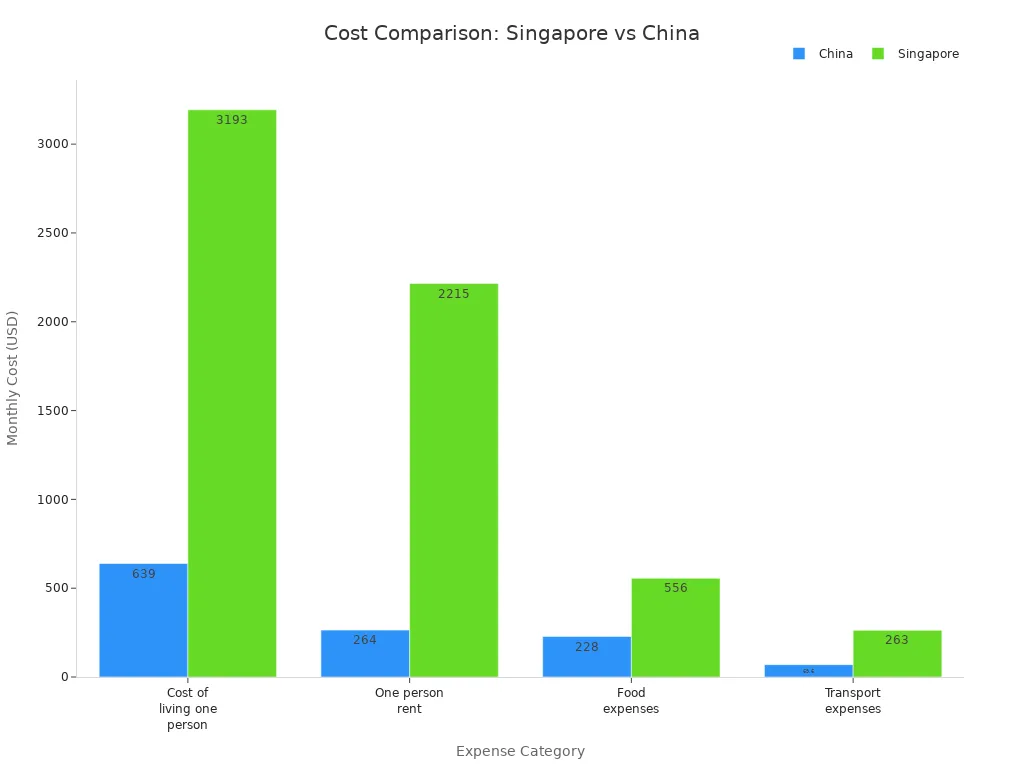
You can see that Singapore costs much more than Mainland China for lakehouse living. The biggest drivers are rent, food, and daily expenses. Check out this table for a quick look:
Expense Category | China ($) | Singapore ($) |
|---|---|---|
Cost of living one person | 639 | 3193 |
One person rent | 264 | 2215 |
Food expenses | 228 | 556 |
Transport expenses | 69.6 | 263 |
Singapore gives you safety and great services, but China offers more space and lower prices. If you want to save money, China might fit you better. For more details, check local real estate sites and cost-of-living calculators.
FAQ
How much more will you pay for a lakehouse in Singapore?
You might pay up to three times more in Singapore than in Mainland China. Prices stay high because of strict rules and limited supply.
Can you save money by living outside city centers?
Yes! If you choose a lakehouse outside big cities, you will see lower prices for rent, groceries, and services. You get more space for less money.
Are utilities expensive in Singapore?
You will notice higher bills in Singapore. Electricity, water, and gas cost more. Using energy-saving appliances helps you cut costs.
Is healthcare better in Singapore or China?
Singapore offers top-quality healthcare, but you pay more for insurance and private care. China’s healthcare costs less, but you may need to travel for special treatments.
See Also
Exploring Lakehouse Significance in Modern Data Environments
Enhancing Dataset Freshness by Linking PowerBI with Singdata Lakehouse
A Comparison Between Apache Iceberg and Delta Lake
Evaluating VRP Solvers: OR-Tools, OptaPlanner, and SaaS Solutions