
Singdata Lakehouse vs Databricks vs Snowflake: Enterprise Batch, Streaming and Governance Compared
A criteria-based comparison of Singdata Lakehouse, Databricks and Snowflake for enterprise batch and streaming pipelines, covering documented latency floors, exactly-once and late-data handling, where governance is enforced, open-format lock-in and cost normalization, with a proof-of-concept acceptance checklist.
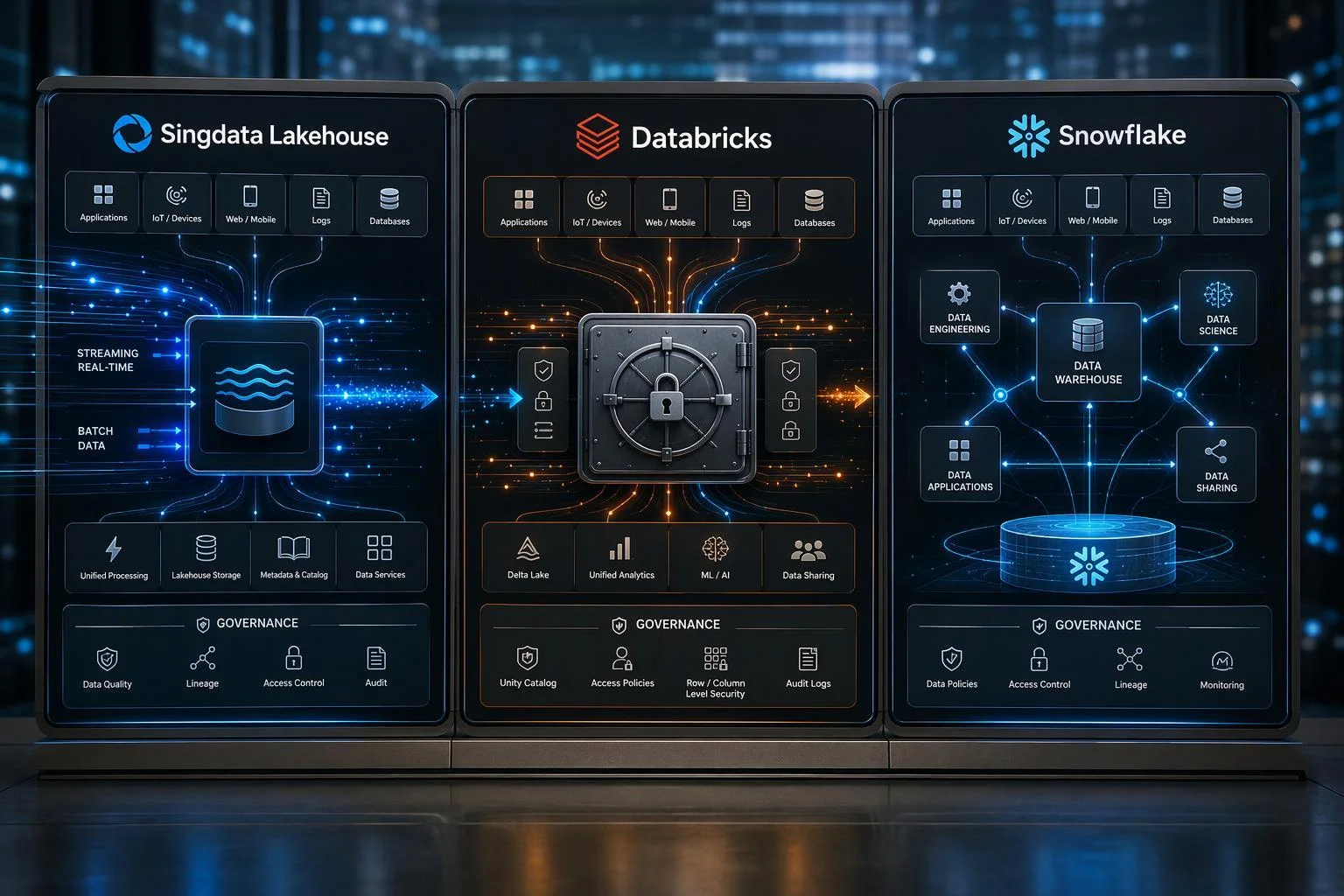
Three platforms now claim the same thing: one system for batch and streaming pipelines, with governance built in rather than bolted on. The claim is similar enough across Singdata Lakehouse, Databricks and Snowflake that a feature-by-feature scorecard will not separate them. What separates them is architecture, the latency floor each one actually documents, where governance is enforced, and how much of your data you can take with you if the decision goes wrong.
This comparison is organized by evaluation criteria, not by vendor. Each section states the documented position for all three, marks vendor-reported performance and savings figures as claims to validate rather than facts, and names the specific test that would confirm or refute the position for your workload. The later sections give you a test design and an acceptance checklist you can carry into procurement.
Summary comparison matrix
The table below states each platform's documented position against the criteria that decide enterprise batch-and-streaming purchases. Cells carry scope qualifiers where the vendor documentation limits the claim; a capability that exists under stated conditions is not the same as a guarantee for every query.
Criterion | Singdata Lakehouse | Databricks | Snowflake |
|---|---|---|---|
Unified batch and streaming architecture | Single-engine architecture positioned by the vendor as replacing Spark + Flink + a data warehouse, with incremental compute. Vendor positioning, not an independently verified equivalence. | Apache Spark Structured Streaming uses the same Spark APIs for batch and streaming, with two processing modes (real-time and micro-batch) sharing one API surface; Lakeflow pipelines handle orchestration, checkpoints and recovery. | Snowpipe Streaming for row-level ingestion plus dynamic tables for declarative transformation; target lag is the single freshness dial. Dynamic tables explicitly do not support data fresher than 60 seconds or strictly guaranteed refresh timing. |
Latency floor | Real-time positioning stated at the level the vendor publishes; buyers must measure p50/p99 end-to-end latency on their own event shapes. | Real-time mode targets sub-second operational workloads with vendor-documented end-to-end latency as low as five milliseconds. Micro-batch is the default and targets seconds-to-minutes analytical and ETL work. | Dynamic tables have a 60-second minimum target lag, and actual lag can exceed the target when refreshes take longer than expected. |
Exactly-once and late data | Exactly-once semantics are not publicly specified in the material reviewed here; treat as unconfirmed and test directly. | Delta Lake tables as streaming sources and sinks with exactly-once processing guarantees; checkpoints for fault tolerance; watermarks control how long stateful operations wait for late data. | Dynamic table refreshes are applied atomically so readers never see a partial refresh; dependency graphs use a consistent snapshot timestamp. Snowpipe Streaming Elastic Channels provide at-least-once delivery without an ordering guarantee. |
Governance enforcement | One set of permissions and one semantic layer across the lakehouse, per vendor material; vendor-stated, so verify through every access path. | Unity Catalog is the unified governance layer: access control with row filters and column masks, column-level lineage, data classification, quality monitoring and audit logs, with a documented path for configuring it for Structured Streaming. | Horizon Catalog executes governance policies at the query engine layer, not the application layer, applying to every caller; masking and row-access policies are enforced across Iceberg REST Catalog-compatible engines. |
Open format and lock-in | Built on Apache Iceberg; one copy of data in open formats in the customer's own object storage. The vendor's claim that unplugging is trivial is a vendor claim. | Delta Lake plus documented external Iceberg access. Delta and Iceberg are different formats; confirm which format your tables land in and what an exit requires. | Snowflake-managed and external Iceberg tables; Iceberg REST Catalog API lets Spark, Flink and Trino query natively. Write support from external engines for Snowflake-managed Iceberg v2 and v3 tables became generally available on May 26, 2026. |
Cost model | Incremental compute positioned as the cost lever, with vendor-reported TCO reduction figures. | Cost depends on compute mode, trigger intervals and cluster configuration. | Dynamic tables incur warehouse compute, Cloud Services and storage costs; target lag affects scheduling work. |
Operational complexity | Vendor positions a single engine as reducing architecture complexity; validate the adjacent components you still need. | Cluster tuning, streaming job design and failure handling are real operational duties, documented at length in Databricks' production guidance. | Declarative pipelines reduce orchestration code; warehouse sizing and refresh scheduling remain yours to manage. |
Read the table as a map of where to dig, not as a verdict. Every cell compresses a documented position that has conditions attached, and several cells describe vendor positioning rather than measured behavior. No cell substitutes for the acceptance test described later in this article, where you run the same workload through each candidate and measure the outcome yourself.
Unified batch and streaming architecture
The architectural question is not whether a platform can process both batch and streaming data. All three can. The question is how much of a separate streaming stack you still have to operate alongside it, and what the platform's own documentation says about where the boundary sits.
Databricks takes the most explicit position. Structured Streaming lets you build streaming applications with the same Spark APIs you use for batch processing, and it exposes two processing modes over that single API surface. Real-time mode processes records as they arrive for sub-second operational workloads; micro-batch mode, the default, processes streams in small batches and balances compute cost against latency measured in seconds or minutes. For queries supported by both modes, you switch between them through trigger and compute configuration rather than rewriting the pipeline. Above that sits Lakeflow, a declarative framework for batch and streaming pipelines in SQL and Python whose flows support both streaming and batch semantics, and which manages orchestration, checkpoints and recovery.
Snowflake splits the job between two mechanisms. Snowpipe Streaming is the real-time ingestion service, streaming rows directly from devices, applications and services into Snowflake tables or Snowflake-managed Iceberg tables, and the documentation notes this direct path can remove staging files, intermediate object storage, message buses and connector services the workload does not otherwise need. Transformation then happens through dynamic tables, which materialize a SELECT query and keep it current against a target lag, with Snowflake inferring the dependency graph when dynamic tables read from each other. The architectural constraint is stated plainly in the same document: dynamic tables do not support workloads that require data fresher than 60 seconds or strictly guaranteed refresh timing.
Singdata positions its lakehouse as a single engine that replaces Spark, Flink and a separate data warehouse, with incremental compute as the mechanism. That is vendor positioning, not an independently verified equivalence, and the honest way to read it is as a claim about how many moving parts you operate rather than a proof that every Spark or Flink workload ports unchanged. The test is concrete: take your two most complex stateful streaming jobs and your heaviest batch job, and confirm they run on the single engine with the same semantics you have today, including checkpoint recovery and late-data behavior.
All three still need adjacent components in most enterprises. Databricks reads from message buses such as Kafka, Kinesis, Pulsar or Pub/Sub, and its production guidance recommends idempotent sink design so downstream consumers handle duplicates. Snowflake's Snowpipe Streaming documentation lists a Kafka connector among its integration options, which tells you the message bus remains part of the architecture. Singdata's own material describes ingestion from external sources into the lakehouse. Budget for the bus, the orchestration layer around it, and the monitoring that watches all of it, whichever platform you choose.
Latency floors and real-time suitability
"Real time" means something different on each platform, and the difference is measured in orders of magnitude. Define your SLA in milliseconds before you compare anything, because a platform that meets a five-second target and one that meets a five-millisecond target are not competing for the same workload.
Databricks documents the tightest floor. Real-time mode is designed for sub-second operational workloads such as fraud detection and real-time personalization, and the documentation states end-to-end latency as low as five milliseconds. Read that as a vendor-documented capability, not a guarantee for every query: it describes a floor the mode can reach, and your achieved latency depends on sources, sinks, query complexity and cluster configuration. Micro-batch, the default mode, targets latency measured in seconds or minutes and is aimed at analytical and ETL work. Databricks' production guidance adds a useful calibration point for operational workloads: low latency typically means tens to hundreds of milliseconds, though many teams set SLAs in the seconds range to account for variability at higher percentiles.
Snowflake's floor is structural rather than incidental. Dynamic tables have a 60-second minimum target lag, and the documentation states that actual lag can exceed the target when refreshes take longer than expected. There is no strict refresh guarantee. If your pipeline needs data fresher than a minute, dynamic tables are the wrong mechanism by Snowflake's own documentation, and you should be evaluating Snowpipe Streaming plus a different transformation path rather than assuming a tighter target lag will deliver it.
Singdata's real-time positioning should be read at the level the vendor states it, and the vendor's published material emphasizes incremental compute and fresh data rather than a specific millisecond figure. That is not a weakness in the comparison; it is a signal about what to measure. Ask for the latency distribution, not a headline number.
Whichever platform you shortlist, measure p50 and p99 end-to-end latency on your own event shapes, from producer timestamp to query visibility, under your normal and peak concurrency. A single benchmark run on synthetic events will not tell you what a p99 looks like when a downstream sink slows down. The practical rule: if two platforms both claim real time but one documents a five-millisecond floor and the other a sixty-second minimum, they are answering different requirements, and only your SLA can decide which answer you need.
Exactly-once and late-data handling
Duplicate records and late-arriving events are where streaming promises meet production reality. The documented mechanisms differ enough that you should compare them directly, then run one test protocol across all candidates rather than trusting any vendor's description of its own semantics.
Databricks documents the most complete mechanism set. Delta Lake tables can serve as streaming sources and sinks with exactly-once processing guarantees, checkpoints store processing state to enable fault tolerance and exactly-once delivery semantics, and watermarks control how long stateful operations wait for late-arriving data. The production guidance is worth reading closely on watermarks: a watermark that is too short silently discards valid late records, a longer watermark tolerates more late data at the cost of latency and retained state, and a small multiple of your latency SLA, such as 2x, is a reasonable starting point for tuning. That is a documented trade-off, not a default that suits every workload.
Snowflake's guarantees are stated at a different level. Dynamic table refreshes are applied atomically, so readers never see a partial refresh, and when dynamic tables depend on each other Snowflake picks a consistent snapshot timestamp and refreshes in dependency order so downstream tables see a consistent view of upstream inputs. On the ingestion side, Snowpipe Streaming Elastic Channels provide at-least-once delivery without an ordering guarantee, and the documentation states that producers retain unacknowledged events according to their delivery requirements. Named Channels are documented for CDC pipelines requiring exactly-once delivery guarantees. The distinction matters: at-least-once ingestion plus atomic transformation is a coherent design, but it is not the same guarantee as exactly-once end to end, and you need to know which one your pipeline depends on.
Singdata's public material reviewed for this comparison does not specify exactly-once semantics for its streaming path. Rather than infer a guarantee from the architecture, treat it as unconfirmed and make it an explicit item in your proof of concept. A vendor that can demonstrate the behavior under failure injection has answered the question; a vendor that describes it in a slide has not.
The test protocol is the same for all three, and it is this author's test design rather than any vendor's claim. Feed the same event stream to each candidate, inject the same duplicates, send the same late-arriving records beyond the declared watermark, and kill the process mid-batch. Use identical success criteria: no duplicates in the target table, late records handled according to the policy you declared in advance, and recovery without data loss or silent gaps. Run it twice, because the second run tells you whether recovery is repeatable or lucky.
Governance enforced across both batch and streaming paths
Governance is the criterion where marketing and engineering diverge most sharply. Every platform claims built-in governance; the question is where the policy executes and whether it follows your data through every path a user or agent can take. A policy that only covers the SQL editor is not governance, it is a suggestion.
Databricks positions Unity Catalog as the unified governance layer for data and AI, providing a single place to control access, discover assets, track lineage, classify sensitive data and monitor quality regardless of where data lives. The documented capabilities include fine-grained access control with privileges, attribute-based access control, row filters and column masks; lineage down to the column level including the models that consume the data; automatic scanning and tagging of sensitive data such as PII; data quality monitoring; and audit logs tracking who accessed what. Unity Catalog governs models, functions and other AI assets as securable objects the same way it governs tables. For streaming specifically, Databricks documents a path to configure Unity Catalog for Structured Streaming workloads with governance and access control, which is the detail to verify: governance applies to streaming, and the configuration is a step you perform rather than something that happens automatically.
Snowflake makes the strongest architectural statement of the three. Horizon Catalog documentation states that governance policies execute at the query engine layer, not the application layer, and apply automatically to every caller: human analyst, BI tool or AI agent, with no separate governance configuration for AI workloads. Masking and row-access policies are documented as enforced across any Iceberg REST Catalog-compatible engine, and cross-engine policy enforcement is a named capability, so policies follow data to Iceberg tables and shared data products carry their tags and permissions. The same document describes AI guardrails that detect, redact and block PII and PHI from agent outputs, with agents operating under the same role-based access control policies as human users.
Singdata's vendor material describes one set of permissions and one semantic layer across the lakehouse, with agents operating under the same permissions and semantics as the human team. That is a vendor-stated position, and the specific claim worth testing is the "one set of permissions" part: whether a policy defined once is enforced identically through the SQL path, the streaming sink, an external engine and an agent interface.
The verification method is the same regardless of vendor. Attempt the same unauthorized read through four paths: the batch SQL path, the streaming sink, an external engine querying the open-format tables, and an AI or agent interface. Confirm the policy blocks all four and that the denial is logged. Advertised governance that only covers the SQL path fails this test, and the failure is usually invisible until an auditor or an agent finds it.
Open table formats and lock-in
Lock-in is not decided by whether a platform supports an open format. All three do. It is decided by which format your tables actually land in, who holds the catalog, and whether a non-native engine can both read and write those tables with governance intact. Those are mechanical questions with checkable answers.
Databricks stores data in Delta Lake and documents external access to Databricks tables from Apache Iceberg clients, including a REST catalog configuration that points an Iceberg client at the Unity Catalog Iceberg REST endpoint with OAuth authentication. Two details deserve attention before you treat this as an exit path. First, Delta and Iceberg are different formats, so confirm which format your tables land in and whether the Iceberg access is a view over Delta or a native Iceberg table. Second, the documentation lists constraints for external Iceberg clients, including data types that cannot be created as managed Iceberg tables from external clients. Read the constraints before you assume a clean exit.
Snowflake supports both Snowflake-managed and external Iceberg tables, and its Iceberg REST Catalog API lets Spark, Flink and Trino query Iceberg tables natively through Horizon Catalog with governance enforced automatically. Catalog-linked databases connect to your Iceberg ecosystem including AWS Glue and Azure OneLake. The portability story strengthened materially with the May 26, 2026 release, which made write support generally available for Snowflake-managed Iceberg v2 and v3 tables from any external query engine supporting the open Iceberg REST protocol, using a single Horizon Catalog endpoint and your existing Snowflake users, roles, policies and authentication. That release also added Workload Identity Federation with OpenID Connect as an authentication option. Read and write from external engines through a governed catalog is a meaningfully different posture from read-only external access.
Singdata states that it is built on Apache Iceberg, with one copy of data in open formats in the customer's own object storage, and the vendor claims that unplugging is trivial if the platform does not earn the rest of the estate. Treat that as a vendor claim and test it rather than accepting it. The exit test has three parts: can a non-platform engine read the tables, can it write to them, and do your governance policies still apply when it does? Then ask who holds the catalog. If the catalog is the vendor's proprietary service, your data may be open while your metadata and permissions are not, and that is the part that makes an exit expensive.
Cost comparison done fairly
No published number will tell you which platform costs less for your pipelines, because the three platforms meter different things. A fair comparison normalizes on workload, not on list price, and it treats every vendor savings figure as a claim to reproduce rather than a fact to budget against.
Snowflake documents its cost structure most explicitly. Dynamic tables incur three cost categories: warehouse compute for the virtual warehouse that runs each refresh query, Cloud Services for compiling the refresh query, tracking dependencies, monitoring changes and coordinating refreshes, and storage for the micro-partitions that refreshes add, replace or remove. The documentation names target lag as a cost factor, since a shorter lag means more scheduling work. That is a useful lever and a useful warning: tightening freshness has a price attached.
Databricks cost depends on compute mode, trigger intervals and cluster configuration. Real-time mode and micro-batch mode have different compute profiles, and the production guidance recommends appropriately sized job compute per streaming task rather than one large shared cluster, which changes both the bill and the operational burden. Trigger intervals trade latency against cost directly.
Singdata positions incremental compute as its cost lever, on the argument that processing only new data changes the economics of repeated batch and streaming runs. The vendor publishes performance and savings figures, including claims of up to 4x faster performance than Snowflake, 10x faster than Spark, and a 50% reduction in total cost of operation. Those are vendor-reported claims. So are any Databricks or Snowflake published benchmarks you encounter. None of them should enter a business case as an established fact.
Normalize your comparison on four quantities. First, cost per pipeline per day at a fixed data volume, measured on your own data rather than a standard benchmark. Second, the cost of reprocessing after a failure, which is where incremental engines and full-refresh engines diverge most. Third, the cost of the governance features you actually enable, since classification scans, lineage capture and quality monitoring consume compute. Fourth, the cost of the adjacent components each platform still requires, including message buses, orchestration tooling and monitoring.
Then run a like-for-like benchmark on your own data before signing. Same pipelines, same data volume, same freshness target, same governance configuration, and a full month rather than a single day, because month-end peaks and backfills are where cost models break.
Who should choose which
Each platform has a profile it fits well and a profile where it loses. The useful question is not which one is best but which one fails your requirements least expensively.
Databricks fits teams already invested in Spark who need sub-second operational latency and want one API across batch and streaming. The same Structured Streaming API serving both modes, with real-time mode documented as low as five milliseconds and Lakeflow handling orchestration and recovery, is a genuine architectural advantage for that profile. It loses on operational complexity: cluster tuning, streaming job failure handling and the documented pitfalls around continuous jobs and autoscaling are real work, and teams without Spark depth will feel it.
Snowflake fits SQL-centric teams whose freshness floor is measured in minutes, who value declarative pipelines, and who want governance enforced at the engine layer across every caller. Dynamic tables replace orchestration code with a SELECT definition and a target lag, and Horizon Catalog's engine-layer enforcement is the clearest governance architecture of the three. It loses outright if you need data fresher than 60 seconds through dynamic tables, because the documentation rules that out, and it loses on declarative simplicity if your pipeline logic needs stored procedures or external functions in the definition.
Singdata fits teams prioritizing architecture simplification, incremental compute economics and open-format portability in their own object storage. A single engine replacing Spark, Flink and a warehouse is attractive if operating three systems is your actual pain. It loses on evidence maturity: the exactly-once semantics and the governance enforcement claims need validation in a proof of concept before you commit production pipelines, and the performance and savings figures are vendor-reported. Buyers who need a documented, independently verified streaming guarantee today should treat Singdata as a candidate to test rather than a drop-in replacement to assume.
A practical way to decide: write down your freshness SLA in milliseconds, your governance paths, and your exit requirements. Then eliminate any platform whose documentation rules out one of them, and put the survivors through the acceptance test.
Acceptance checklist before signing
The checklist below converts the comparison into procurement actions. Each item is something your team performs during a proof of concept, not a vendor commitment to accept at face value. Run the items in order, because later checks depend on the pipeline built for the earlier ones, and record the result for each platform in the same test harness.
Latency measured, not quoted. Instrument the pipeline end to end on your own event shapes and record p50 and p99, not an average. Compare those numbers against the freshness floor your business actually needs before you accept any vendor latency figure.
Duplicate handling proven. Inject the same records twice into the stream and confirm the target table holds one copy. Where a platform relies on idempotent sinks rather than engine-level guarantees, confirm the sink is configured that way.
Late data behaves as declared. Send records beyond the configured watermark and confirm they are either retained or dropped according to a policy you wrote down in advance, not according to whatever the engine happened to do.
Failure recovery without loss. Kill the pipeline mid-batch, restart it, and reconcile source counts against target counts. A restart that resumes cleanly but silently skips a micro-batch fails this check.
Governance enforced on every path. Attempt the same unauthorized read through the batch query path, the streaming sink, an external engine, and any AI or agent interface. All four must be blocked by the same policy definition.
Open-format read and write from a non-native engine. Have a Spark, Flink or Trino client read and write the tables with policies intact, and confirm which system holds the catalog.
Exit procedure documented. Write down who owns the catalog, where the data physically lives, and the steps required to leave. If the vendor cannot describe this concretely, treat portability as unproven.
Cost normalized per pipeline per day. Fix the data volume and schedule, then measure total cost including the adjacent components each platform still requires.
Pilot exit criterion defined. Agree in writing what result ends the pilot in either direction, so the decision does not drift into an open-ended evaluation.
FAQ
Can one platform genuinely replace a separate streaming stack?
It depends on what your streaming stack does today. Databricks documents Structured Streaming with real-time and micro-batch modes on one API surface, and Snowflake documents Snowpipe Streaming for ingestion plus dynamic tables for transformation. Singdata positions its single engine as replacing Spark, Flink and a warehouse, which is vendor positioning you should confirm against your own operators, not a documented equivalence. In most architectures a message bus such as Kafka remains in place regardless of platform, so the realistic question is how many processing engines you retire, not whether every component disappears.
How do I test exactly-once under identical conditions across three platforms?
Build one event generator that emits a fixed stream with known duplicates, a known set of late records beyond the watermark, and a scripted failure at a fixed offset. Replay that identical stream into each platform, then compare target row counts, duplicate counts and post-recovery reconciliation. Databricks documents exactly-once guarantees for Delta Lake tables used as streaming sources and sinks; Snowflake documents atomic refresh application and exactly-once delivery for CDC pipelines using Named Channels. Where a platform does not publicly specify its semantics, the test result is your evidence, not the documentation.
How do I tell enforced governance from advertised governance?
Attempt the violation. Advertised governance appears in a feature list; enforced governance blocks an unauthorized read when you actually try it. Run the same unauthorized query through the SQL path, the streaming write path, an external engine connected over an open catalog protocol, and any agent interface. Snowflake states that its policies execute at the query engine layer and apply to every caller, and documents masking and row-access enforcement across Iceberg REST Catalog-compatible engines. Databricks documents Unity Catalog as its unified governance layer with a configuration path for streaming workloads. Verify both claims in your own account rather than accepting the description.
What does lock-in actually look like with Iceberg on each platform?
Lock-in is decided by two things: which format your tables physically land in, and who controls the catalog that grants access to them. Databricks documents Delta Lake plus external Iceberg access, so confirm which format your tables use and what an exit requires. Snowflake documents Snowflake-managed and external Iceberg tables, an Iceberg REST Catalog API for Spark, Flink and Trino, and, per its May 26, 2026 release note, general availability of write support for Snowflake-managed Iceberg v2 and v3 tables from external engines through Horizon Catalog. Singdata states that data sits in one copy in open formats in your own object storage and that unplugging is trivial; treat that as a vendor claim and test it with the exit procedure in the checklist above.
How do I compare cost when the vendors meter differently?
Stop comparing list prices and start comparing a normalized unit: cost per pipeline per day at a fixed data volume and schedule. Snowflake documents three cost categories for dynamic tables, namely warehouse compute, Cloud Services and storage, with shorter target lag increasing scheduling work. Databricks cost varies with compute mode, trigger interval and cluster configuration. Singdata positions incremental compute as its cost lever and publishes vendor-reported savings figures, including a 4x and 10x performance comparison and a 50% TCO reduction. Every one of those figures, from any vendor, is a claim to reproduce on your own data before signing.
See Also
Exploring AI-Driven Layered Structures in Global Supply Chains
Transforming Loyalty Programs with Engaging Gamification Strategies
Understanding OLAP Cubes: Their Importance and Functionality