
Medallion Architecture Monitoring and Observability: Ensuring Data Reliability
Medallion Architecture monitoring and observability safeguard data reliability, enabling early issue detection and trusted business decisions.
Imagine your business making a big decision based on faulty numbers. You could lose money, upset customers, or hurt your brand. Monitoring and observability in Medallion Architecture help you avoid these problems. Poor data quality often leads to flawed strategies, compliance issues, and project delays. High-quality data supports your operations and keeps your workflow efficient. When you watch every layer closely, you protect data reliability and build trust in your results.
Key Takeaways
Monitor each layer of Medallion Architecture—Bronze, Silver, and Gold—to ensure data reliability and prevent errors.
Preserve raw data in the Bronze layer for traceability. This practice helps you identify and fix issues quickly.
Use automated tools for real-time monitoring and alerts. Quick responses to data issues can save your business from costly mistakes.
Implement quality checks at each layer to maintain data accuracy and consistency. This builds trust in your data and supports better decision-making.
Regularly review your monitoring setup and adjust as needed. Continuous improvement strengthens your data systems and enhances operational efficiency.
Data Reliability in Medallion Architecture
Layered Structure: Bronze, Silver, Gold
You can think of Medallion Architecture as a series of steps that help you keep your data organized and reliable. Each layer—Bronze, Silver, and Gold—has a clear job. The Bronze layer stores raw data just as it arrives. The Silver layer cleans and enriches this data, making it easier to use. The Gold layer holds the final, trusted data that you use for reports and business decisions.
If you do not respect these layers, you might face problems. Here are some common challenges:
Using the Bronze layer as your main source can lead to confusion and mistrust.
Putting too many business rules or key metrics in the Silver layer can make it hard to know which numbers are correct.
Expecting the Gold layer to give you real-time answers can slow down your system and cost more money.
Mixing up the roles of each layer can make your data system fragile and more likely to break.
When you follow the layered structure, you help protect data reliability. You know where your data comes from and how it changes as it moves through each step.
Preserving Raw Data for Traceability
You need to keep your raw data safe in the Bronze layer. This step lets you trace any problem back to its source. If you spot a mistake in your reports, you can check the raw data to see where things went wrong. This traceability builds trust in your data and helps you fix issues quickly.
Tip: Always keep a copy of your raw data. This habit makes it easier to audit your work and prove that your results are correct.
By preserving raw data and respecting each layer’s role, you make your data system stronger. You support data reliability and give your team the confidence to use data for important decisions.
Monitoring for Data Quality

Identifying and Fixing Issues
You need to spot problems in your data before they affect your business. When you monitor each layer of the Medallion Architecture, you catch errors early and fix them fast. Common issues include address formatting mistakes, missing claims data, and the need for standardization. These problems can make your analysis confusing and unreliable.
Issue Type | Description |
|---|---|
Address Formatting | Multiple variations of the same address format lead to inconsistencies. |
Incomplete Claims Data | Claims data often lacks necessary information, hurting reliability. |
Data Standardization Needs | Data from different sources needs standardization for accurate analysis. |
You also face challenges when your database lacks structure or stores data in many different schemas. Analysts may struggle to work with scattered tables. To fix these issues, you can use quality checks and tools at each layer:
Layer | Common Quality Checks | Tools |
|---|---|---|
Bronze | Null and empty checks, Duplicate detection | dbt tests, Great Expectations, Delta Live Tables (DLT) |
Silver | Completeness, uniqueness, circuit breaker methods | Profiling tools, anomaly detection tools |
Gold | Metric validation, Historical consistency, Drift detection | Monte Carlo, Bigeye, Soda, Tableau, Power BI |
Proactive monitoring helps you detect anomalies and alerts you to data loss or rule violations. You can combine non-intrusive and intrusive methods to improve Data Reliability.
Enhancing Transparency and Trust
When you monitor data quality, you make your data system more transparent. You show everyone how healthy your data is and how well it meets quality standards. This approach builds trust among your team and stakeholders.
Tip: Use dashboards to measure key metrics close to the data source. Dashboards help prevent extra costs and ensure your data follows contracts.
You should track metrics like accuracy, completeness, and consistency. These steps help you maintain trustworthy data systems and boost operational efficiency. Stakeholders gain confidence in your data, which leads to better decisions and stronger trust in your analysts and engineers.
Layer Monitoring Best Practices
Monitoring each layer of the Medallion Architecture helps you keep your data system strong and reliable. You can use different checks and validation steps at each stage. This approach stops errors from moving through your pipeline and supports Data Reliability.
Bronze Layer Checks
The Bronze layer holds your raw data. You need to make sure this data is complete and accurate before it moves forward. Here are some best practices for monitoring the Bronze layer:
Check for missing or incomplete records. Make sure all expected data arrives on time.
Detect duplicates. Remove any repeated records to avoid confusion later.
Monitor data availability. Confirm that your data sources send information as planned.
Track schema changes. Watch for changes in the structure of incoming data.
Note: Monitoring at this stage helps you catch problems early. You can fix issues before they affect the rest of your data pipeline.
Structured data flow monitoring in the Bronze layer improves reliability by ensuring data quality, checking completeness, and verifying that all data is available for the next steps.
Silver Layer Validation
The Silver layer cleans and enriches your data. You need to validate that these changes work as expected. This step is key for Data Reliability because it makes your data usable and trustworthy.
You can use several validation techniques in the Silver layer:
Validation Technique | Description |
|---|---|
Duplicate Check | Identifies and handles duplicate records appropriately, ensuring no duplicates exist in the data. |
Column Value Check | Checks for discrepancies in column values that should remain unchanged after data transformation. |
These checks help you spot errors and keep your data consistent. You also need to make sure your data meets quality standards. Here is how Silver layer validation supports your goals:
Evidence Description | Contribution to Data Reliability |
|---|---|
Ensures data is usable and trustworthy | |
Data quality checks | Ensures consistency and removes null values |
Improves data reliability and trustworthiness | Directly enhances overall data reliability |
Tip: Use automated tools to run these checks. Automation saves time and reduces human error.
Silver layer validation also includes monitoring transformation quality and verifying compliance with business rules. You can trust your data more when you know it passes these checks.
Gold Layer Assurance
The Gold layer holds your most trusted data. You use this data for reports, analytics, and business decisions. You need to make sure this layer meets the highest standards.
Best practices for Gold layer assurance include:
Validate key metrics. Check that important numbers match your expectations.
Monitor historical consistency. Make sure new data fits with past trends.
Detect data drift. Watch for sudden changes that could signal a problem.
Review compliance. Confirm that your data meets all legal and business requirements.
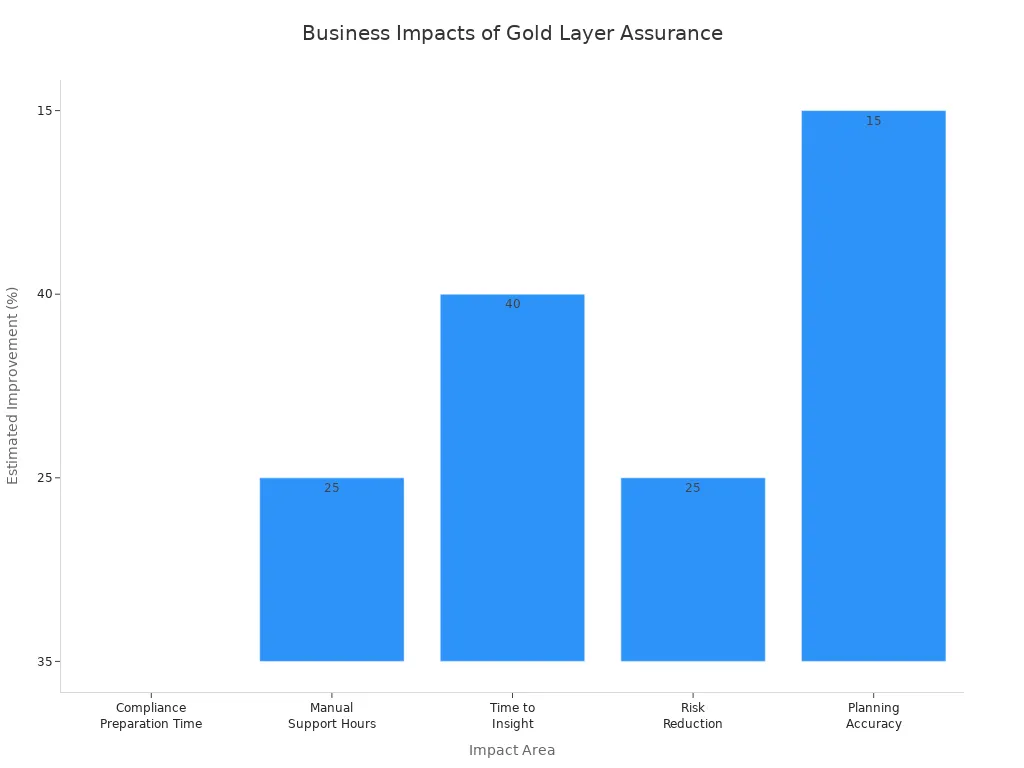
You can see the business impact of strong Gold layer assurance in the table below:
Impact Area | Estimated Improvement |
|---|---|
Compliance Preparation Time | 35% reduction |
Manual Support Hours | 20–30% fewer hours annually |
Time to Insight | Up to 40% reduction from detection to insight |
Risk Reduction | 25% reduction in outages or violations |
Planning Accuracy | Up to 15% improvement in accuracy |
Tip: Regularly review your Gold layer data with dashboards and alerts. This practice helps you catch issues fast and keeps your business running smoothly.
Why Layered Monitoring Matters
When you monitor each layer, you stop errors from spreading. You make sure your data is complete, accurate, and ready for use. This process supports Data Reliability and helps your business make better decisions.
You can follow a simple framework to check your monitoring system:
Plan which tools and technologies you need.
Execute data ingestion, transformation, and consumption steps.
Monitor and optimize your system regularly.
By following these best practices, you build a strong foundation for reliable data and confident decision-making.
Automated Monitoring and Observability
Real-Time Alerts and Tools
You can boost your data system by using automated, real-time monitoring tools. These tools help you spot problems as soon as they happen. When you set up real-time alerts, you get notified right away if something goes wrong. This quick response helps you fix issues before they affect your business.
Here are some top tools for real-time alerts in Medallion Architecture:
Tool | Features |
|---|---|
Data Activator | Listens for real-time patterns, triggers alerts, actions, and workflows. |
Power Automate | Lets you create no-code rules for proactive decision-making. |
KQL Database | Works across many data sources, including Eventstream and Lakehouse, for real-time data. |
Data Activator can automate data ingestion and alerting in your Medallion Framework.
Power Automate helps you set up rules without writing code.
KQL Database lets you monitor data from different sources in real time.
Real-time alerts flag data issues as they occur. You can set up custom alerts based on your business rules. When you connect these alerts to incident management platforms, your team can solve problems faster. Continuous monitoring also helps you spot data quality drops and system health issues before they cause outages.
Tip: Use dashboards to track data freshness, volume, schema, lineage, and quality. This gives you full visibility into your data system.
Use Case: Improving Data Reliability
Let’s look at how automated monitoring improves Data Reliability. Imagine you work in healthcare. Your system collects patient data from many sources. If a data feed fails or sends incomplete records, real-time alerts notify your team right away. You can fix the problem before it affects patient care or reporting.
Automated observability brings clear business benefits:
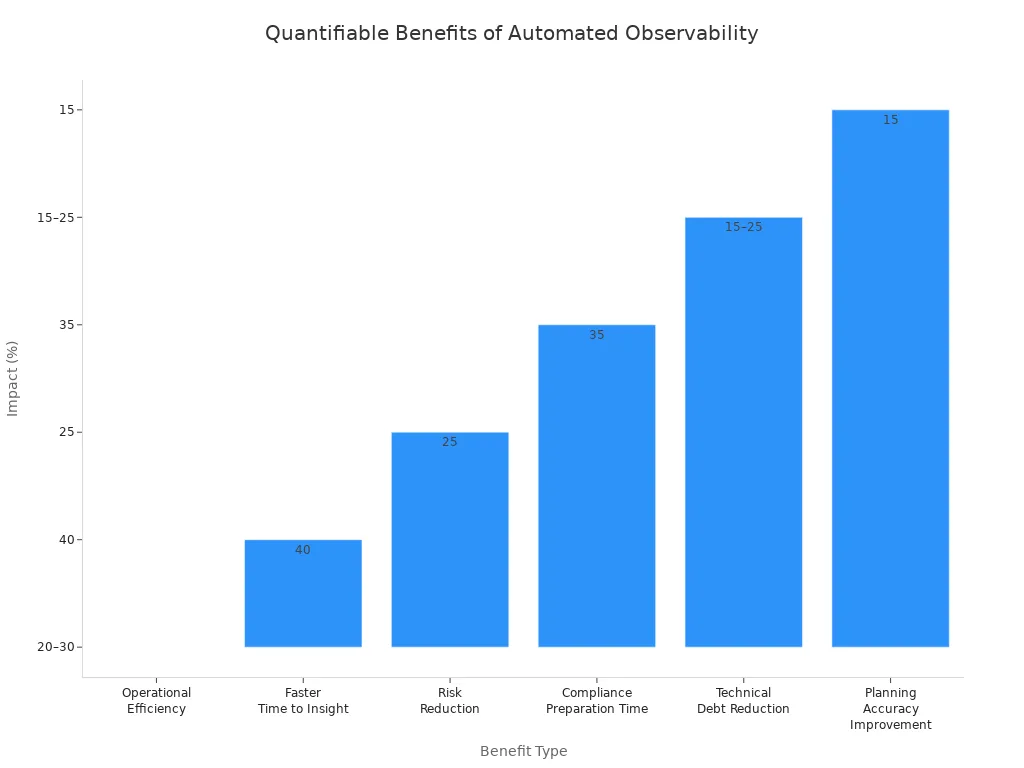
Benefit Type | Quantifiable Impact |
|---|---|
Operational Efficiency | 20–30% fewer manual support hours annually |
Faster Time to Insight | 40% reduction from event detection to insight |
Risk Reduction | 25% reduction in costly outages or violations |
Compliance Preparation Time | 35% reduction in preparation time |
Technical Debt Reduction | 15–25% reduction annually |
Planning Accuracy Improvement | Up to 15% improvement in planning accuracy |
You can see these results in many industries. In financial services, real-time monitoring supports AI and compliance. In manufacturing, it helps prevent equipment failures. In gaming, it improves query speed and lowers storage costs. Automated monitoring makes your data system stronger and keeps your business running smoothly.
Continuous monitoring and observability give you a clear view of your data’s health. You can spot issues in real time, keep your data accurate, and avoid costly mistakes. If you neglect monitoring, you risk project delays and budget overruns. To improve your Medallion Architecture, start by tracking pipeline performance, managing costs, and setting up job alerts.
Data observability helps you:
Identify and fix problems quickly
Maintain Data Reliability
Take time to review your current monitoring setup and plan your next steps for stronger data systems.
FAQ
What is the main goal of monitoring in Medallion Architecture?
You want to catch data issues early. Monitoring helps you keep your data accurate and reliable. This process protects your business from costly mistakes and builds trust in your results.
How often should you check data quality in each layer?
You should check data quality every time new data enters a layer. Automated tools can help you run these checks in real time or on a set schedule.
Which tools work best for automated monitoring?
Popular tools include dbt, Great Expectations, Delta Live Tables, Monte Carlo, and Power Automate.
You can choose tools based on your data platform and business needs.
Why does preserving raw data matter?
You keep raw data to trace problems back to their source. This step helps you audit your work and fix errors quickly. You also build trust in your data system.
See Also
Exploring The Fundamentals Of Cloud Data Design
Why Businesses Should Embrace AI Observability Solutions
Navigating Data Management Challenges In Modern Businesses