
Why Multi-Model Routing Needs a Unified Enterprise Data Layer
Why multi-model routing needs unified enterprise data semantics: one metric definition, least-privilege access and end-to-end evaluation.

Routing a request to a different model is now routine operation, but the answer's meaning, the data it may see and the way it is judged must not change with the model. That is the gap Multi-Model Routing opens in an enterprise data estate, and it is a data problem before it is an API problem. A switchboard can move a call to any line it likes, but if each line answers with a different definition of the customer, the call was never really connected.
This article gives you criteria you can test and sign off, not a product tour. Each section turns a governance question into something a security reviewer or a data platform lead can check against a running pipeline, from semantic drift under model switching to least-privilege access for AI agents and end-to-end evaluation of the routed path. The thread running through all of it is Unified Enterprise Data Semantics: one governed definition of the business that every model inherits. Every gateway figure cited comes from one vendor's telemetry, Vercel's AI Gateway Production Index for October 2026, and is scoped to that gateway throughout.
Why Multi-Model Routing Is a Data Problem Before It Is an API Problem
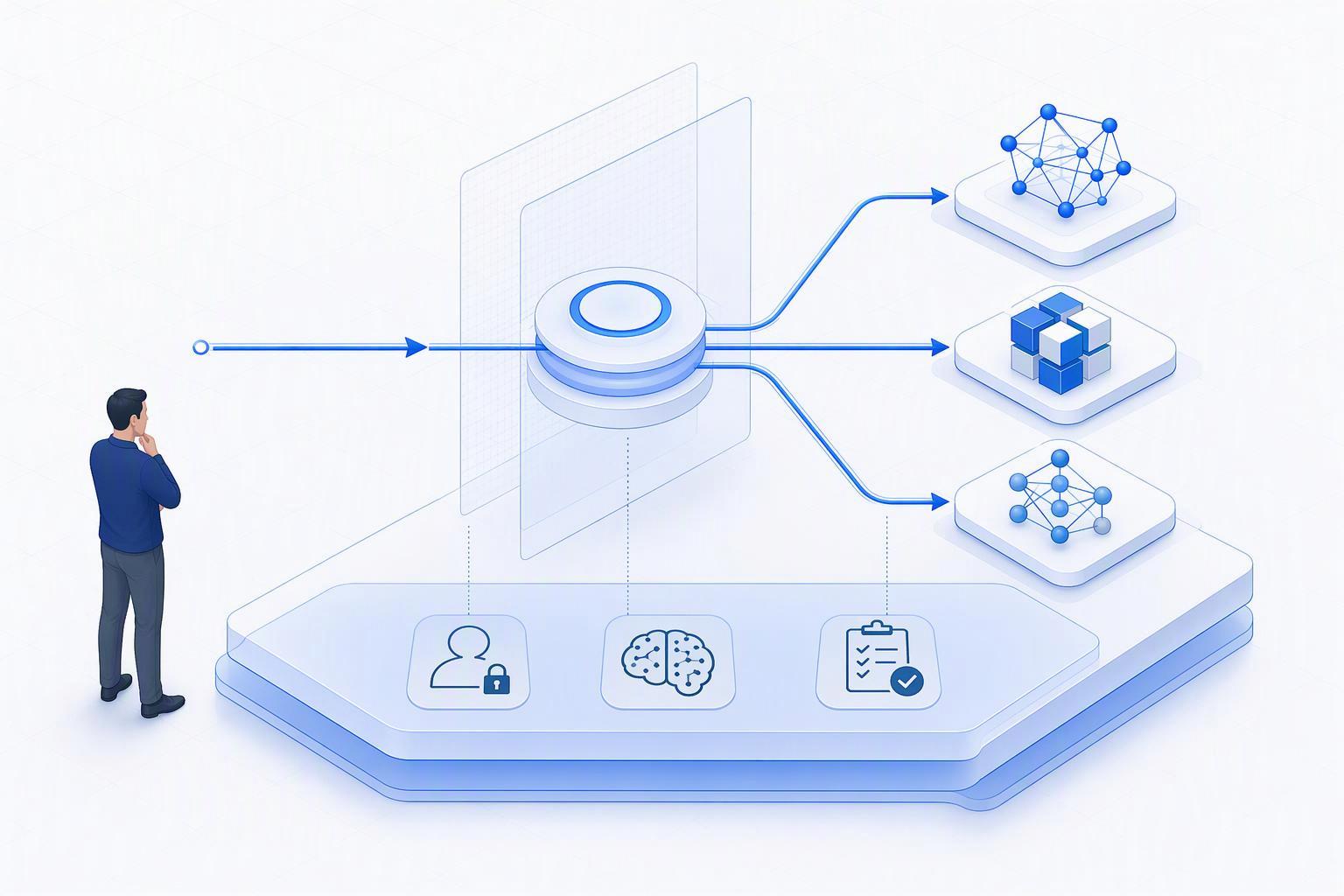
Multi-Model Routing is the logic that decides which model handles each request, weighing task type, required quality, cost, latency, safety and availability. It is already normal operation rather than an edge case. Vercel's October 2026 AI Gateway index found that nearly one in two teams changed their most-used model in September, and almost one in three changed their most-used lab, an index record (Vercel, AI Gateway Production Index, 2026-10-15).
The API layer makes that cheap. A gateway's unified API lets you "switch between different AI models and providers without rewriting parts of your application", and ordered provider and model fallbacks are configurable (Vercel AI Gateway documentation, retrieved October 2026). The same gateway records status, provider, latency, token usage, cost and every routing attempt, so the switch is observable after the fact.
What the API layer does not decide is what stays constant. Teams processing at least 10 million tokens between December and September used an average of 15 different models; at 100 million tokens the average was 26, and at 1 billion it was 42 (the gateway's own production index, 2026-10-15). A gateway routes a request, but it cannot own a metric definition or an access scope. Those have to hold still while the model above changes, which is the job of Unified Enterprise Data Semantics: one definition per metric, one access rule per row, one evaluation suite, inherited by every enterprise data agent that spans several models.
What the 71.5% Token and 23% Spend Figures Actually Cover
Open-weight models processed 71.5% of tokens and accounted for about 23% of estimated spend through Vercel AI Gateway in September 2026 (Vercel's AI Gateway Production Index, October 2026, 2026-10-15). Read the two numbers together and the useful finding is not the model name but the gap: inside a single gateway, token volume and spend diverge sharply, so neither cost nor quality can be inferred from which model handled a request.
The scope is narrower than the headline suggests. The index measures only traffic through that one gateway and, as The Register noted when the index landed (2026-10-17), it does not see usage through other gateways, direct vendor access or on-premises hosting. Two caveats travel with the same figures: open-weight classification follows the gateway's current model list, a broader definition than in earlier reports, and spend is estimated at published list prices, with average price per token calculated as estimated spend divided by token volume and prior months open to revision.
The direction still earns a place in a procurement conversation. Open-weight's share of gateway spend more than quadrupled from one in twenty dollars in June to nearly one in four in September, while September spend ran at roughly 13 times December's and average price per token fell 47%. Falling unit prices alongside rising spend is what heavier, cheaper-model workloads look like inside one gateway.
⚠️ Warning: These figures describe traffic through one gateway and are not market shares. Do not quote them in a business case without the scope sentence attached.
Is Open-Weight the Same as Open-Source?
No. Open-weight means the parameters are published; open-source is a licence test, and the two are reviewed separately in procurement.
The Open Source Definition (v1.9) requires free redistribution, source code in preferred-modification form and permitted derived works, applied to software distribution (the Open Source Definition, 2007-03-22). The Open Source AI Definition (v1.0) goes further for AI systems: it grants the freedoms to use, study, modify and share, and requires the preferred form to include Data Information, Code and Parameters under OSI-approved terms (the Open Source AI Definition, v1.0). Weights alone therefore do not make a model open source.
The due-diligence test has two items. First, ask which licence governs the weights and whether it meets the OSD criteria for the code and the OSAID criteria for data information and parameters. Second, record the answer in the model inventory next to the version, because a licence position that is not written down cannot be audited later.
Semantic Drift, Shared Metrics and Least-Privilege Access Under Model Switching

Semantic drift is what a model switch exposes: the same business term computed several ways, with the model blamed for the difference. A governed semantic layer fixes the definitions once. Cube describes one that defines metrics, dimensions, join paths and access rules so a BI dashboard, an embedded app, a spreadsheet and an AI agent all return the same numbers (Cube's semantic-layer definition, 2026-06-14). Put another way, an enterprise semantic layer is the artefact a reviewer can diff between releases.
Versioned definitions, not prompt text
The mechanism is a committed definition, not documentation. MetricFlow works through a semantic graph in YAML that links language to data, and metric YAML can be committed so teams approve it as the true and only source of information (MetricFlow's metric definitions, 2026). The dbt Semantic Layer then serves those definitions through JDBC and GraphQL APIs, so consumers query from their preferred environment and get consistent, governed, tested data (the semantic layer's query APIs, 2026). Any definition that lives in a prompt rather than in that layer drifts the moment routing sends the question to a second model.
The fragmentation is also being standardised. Apache Ossie, formerly Open Semantic Interchange, is a single JSON- and YAML-based specification any tool can read and write, aimed at the same KPI defined differently across tools and at agents producing unreliable outputs grounded in inconsistent business logic (the Apache Ossie specification, retrieved October 2026).
Least-privilege access for AI agents
Least-privilege access for AI agents is the third constant, and it is a permission problem rather than a routing one. OWASP names excessive functionality, excessive permissions and excessive autonomy as the root causes of LLM06:2025 Excessive Agency, with mitigations to minimise all three (OWASP's LLM06 Excessive Agency, 2025). Its agent guidance adds per-tool permission scoping, short-lived authorization artifacts and enforcement of the sender's permissions at the receiving service (OWASP's agent security guidance, current).
Credentials are where that becomes auditable. Google Cloud's service-account guidance recommends single-purpose accounts per application and warns that shared accounts defeat the trail, because logs show the service-account name but not the application that used it (Google Cloud's service-account guidance, retrieved October 2026). Cube's security context shows the enforcement side: a JWT verified with JWKS, and generated SQL that includes row-level constraints from the access control rules, so restrictions travel with the query (Cube's security context, retrieved October 2026).
Key Takeaway: Meaning, metric definition and access scope must be resolved before the model speaks. Unified Enterprise Data Semantics is the sum of the three: one definition, one scope, one identity per workload.
Each of these is testable in a review, and none of them is a routing setting.
How we apply this at Singdata, the publisher of this guide: our semantic layer holds business meaning above physical tables as lakehouse metadata objects, so a metric keeps one definition when the model behind a request changes. It does not decide which model should serve a request, and it cannot guarantee that every source system is modelled correctly; that mapping and review remain yours, with any platform, ours included.
How to Evaluate a Routed Pipeline End to End
With definition, scope and identity held constant, the remaining question is how to prove it on every route. End-to-end evaluation means testing the whole path, not the model in isolation. NIST AI 600-1 recommends establishing risk-relevant evaluations both prior to deployment and on an ongoing basis, through internal and external evaluations (NIST AI 600-1, July 2024). NIST's AI Risk Management Framework, which is intended for voluntary use and is being revised as part of the White House AI Action Plan, organises that work under GOVERN, MAP, MEASURE and MANAGE (NIST's AI Risk Management Framework, 2023-01-26).
The harness is engineering practice, not a published standard. Build it from four checks, each run on every candidate model before promotion:
Routing quality. Does the request reach the model the policy intended, and does the fallback path behave when the first provider fails?
Semantic conformance. Does the same business question return the same metric value across models, checked against the committed definition?
Access scope. Does each model see only the rows and tools its workload identity permits, verified at the receiving service rather than at the prompt?
Output checks. Does the response meet the accuracy and integrity criteria recorded for that use case?
Pro Tip: Pin stable internal route names and record the provider and model version on every request. Re-run the full suite before promoting a model change, so a silent provider update cannot ship without evidence.
FAQ
Is multi-model routing the same as a model gateway?
No. A gateway is the transport that routes requests across providers and fallback models and records status, provider, latency, token usage, cost and every routing attempt (Vercel AI Gateway documentation, retrieved October 2026). Routing is the policy that decides which model gets a request. Neither one owns the metric definitions or access rules the answer depends on.
Does gateway logging cover our audit requirements?
Only partly. Gateway logs record the request, the provider and the cost, which answers "what happened". They do not answer "who was allowed to ask", because that depends on the identity and scope behind the call. NIST guidance calls for tightly scoped, short-lived tokens for workload identities, and Google Cloud notes that logs show the service-account name but not the application (Google Cloud's service-account guidance, retrieved October 2026). Pair gateway logs with per-workload identities before claiming audit coverage.
We already have dashboards with agreed definitions. Is that enough?
Not if the definitions live only in the dashboard. A semantic layer defines metrics, dimensions, join paths and access rules once so every consumer, including an AI agent, returns the same numbers (Cube's semantic-layer definition, 2026-06-14). If the agent cannot query that same definition layer, it is computing its own version.
Is an open-weight model effectively open-source?
No. The Open Source AI Definition (v1.0) requires the preferred form to include Data Information, Code and Parameters under OSI-approved terms, so published weights alone are not sufficient (the Open Source AI Definition, v1.0). Review the weights licence and the data information separately.
Do we have to benchmark every model we route to?
You have to evaluate every route you promote, which is a smaller set. NIST AI 600-1 recommends evaluations prior to deployment and on an ongoing basis (NIST AI 600-1, July 2024). Run the four checks on the models in your active routing policy and re-run them when the policy or a provider version changes.
Conclusion
The evidence points one way: the model layer is now the volatile part of the stack, and the data layer has to be the stable one. Inside a single gateway, teams changed their most-used model at record rates and spread across 15 to 42 models depending on volume (Vercel, AI Gateway Production Index, 2026-10-15). Nothing in that pattern suggests the churn will slow.
So the acceptance criteria for a routed pipeline are the ones this article set out: one definition per metric, committed and diffable; one access scope per workload, short-lived and enforced at the receiving service; one evaluation suite, run before every promotion. Those three survive a model switch, a provider deprecation and a security review, and they are what a procurement sign-off should ask for.
The next step is to run the four checks against one production route, with your security lead in the room, and record what fails. That record is the business case.
Talk to a solutions consultant to walk the checklist against your own stack.