
Natural Language BI for Enterprises: A Governance-First Rollout Guide
A governance-first guide to rolling out NLQ safely: semantic layers, verified answers, and a phased adoption plan.
Natural language BI is having a second moment.
The first wave promised that “anyone can ask questions” and dashboards would become optional. The second wave is more realistic: natural language can work, but only when it’s anchored to governed definitions, predictable access controls, and an operating model your data team can actually support.
If you’re an enterprise data modernization team, you already know the hard part isn’t generating SQL from English. The hard part is making sure the answer is correct, consistent, and allowed—across business units, evolving definitions, and high compliance sensitivity.
This guide is a governance-first rollout plan: what to evaluate, what to set up before enabling NLQ (natural language query), and how to ship natural language BI in a way the business will trust.
Why natural language BI fails in enterprises (and how to prevent it)
Most natural language BI initiatives stumble for one of three reasons:
Ambiguity: the same question can mean different metrics (e.g., “revenue” gross vs. net; “active customers” by different activation rules).
Metric drift: definitions evolve, but the natural language experience keeps answering from old logic.
Governance gaps: a user gets an answer they shouldn’t see, or can’t reproduce how the number was calculated.
The fix looks less like “add a chat UI” and more like “treat semantics as infrastructure.”
Platforms are converging on the idea of a unified semantic layer to ground both BI and AI—so you don’t end up with one set of numbers in dashboards and another set of numbers in conversational analytics. Databricks lays out the rationale in Open and Unified Business Semantics for BI and AI (2026).
The evaluation criteria: what to demand from NLQ
Before you roll anything out, you need a scorecard. The right criteria prevent you from piloting an interface that can’t be made trustworthy later.
1) A semantic layer with governed metrics (not just schema metadata)
Schema-only NLQ is fragile. Tables and columns don’t encode business meaning.
What you want is a semantic layer that:
defines metrics once (including filters, time logic, and exclusions)
provides business-friendly names and descriptions
supports synonyms (what finance calls “bookings” vs. what sales calls “new ARR”)
can be versioned and deployed like code
If you can’t point to where “Active Customer” is defined and who owns it, you’re not ready for natural language BI.
2) Access control that’s enforced at query time
Enterprises don’t just need “role-based access.” They need consistent enforcement across:
row-level security
column masking
dataset boundaries (what a business unit can query)
audit trails (who asked what, when, and what was returned)
Your NLQ layer should inherit and respect the same controls your governed data already uses—otherwise the pilot becomes a compliance incident.
3) Verifiable answers: lineage, generated SQL, and reliability signals
Trust isn’t a feeling. It’s an artifact.
At minimum, your natural language BI experience should be able to show:
what metric was used
what filters and time windows were applied
the generated SQL (or equivalent)
enough context that an analyst can reproduce or challenge the number
Many platforms also encourage “verified answers” for high-visibility questions—curated, owner-approved responses triggered by multiple phrasings. Microsoft explains the pattern in Semantic model best practices for data agent (2026).
4) Guardrails for cost and performance
Text-to-SQL can be correct and still be expensive.
Enterprise rollouts should require:
query timeouts and resource limits
caching or materialized patterns for common questions
workload isolation (so NLQ doesn’t starve operational analytics)
monitoring for “runaway” query patterns
If you don’t control cost, the first success story becomes the reason the feature gets turned off.
5) An operating model: who owns semantics, and how changes ship
The most underrated criterion is change management.
Ask these questions early:
Who owns metric definitions?
How are changes reviewed and deployed?
How do you communicate semantic changes to stakeholders?
Treat semantics like a product with an owner, a backlog, and releases.
Prerequisites before you turn NLQ on for the business
A good rollout starts with a short checklist. If you can’t complete these, you can still pilot—but only with a narrow audience and realistic expectations.
Prerequisite A: Define the “top 20” business questions
Start with a small set of high-frequency questions that:
executives ask repeatedly
appear in weekly business reviews
currently create analyst backlog
This forces alignment on language and metrics before the interface becomes widely visible.
Prerequisite B: Make metric definitions explicit and discoverable
For each core metric:
define the calculation
define inclusion/exclusion rules
document the grain (customer-level, order-level, etc.)
define time logic (timezone, booking date vs. close date)
If your semantic layer supports it, add synonyms and descriptions so the NLQ system has context beyond column names.
Prerequisite C: Prepare models for question answering
Natural language BI depends on predictable modeling.
Even if you’re not using Microsoft Fabric, the modeling principles still apply: simplify what the system can “see” to reduce ambiguity, and document the intent of tables, measures, and dimensions. The Fabric guide above highlights practical practices like clear naming, curated schema scope, and explicit measures.
Pro Tip: Start with a “safe sandbox” dataset that contains real structure but reduced sensitivity. You’ll validate semantics and experience before expanding scope.
A safe rollout plan (phased) with checkpoints
Here’s a rollout sequence that works in enterprise environments because it builds trust before it builds breadth.
Phase 1: Private pilot with power users
Scope: 1–2 domains, 10–30 users.
Done when: the top questions return consistent results across phrasings, and security stakeholders approve access behavior.
Phase 2: Lock down executive metrics with verified answers
Scope: pre-approve the responses that will be screenshot, forwarded, and debated.
Done when: high-visibility metrics have owner-approved answers with reproducible lineage (filters, time windows, and query logic).
Phase 3: Expand to adjacent domains
Scope: add domains only when semantics are stable.
Done when: support load is predictable and new users can self-serve without heavy onboarding.
Phase 4: Operationalize continuous improvement
Scope: treat ambiguity as backlog.
Done when: misfires become inputs to semantic iteration, not a reason to abandon the feature.
Example workflow: from a business question to an answer you can trust
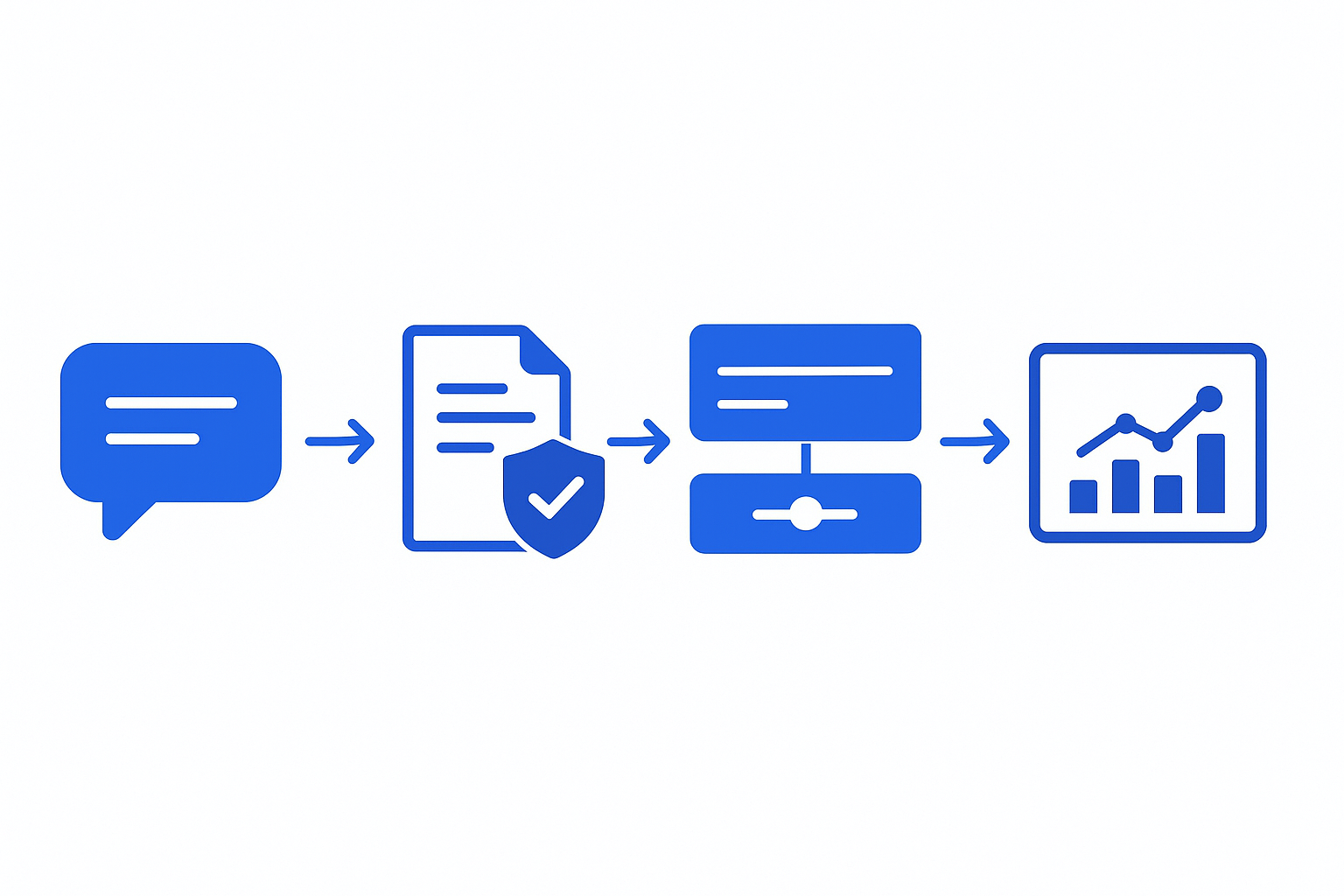
A reliable enterprise workflow typically looks like this:
User asks a question in plain English
The system maps the question to governed metrics (semantic layer)
Text-to-SQL generates a query grounded in those definitions
The query executes with enforced permissions
The result returns with context (metric used, filters, and a chart)
Singdata’s DataGPT (Data Analytics Agent) is designed around this pattern: ask in natural language, map to governed business metrics via a semantic layer, generate SQL, and return answers with charts and context—grounded in the actual enterprise data rather than invented numbers.
Step 1: Choose a question that has a governed owner
Pick something like:
“What’s our net revenue by region month to date?”
Done when: finance agrees on the net revenue definition and time window.
Step 2: Ensure the semantic layer contains the metric and synonyms
Make sure the metric exists as a governed object and is described in business language.
Done when: the metric resolves consistently across 5–7 phrasings your users actually use.
Step 3: Validate access controls with a negative test
Ask the same question from a role that should not see one region or one product line.
Done when: the system denies or masks correctly and logs the attempt.
Step 4: Validate correctness against a trusted report
Compare the result to a trusted dashboard or finance report for the same time window.
Done when: the number matches within an agreed tolerance, and discrepancies have an owner.
Step 5: Capture a verified answer for the canonical question
For high-visibility questions, pre-approve the response so the organization sees the same result and explanation across teams.
Done when: business owners sign off and the response is reproducible.
⚠️ Warning: Don’t let the natural language BI interface become the place where metric debates happen. If a question triggers a definition conflict, route it to the metric owner and resolve it in the semantic layer.
Common failure modes (and concrete mitigations)
Natural language BI rarely fails because the model can’t generate SQL. It fails because the enterprise can’t operate it.
Failure mode 1: “Revenue” means three different things
Mitigation: govern revenue variants explicitly (gross, net, recognized), and require clarifying questions when ambiguity is detected.
Failure mode 2: The system answers correctly—but users don’t believe it
Mitigation: show the metric definition, display filters/time windows, and make lineage discoverable (generated SQL + sources).
Failure mode 3: The chatbot becomes a cost bomb
Mitigation: enforce timeouts and query limits, then optimize and cache the top questions.
Failure mode 4: The rollout creates more confusion than adoption
Mitigation: start narrow, use verified answers for executive metrics, and publish a simple “how to ask good questions” playbook.
This is also where the phrase semantic layer for AI analytics matters: you’re building a shared meaning system that both dashboards and assistants can rely on.
How to measure adoption and trust
If your goal is adoption—not a one-time demo—you need feedback loops.
Track metrics such as:
Coverage: % of top 20 questions that return stable answers
Resolution quality: % of questions that map to the intended governed metric on the first try
Time-to-insight: median time from question to answer
Analyst deflection: reduction in repetitive “can you pull this number?” requests
Trust signals: ratio of “follow-up verification” requests to total usage
The best-performing rollouts treat misfires as backlog. Every ambiguous question is a chance to improve semantics.
Next steps
If you already have an enterprise lakehouse and a semantic layer (or you’re building one), start small:
pick one domain
govern the top 20 questions
validate access control and reproducibility
add verified answers for executive metrics
If you want a structured pilot checklist for rolling out natural language BI without breaking governance, schedule a short readiness review with your Singdata team and turn your “top 20 questions” into a controlled, measurable adoption plan.