
OpenAI Data Agent and the Analytics Front Door: What It Means for Enterprise Data Teams
What OpenAI's Data agent shipped, the semantic layer it depends on, and how to keep governed metric definitions portable across front doors.

The launch headline is not the story. The question worth a budget meeting is whether OpenAI's Data Agent in ChatGPT Work becomes the default conversational entry point to enterprise data, and whether that changes where your next dollar goes. OpenAI's own scale signal is a self-report: OpenAI's launch post for the Data agent in ChatGPT Work says "nearly all of our product team and over two-thirds of our GTM organization use data agents in ChatGPT Work to analyze company data themselves" (OpenAI, 2026-09-10). No denominator is disclosed, and it describes one vendor's internal usage, not enterprise deployment.
So the OpenAI Data Agent is worth watching, but the layer beneath the front door is what decides whether any of it works. Three things follow: what OpenAI actually shipped, the dependency that determines whether answers are correct, and the investment criteria that survive whichever interface wins.
What OpenAI's Data Agent Actually Shipped, and Why the Front Door Is Now Contested
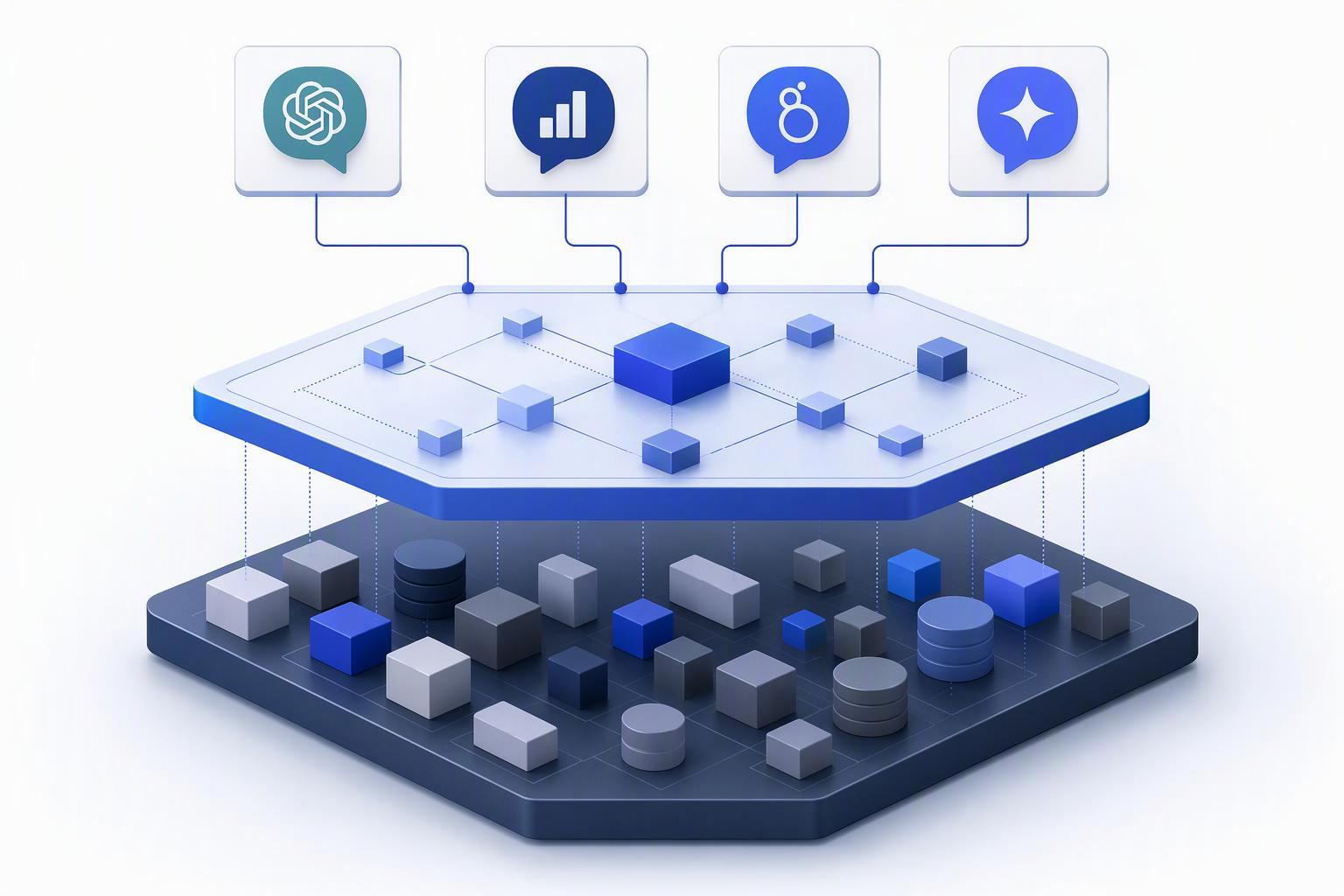
The Data plugin rolled out in ChatGPT Work and Codex on 2026-09-10, per OpenAI's release note that dated the Data plugin rollout, which states users can "bring in your team's metric definitions and other business context" and that admins manage installation policy under Workspace settings > Plugins. It reads the organization's business terms, metric definitions, custom calculations and data relationships, and it enforces the connected account's existing table, row and column permissions (OpenAI's launch post for the Data agent in ChatGPT Work, 2026-09-10). The connector surface spans named warehouses, files from Google Drive and SharePoint, and BI tools; ChatGPT Work's data-teams product page lists 25+ plugins while the launch post names a shorter set, so treat the categories as the reliable part and the count as unsettled.
OpenAI positions this inside ChatGPT Work and nowhere claims to replace BI, so "primary entry point" is our reading, not the vendor's. The reason it holds: every competing front door rests on a governed model. Microsoft requires that model owners "prepare your semantic model before you use Copilot", warning that without preparation Copilot "can misinterpret the data and return generic or inaccurate results" (read 2026-10). Databricks markets Genie as "a single, governed entry point" built on Unity Catalog with a knowledge store of curated semantic definitions (read 2026-10). Four vendors, four front doors, one shared dependency: conversational analytics needs a semantic layer underneath it before it can be trusted.
What the Data Agent Depends On, and Where Conversational Analytics Actually Breaks
The shared dependency is the semantic layer, and OpenAI's own material names it. OpenAI's setup guidance for the Data plugin recommends a warehouse plugin plus "a data semantic layer" (OpenAI Help Center, undated), and its account of what a data agent needs to work describes four context layers, including human annotations capturing "intent, semantics, business meaning, and known caveats." That same account states that without rich, accurate context "even strong models can produce wrong results, such as vastly misestimating user counts or misinterpreting internal terminology" (OpenAI, 2026-01-29).
MIT CISR's academic case for the semantic layer defines it as "a system of technologies and techniques that organizes and maintains a consistent and unified representation of data from various sources that is interpretable by humans and machines," and notes that in the GenAI era it "must encode, for example, data usage constraints, permitted data combinations, rules for handling personal data, and data to support compliance audits" (MIT CISR, 2026-05-21). IBM's breakdown of what a semantic layer contains lists metadata that maps technical items to business terms, business logic and calculations, a logical data model, and security and access controls (IBM, 2024-08-07). Those four artifacts, metric definitions, entity relationships, lineage and access policy, are what a conversational analytics semantic layer has to supply before an agent can be trusted with a number.
Where it breaks is semantic, not syntactic, which is why semantic validation for AI queries sits upstream of the model. Cube's argument for decoupling semantics from the front end states that pointing an LLM at raw tables means "it re-derives joins and metric logic on every prompt, so the same question can return different numbers" (Cube Dev, read 2026-10). The EntSQL enterprise-grounding benchmark, a preprint covering 1,066 examples of which 96.0% require domain knowledge beyond question and schema, measured 4.7% to 6.8% execution accuracy question-only, rising to at most 21.4% with expert-curated evidence (arXiv, 2026). The CIDR audit of text-to-SQL benchmark validity found 52.8% of BIRD Mini-Dev problems contain annotation errors, and re-evaluating five agents on a corrected sample moved accuracy by -2% to +19% absolute (VLDB CIDR 2026, 2026). Benchmark scores and production answers are both shakier than leaderboards suggest.
What to Fund Now, and How to Keep Semantics Portable Across Front Doors

The readiness gap is the reason to fund governed metric definitions for AI before funding another interface. The readiness gap in enterprise AI adoption, a survey of 505 data and analytics leaders fielded in H2 2025, found 43% cite data readiness as the most significant barrier to AI aligning with business objectives while 88% claim they already have the necessary data readiness (Drexel LeBow and Precisely, 2026-01). Data leaders' trust gap and semantic layer adoption, a survey of 65+ data leaders, found 31% cite data quality and lack of trust as their top AI concern and standalone semantic layer adoption tripled from about 8% to 28% between spring and fall 2025 (Hex, December 2025).
AI-ready data for enterprise analytics means definitions that live outside any single front end. dbt's governed metric definitions move metric definitions "out of the BI layer and into the modeling layer," so business units work from the same definitions "regardless of their tool of choice," and a change refreshes everywhere the metric is invoked (dbt Labs, current). That is the portability test: if a metric definition can only be edited inside one vendor's UI, the semantic layer vendor lock-in risk is real, and swapping front doors means rebuilding definitions.
A concrete artifact makes this inspectable. MetricFlow models metrics as semantic models built from entities, dimensions and measures, then builds SQL at query time (dbt Labs, current). A definition expressed that way is reviewable, diffable and testable, and it can be read by a BI tool, an embedded app or an agent over MCP. Definitions stored in open, version-controlled formats survive a front-door change; definitions typed into a chat prompt do not.
What not to do: Do not re-platform the warehouse because a new front end launched. Do not let metric definitions live only inside one vendor's UI. Do not treat a connector list as a governance strategy.
One honest limit: the available evidence does not measure a production accuracy delta from semantic-layer adoption, so the case here is durability and portability, not a claimed ROI.
How we apply this at Singdata, the publisher of this guide. Our semantic layer keeps each metric to one definition, stored in open, version-controlled formats, so the governed definitions you fund stay portable across front doors. It does not decide which metrics matter or who owns them; that work stays with your data team.
Frequently Asked Questions
Does OpenAI's Data agent replace a semantic layer?
No. OpenAI's setup guidance recommends a warehouse plugin plus "a data semantic layer," and the launch post states the agent's context comes from semantic layers and trusted sources (OpenAI Help Center, undated).
How accurate are conversational analytics tools today?
On the EntSQL enterprise-grounding benchmark, execution accuracy ranged from 4.7% to 6.8% question-only and reached at most 21.4% with expert-curated evidence (arXiv, 2026). The benchmark is a preprint built on Chinese-origin enterprise data translated into English, so treat the figures as directional.
What is semantic layer vendor lock-in, and how do I avoid it?
It is the condition where metric definitions can only be edited inside one vendor's interface, so changing front ends means rebuilding them. Definitions held in open, version-controlled formats and modeled in code avoid it; dbt moves definitions into the modeling layer so they refresh everywhere they are invoked (dbt Labs, current).
Is our data already AI-ready?
Most leaders think so, and the evidence disagrees. 88% of surveyed leaders claim the necessary data readiness while 43% name data readiness as their biggest barrier to AI alignment (Drexel LeBow and Precisely, 2026-01), and only 21% of executives rated their data curation practices well developed (MIT CISR, 2026-05-21).
Conclusion
The front door is contested and will keep changing hands. OpenAI's Data Agent, Microsoft's Copilot semantic-model requirement, Google's LookML grounding, and Databricks Genie are all bets on the same layer beneath the interface, and the OpenAI Data Agent is only the most recent entrant.
That layer determines whether any front door gives correct answers. Governed metric definitions for AI decide what a conversational analytics semantic layer can safely resolve, and no interface compensates for definitions that disagree with each other.
Open, version-controlled semantics are what keep that layer portable. When definitions live in code rather than a proprietary UI, the next front door inherits them instead of forcing a rebuild, which is also the practical answer to semantic layer vendor lock-in.
Key Takeaway: Fund the layer, not the interface. AI-ready data for enterprise analytics starts with definitions you can diff, review, and move.
If your team is weighing where to put the next quarter's budget, talk to a solutions consultant about your semantic layer. This post comes from a data platform vendor with a commercial interest in semantic layers, so weigh the argument on its evidence rather than on the source.