
Real-time vs batch processing: how to choose without getting surprised by the bill
A FinOps-informed framework to decide when streaming is worth it and when batch is enough, with enterprise governance and cost criteria.
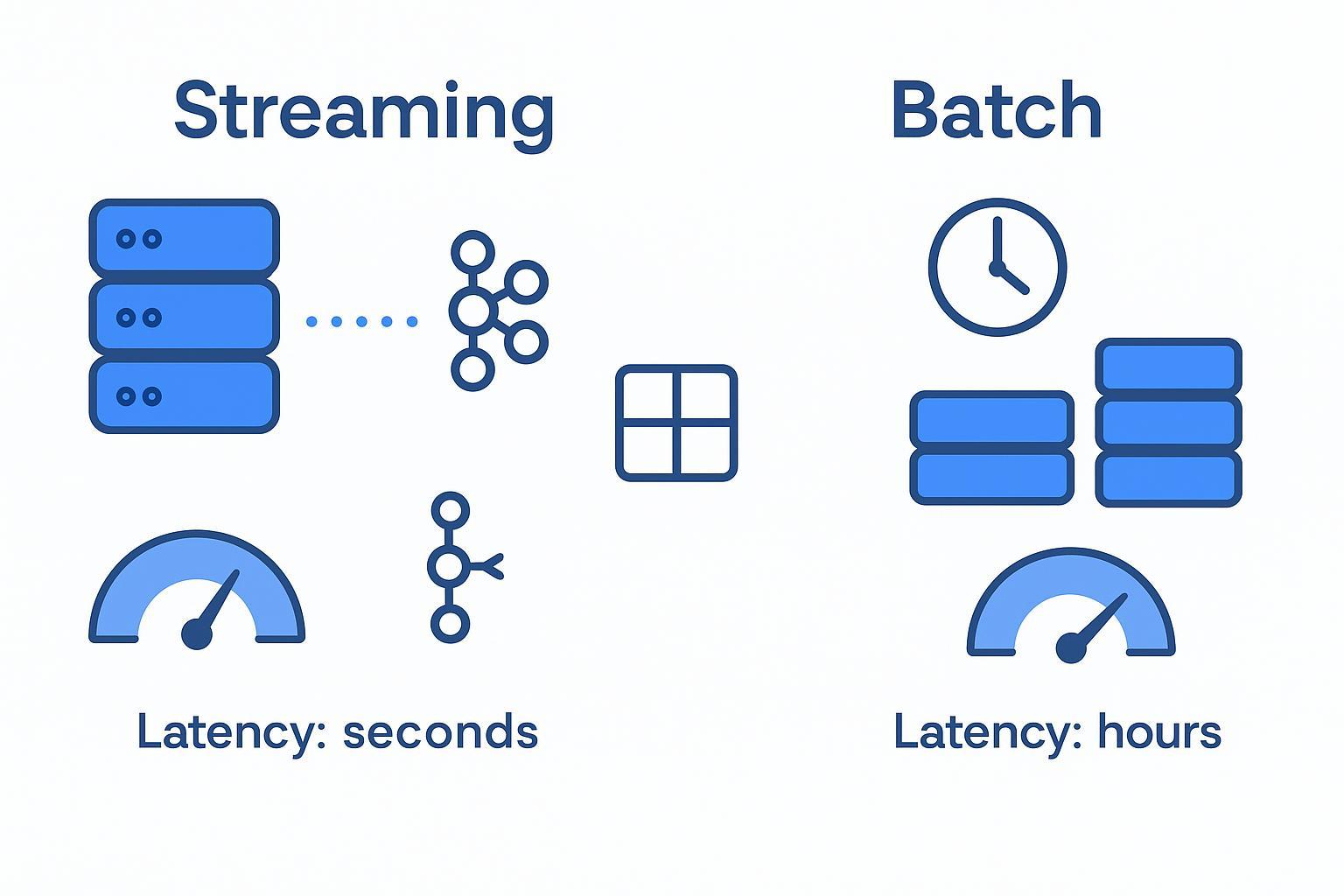
Teams don’t usually end up with “real-time” pipelines because they did a clean cost-benefit analysis. They end up there because “real-time” sounds like table stakes.
In practice, streaming architectures (Kafka + Flink, managed streaming platforms, always-on consumers) behave like production systems that never sleep. That’s great when seconds matter. It’s also an expensive default when they don’t.
This post is a decision framework for enterprise data teams comparing streaming vs batch processing (including Kafka and Flink), with a FinOps cost optimization lens. The goal is simple: pick the lowest-latency option that still preserves business value.
Streaming vs batch: a quick comparison matrix
Evaluation criterion | Streaming (Kafka/Flink-style) | Batch (hourly/daily jobs) |
|---|---|---|
Latency / freshness | Seconds to sub-minute, if engineered correctly | Minutes to hours (or daily), by design |
Cost model | Always-on compute + state + networking + ops overhead | Run-to-completion compute, easier to schedule off-peak |
Operational complexity | Higher: state, backpressure, replay, late events, continuous monitoring | Lower: clear checkpoints, re-runs, simpler debugging |
Failure modes | Silent lag, partial outages, correctness drift, schema evolution surprises | Job failures are visible; recovery is straightforward |
Governance / audit | Possible, but more moving parts and more real-time access concerns | Often simpler to reason about lineage and backfills |
Best-fit use cases | Fraud detection, anomaly alerts, live personalization, operational triggers | Dashboards, reporting, inventory reconciliation, behavioral analytics |
If you want a single default, make it this: start with batch, then “earn” streaming by proving that lower latency changes an outcome.
Criterion 1: latency tiers and how fast value decays (real-time vs batch processing)
“Real-time” is not one requirement. It’s a set of latency tiers with very different costs.
A practical way to scope it (a data pipeline latency SLA):
Sub-second to a few seconds: action must happen now (fraud blocks, safety cutoffs)
Near-real-time (tens of seconds to minutes): still time-sensitive, but you can absorb batching and retries
Hourly/daily: decisions happen on a cadence (operations review, planning, most exec dashboards)
Before you touch architecture, define an end-to-end SLA: “time from event creation to decision-ready data.” Then ask one blunt question:
If this metric is 30 minutes late, what breaks?
If the honest answer is “not much,” streaming is a hard sell.
To make this concrete, compare two scenarios:
Scenario A: fraud detection
Every minute of delay has direct loss exposure. The business value decays fast, and the system needs state (per-user or per-account behavior). Streaming fits.
If you need examples of the kinds of workloads stream processors are built for, the official Apache Flink use cases are a good reality check.
Scenario B: a weekly retention dashboard
If the dashboard is used in Monday meetings, hourly refresh may be plenty. Daily may be enough if the organization makes decisions on that rhythm.
In other words, freshness is a product requirement, not a badge.
Criterion 2: the cost model difference (why streaming can surprise you)
The biggest mistake I see in real-time scoping is treating “streaming” as a faster version of batch.
Batch workloads have a natural off switch. They finish.
Streaming workloads don’t. They carry a standing army of resources:
Always-on compute for consumers/processors
State storage for joins, windows, deduplication, and exactly-once semantics
Replication and network transfer for durability
Monitoring and on-call for a system where failure often looks like lag
Even vendors who argue for streaming will concede the point: the economics are different. Confluent frames this explicitly in “The True Cost of Real-Time Data Streaming” (2025): the cost isn’t just infrastructure, it’s operational burden and organizational readiness.
A FinOps lens: where “waste” shows up
If you run FinOps, you already know the pattern. Waste isn’t always a single misconfigured instance; it’s a long tail of always-on usage that nobody owns.
The FinOps Foundation’s State of FinOps 2026 highlights that “workload optimization and waste reduction remain the single top current priority,” while also noting that many teams feel they’ve already captured the obvious savings and are left with a pile of smaller opportunities.
The number in your draft (32–40% waste) does exist in the wild, but it’s not clearly presented as a direct quote from the FinOps Foundation report. A 2026 write-up by Codelynks claims the average organization wastes “32 to 40 percent of its cloud spend”. If you use that range in your internal decision memo, attribute it to that source, not to FinOps Foundation.
The point is bigger than the exact percentage: streaming is an architecture choice that creates continuous spend. If you don’t assign cost ownership early, you get “real-time” everywhere and accountability nowhere.
Criterion 3: operational complexity and failure modes (the part nobody budgets for)
Streaming pipelines aren’t hard because Kafka is hard or Flink is hard. They’re hard because correctness has a time dimension.
You’re dealing with late and out-of-order events, replays, schema evolution, backpressure/lag, and state growth. Batch has its own problems, but its failure modes are often easier to see and recover from. If a job fails, you re-run it. If you change logic, you backfill.
If you’re comparing streaming vs batch processing for analytics, don’t just compare latency. Compare the organization’s ability to run an always-on system with real SLAs.
Criterion 4: governance, auditability, and enterprise constraints
Enterprises don’t just need fast data. They need data they can defend.
That includes:
Who can access which events and derived metrics
How definitions are governed (semantic layer / metrics layer)
Lineage and audit trails
Change control for pipelines and schema
This matters more in “real-time,” not less, because real-time tends to expand access. When more teams can see data faster, mistakes propagate faster too.
One practical control is to define freshness SLAs the same way you define availability SLAs. Metaplane’s guide to measuring data freshness lays out common approaches, including timestamp differentials and source-to-destination lag monitoring. The implementation details vary, but the governance move is universal: define what “fresh” means and alert on violations.
The hybrid default: route by business value, not by trend
For most enterprises, the right answer isn’t “streaming everywhere” or “batch forever.” It’s a portfolio.
A simple hybrid model looks like this:
Start with an SLA for each data product (fraud alert, pricing feed, executive dashboard)
Assign a cost owner and a “why it matters” owner (finance and the business stakeholder)
Choose the lowest-latency architecture that meets the SLA
Use near-real-time as a pressure valve (micro-batch every few minutes) when the business wants “faster,” but seconds don’t change the decision
Re-evaluate quarterly: some “real-time” use cases cool off when teams learn what they actually do with the data
This is what “architecture follows requirements” means in practice.
Where SingData fits (without forcing everything into streaming)
SingData’s point of view is aligned with that hybrid reality: don’t pick an architecture because it sounds modern. Pick it because it returns more value than it costs.
On a unified lakehouse, the goal is to reduce the number of separate systems you have to run just to meet different latency targets. If you’re currently carrying a fragmented stack, it’s worth reading SingData’s take on lakehouse vs. traditional warehouse architecture and how teams approach modernization with governance in mind, like migrating legacy pipelines using a Medallion-style model.
A reasonable pattern for enterprise teams is:
Use streaming only for the flows where seconds matter
Keep the majority of analytics and reconciliation on batch schedules
Standardize governance, access control, and definitions across both
Done well, you reduce architecture sprawl without pretending everything needs sub-second freshness.
A decision checklist you can reuse
If you’re choosing between real-time and batch, ask these questions in order:
What is the SLA? “Event to decision-ready data” in minutes/seconds, not vibes.
What breaks if the data is late? Name the outcome and its cost.
Does the logic require state? Joins/windows/deduplication at scale push you toward stream processing.
What’s the always-on budget? Include on-call and monitoring, not just cloud resources.
What’s the governance plan? Metrics definitions, lineage, and access control.
Can near-real-time solve it? If the business wants “faster,” test micro-batch before you commit to always-on.
If you can’t answer #4 and #5, you don’t have a streaming plan yet.
Next step
If you want a second opinion on your workload mix, map your top 10 data products by SLA (seconds, minutes, hourly, daily) and cost ownership. That one table will usually show you where streaming pays off and where it doesn’t.
If you’re modernizing a fragmented stack and want to consolidate without losing the ability to run real-time where it matters, explore SingData’s real-time lakehouse approach and the broader reliability angle in delivering reliable BI and AI with SingData Lakehouse.