
Semantic Layer for AI Trust: Consistent Definitions Make Answers Testable
Semantic layers make AI trustworthy because consistent definitions make answers testable. Learn how governed meaning turns a plausible AI answer into one you can verify.
An AI answers a question about churn, and the number looks clean. The model is fluent, confident, quick. Nobody in the meeting can say whether it is right, because nobody has a single agreed version of what "churn" even means in this company.
That is the real problem with AI analytics, and it is not where most teams point first. The complaint is usually about accuracy, hallucination, or the model. But the harder issue is testability. When there is no consistent definition, an answer cannot be checked. And an answer you cannot check is not an answer you can trust, which is why semantic layers and AI trust have become inseparable in enterprise planning. AI trust is not a property of a model. It is a property of being able to prove an answer right.
Consistent definitions change that. Define each business term once, in a governed, versioned way, and the AI answer stops being a plausible guess and becomes something you can verify. That link, from consistency to testability, is what separates AI nobody trusts from AI a board would act on.
The Limit of a Confident Answer
The fixation on model quality is understandable, and it misses the point. Hand a large language model a plain-English question and it writes SQL, runs it, and presents the result with total assurance. The assurance is not evidence. A model told to report gross margin does not know whether that term means recognized revenue net of refunds, as Finance uses it, or bookings including pending deals, as Sales does.
At RSM, an implementation story makes the consequence concrete. Ask the AI "What was our gross margin last quarter?" and it returned three different answers, each one mathematically correct inside its own assumption, none of them the answer the enterprise actually reports. RSM's point is that AI left to infer meaning from raw tables becomes a trust multiplier in the wrong direction, scaling inconsistency across the organization rather than resolving it.
None of this means the model was weak. It means the answer was not testable, because there was no standard to test it against.
Why a Consistent Definition Is What a Test Needs
Here is the mechanism that usually goes unsaid. A test, any test, requires a reference. You validate output against an expected result, a defined rule, a known source. Software engineers write regression suites for exactly this reason: they have a stable spec, so they can tell when new code breaks it.
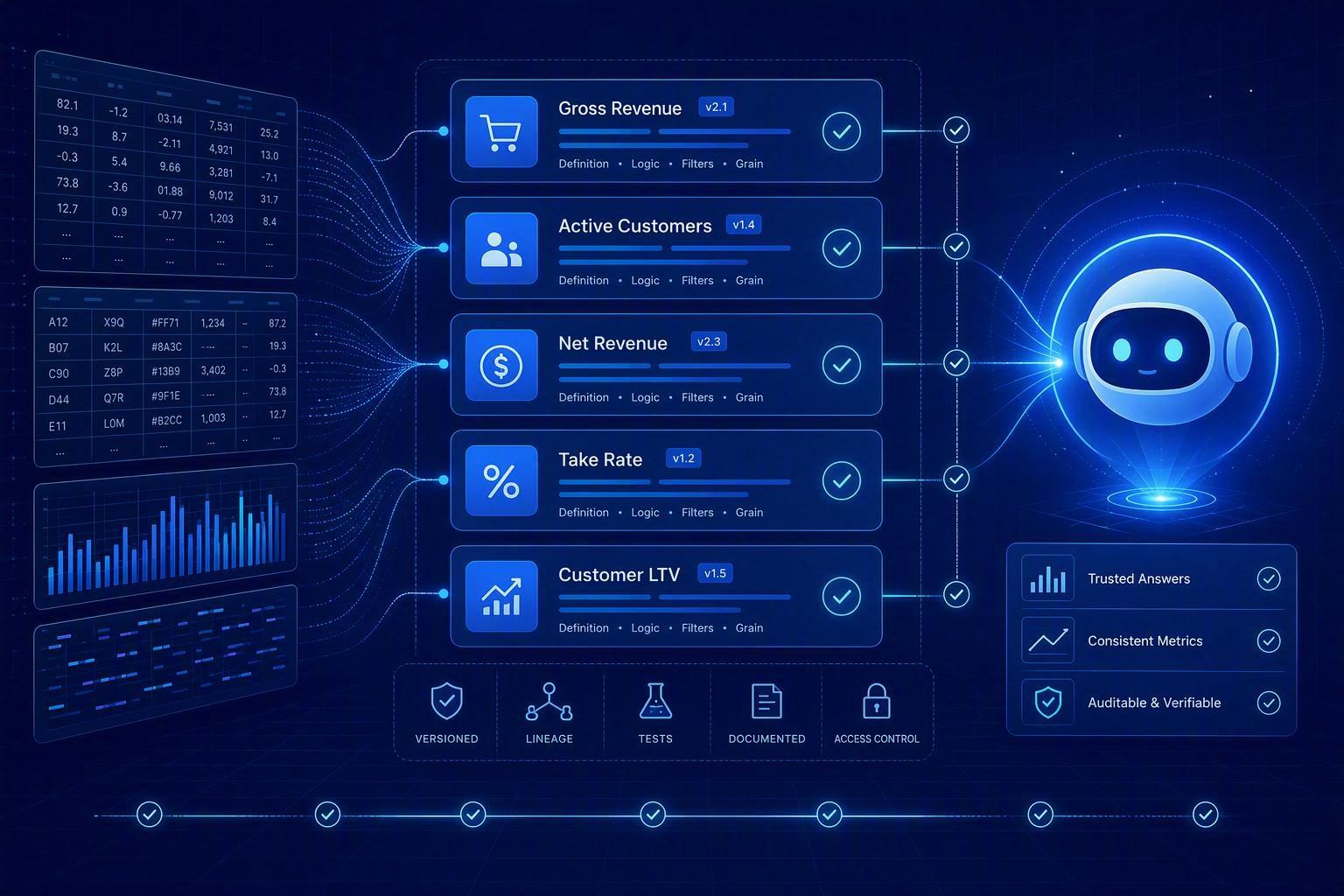
A governed semantic layer is the data version of that spec. It sits between raw data and the dashboards, BI tools, notebooks, and AI agents that consume it, and it states what each metric means, how it is calculated, which dimensions it breaks down by, and who is allowed to see it. Define "net revenue" once, with its formula, grain, exclusions, and time logic, and every tool and agent now queries that single definition.
The payoff is that AI answers become deterministic and checkable. Because the metric, the join, and the filter are predefined rather than guessed, the same question returns the same answer every time, and you can compare it against the definition of record. Without that definition, "correct" is unfalsifiable. You cannot test a guess.
The data on this is blunt. Real enterprise text-to-SQL systems that operate directly against a raw schema often land at 10 to 31 percent accuracy on actual production data. A well-modeled semantic layer raises covered questions into the high nineties. In dbt Labs' 2026 benchmark update, grounding the query in a semantic layer lifted Claude Sonnet 4.6 from 90.0 to 98.2 percent accuracy and GPT-5.3-Codex from 84.1 to 100.0 percent, with the semantic layer adding a 17 to 23 point advantage across the models tested. The models improved less than the context did.
Models Are Not the Bottleneck; Meaning Is
The numbers above point at something uncomfortable for anyone betting on pure model progress. Accuracy does not scale with model size once the data is already ambiguous. Model choice within a tier made almost no difference to the result; the presence of a meaning layer explained nearly all the variance.
a 2026 arXiv study of semantic-layer grounding tested a hundred natural-language questions across three frontier models, first against the warehouse schema alone and then against the schema plus a roughly four-kilobyte semantic definition. Adding that short, governed description improved the first-shot pass rate by a consistent 17 to 23 percentage points across all three models, and the differences were statistically significant. Give a better model the same vague schema and it produces the same confident, unverifiable answer, faster.
This has a practical consequence that matters beyond the benchmark. If meaning, not model, is the binding constraint, then a company's leverage comes from defining its terms well, not from waiting for the next model release. The team that fixes its definitions unlocks every model; the team that chases models without fixing meaning stays stuck.
Pro Tip: Decide which metric your teams argue about most, get that single definition written down, versioned, and owned, then test an AI answer against it. That exercise turns an abstract debate into a concrete, reproducible check.
Why Consistency Is a Governance Problem, Not Just a Technical One
Testability is not a one-time property a semantic layer grants. It decays when definitions drift, which is why so few organizations can answer a simple question: who owns the definition of revenue, and which version is current?
In MIT CISR's case for a semantic layer, the researchers argue the layer itself must be treated as a governed asset, built incrementally from priority data, with a named owner who decides when definitions change. Define a metric and leave it unowned, unversioned, and uncertified, and an AI agent has no way to tell whether the definition it was handed is authoritative or a draft. It reasons over whichever interpretation it happened to retrieve. That is an untestable answer produced reliably.
MIT Sloan connects this to performance. Its analysis of the semantic layer for AI reports that in MIT CISR's 2024 survey of 349 executives, only 21 percent rated their data curation practices as well developed. Those organizations were more than three times as likely to be effective at delivering value from data and AI initiatives and twice as likely to report meaningful competitive advantage. Governed meaning is not hygiene. It is a predictor of whether AI returns answers anyone will trust.
The market is moving the same way. DBTA's 2026 survey found nearly 59 percent of enterprises directing incremental budget toward the semantic layer, reframing it from BI convenience into what the Futurum Group's survey calls mission-critical AI trust infrastructure. The reason is direct: when a business cannot verify an AI output, it cannot let the output drive decisions, and every dollar spent on an unverifiable agent is wasted.
The Argument People Raise: Can't a Bigger Model or Better Retrieval Fix It?
The most natural objection is that testability is a temporary problem, that a smarter model or a richer retrieval layer will eventually infer meaning well enough on its own.
Retrieval-augmented generation is the usual home of this argument, and it deserves credit. RAG is genuinely useful for pulling unstructured knowledge into the context window. But it retrieves candidate material; it does not certify meaning. It cannot tell you that the revenue definition Finance approved excludes trial users, enforce the canonical join between two systems that track the same customer differently, or reject an action that violates a policy nobody wrote down. RAG and a governed semantic layer solve different problems, and the strong version of this stack uses both, retrieval for knowledge and semantics for business truth.
The bigger-model objection fails on the evidence. When the semantic layer was present, model choice within a tier barely moved accuracy, and the grounding lift was large and consistent regardless of model. That is the fingerprint of an architecture fix, not a model fix. The objection that "verification is too expensive" is really an argument for scoping. You do not model the whole enterprise to get going. You define the ten to twenty metrics your decisions actually hinge on, validate answers against the reports your analysts already trust, and expand from there.
What Testable AI Requires in Practice
Making AI answers testable is not a single purchase. It is a discipline with three clear moves, and they build on each other.
Define each metric once, from how the business operates. Start with the terms your teams argue about and make decisions on. Record the formula, grain, dimensions, time logic, exclusions, and the owner of each one. Derive these from Finance, Sales, Marketing, and Product, not from the warehouse schema, because the schema reflects structure, not intent.
Govern the definition as an asset. Give it a named owner and a lifecycle, with a certification status, version history, and a clear record of which version is current and approved. When every dashboard, tool, and agent queries that single versioned object, an AI answer can be traced back to documented logic, and you can audit how the number was derived. This is the step that makes defined mean trustworthy.
Test against the definition of record. Once the meaning is explicit and machine-readable, treat the agent's output like any other governed output. Compare it against the certified definition, watch whether a small change in inputs flips an answer that should be stable, and log the evidence trail, the query path, the source, and the decision, so any answer can be reproduced later. Consistency gives you a standard; testing and logging are what turn that standard into trust that holds up in a review or an audit.
An AI-native lakehouse takes some of this burden off the data team by keeping the governed metric definitions, lineage, and access rules alongside the data the agents consume, so the meaning that answers depend on lives where the compute runs rather than in a fragmented set of tools. Grounded in that single, governed source, Singdata's Analytics Agent maps a plain-language question to a defined metric and returns an answer you can verify, because the agent is no longer guessing. It is reasoning over meaning that was defined once, governed, and made testable.
Trust Is Earned by Being Checkable
Ask how many teams can describe, on demand, the exact definition of their top ten metrics and who owns each one. For most, the answer is no. That gap is why AI analytics keeps returning numbers that cannot be reconciled with anything else in the organization.
The fix is not a more confident model. It is a consistent definition, because consistency is what makes an answer testable, and testability is what makes it trustworthy. A governed semantic layer creates the single standard you need to check any answer against, turn a plausible guess into a verified result, and let an auditor or a skeptical executive confirm it later.
For enterprises building AI agents and natural-language analytics, the question is not whether your output will be checked. It will. The question is whether you built the consistent, governed definitions that make those checks pass. That decision, more than any model choice, is what determines whether your AI gets trusted or gets switched off.