
Can Singdata's Dynamic Tables Really Replace Your Batch and Streaming Pipelines?
A buyer's evaluation of Singdata Dynamic Tables and incremental processing: what consolidates into one pipeline, what still needs streaming semantics, where incremental refresh falls back to full recompute, and what public production evidence actually supports.
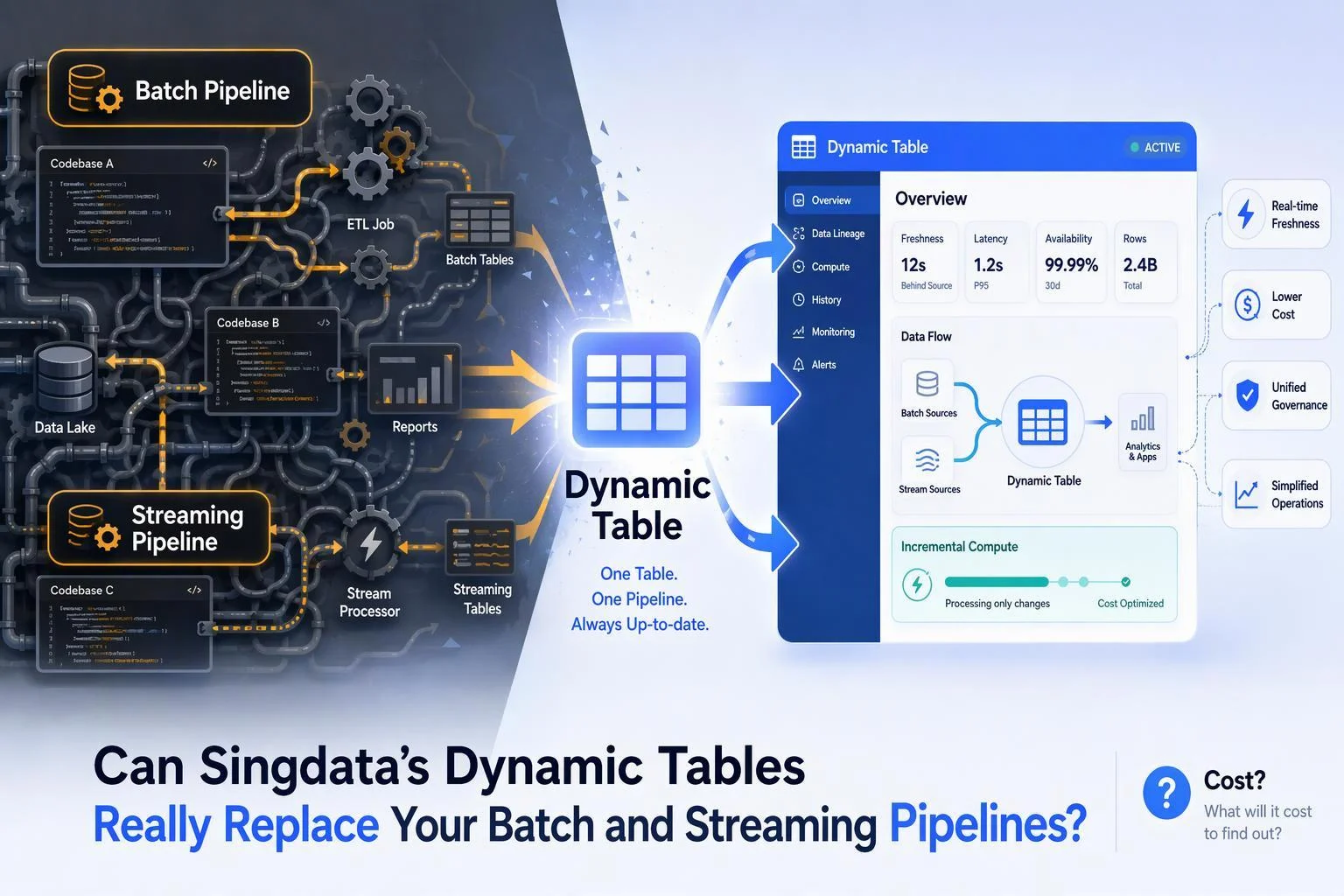
The question behind most Singdata evaluations is not what a Dynamic Table is. It is whether declaring a SQL query and letting the engine maintain the result actually collapses two operating models into one — and what it costs to find out.
The dual-pipeline pain is familiar: two codebases computing the same metric with slightly different logic, two on-call rotations, and a reconciliation job whose only purpose is to prove the batch path and the streaming path still agree. Singdata's answer is a declarative object that detects upstream changes and recomputes only what moved. That removes a large share of the plumbing burden. It does not remove streaming semantics, and it does not remove the operating discipline around them.
This article separates what genuinely consolidates from what does not. Mechanism claims come from Singdata's own documentation, which is the primary source available. Production evidence is thin and vendor-published, and is treated that way. The piece closes with a testable acceptance checklist you can carry into a pilot review.
What a Dynamic Table Actually Removes From the Dual-Pipeline Burden
Picture two hand-built conveyor belts running side by side, both carrying the same boxes to the same warehouse. One belt moves everything every night; the other moves items as they arrive. Now replace both with a single belt that only moves the boxes that changed. That is the shape of the consolidation claim, and the mechanism behind it is worth stating precisely before you decide whether it applies to your estate.
A Dynamic Table in Singdata Lakehouse is an incremental-computation object: you define a SQL query, the system detects changes in upstream data, computes only the changed portions incrementally, and persists the results (Dynamic Table overview). The engine underneath — Generic Incremental Computing — decomposes standard SQL into operator-level incremental plans covering filters, joins, aggregates and windows, and selects between incremental and full execution on each refresh (Concepts).
What disappears from the operator's plate is concrete. You stop hand-writing merge and upsert logic for SQL-shaped transforms. You stop maintaining a stream implementation and a batch implementation of the same aggregation. You stop managing watermarks and checkpoints for transforms that are expressible as a query. And you stop running the reconciliation job that proves the two paths agree, because there is only one path.
What replaces it is a smaller but real set of obligations. Refresh cadence is set declaratively through REFRESH INTERVAL, with a documented minimum of one minute; scheduling through Lakehouse Studio adds dependency orchestration and failure or timeout alerts, while DDL-only scheduling gives you neither (Dynamic Table summary). Each refresh records a refresh_mode of NO_DATA, FULL or INCREMENTAL alongside incremental row counts in the refresh history (SHOW DYNAMIC TABLE REFRESH HISTORY).
The burden therefore shifts rather than vanishes: from maintaining two implementations to governing one implementation and watching its refresh mode. That is a materially better job, but it is still a job, and the next two sections explain why it needs an owner.
What It Does Not Remove: Streaming Semantics That Still Need Design
Declarative refresh maintains a result set. It does not supply the semantics that a stream processor exists to provide, and conflating the two is the most expensive mistake in this evaluation.
Documented minimums and vendor-reported observations, not guarantees. Singdata Dynamic Table scheduled refresh has a one-minute floor; Snowflake's minimum TARGET_LAG is 60 seconds; Kuaishou's reported freshness points are 5 minutes for simple/medium and about 30 minutes for the complex workload. Sub-minute requirements point to a different mechanism (streams and tasks, or real-time trigger mode), not to a faster Dynamic Table.
Start with event time. In Flink, progress through event time is measured by watermarks; the event-time clock those watermarks advance defines when an element counts as late; and aggregates on streams are scoped by windows (Timely Stream Processing). A Dynamic Table refreshing on an interval has no equivalent notion of "how late is too late" — it recomputes affected rows when it runs. If your business logic depends on correcting a window after a late event arrives, that policy has to be designed somewhere, and a scheduled refresh does not design it for you.
Exactly-once delivery to an external sink is the second gap. Flink achieves exactly-once processing semantics by taking consistent snapshots of operator state and restoring from them on failure (Stateful Stream Processing). Singdata documents semantic consistency for Dynamic Table results based on MVCC version management, with incremental results strictly consistent with full recompute. That is a guarantee about the table's contents, not about a downstream Kafka topic or an OLTP store receiving each record once.
Latency needs the same care. Singdata documents three scheduling modes: real-time trigger with second-level latency, periodic scheduling at minute or hour intervals, and DAG dependency trigger (Concepts). The scheduled Dynamic Table path has a one-minute floor. Sub-minute freshness claims must therefore be tested against the specific mode a pipeline uses, not against the product category.
Singdata's own freshness guidance is candid about why streaming persists: stream processing often remains in production "because of stateful semantics, not because of latency," with exactly-once, out-of-order correction and complex event pattern matching named as the hard-to-replace capabilities (Data freshness).
The practical implication is a sorting rule. If a streaming job exists mainly to keep a second copy of batch logic in sync, consolidation is a strong fit. If it enforces event-time correctness or exactly-once delivery into an external system, expect to keep explicit design there — and budget for it.
Where Incremental Refresh Falls Back — and Why That Threatens Cost Predictability
The quiet failure mode in declarative pipelines is not a failed job. It is a job that succeeds, takes longer, and costs more, because the engine stopped refreshing incrementally and nobody noticed.
Singdata documents the triggers. Changing WHERE conditions, JOIN keys or GROUP BY keys forces a full refresh on the next run; adding a column that participates in computation does the same, while adding or removing pass-through columns keeps the refresh incremental (Create Dynamic Table). Some constructs cannot be incrementalized at all — the SQL guide names outer joins with non-equi conditions as an example where the system automatically falls back to full refresh (SQL guide). Parameterized Dynamic Tables add another path: in a non-partitioned table, a changed parameter value forces a full refresh because the change is equivalent to changing the table definition, and in a partitioned table a changed parameter on an existing partition also forces a full refresh (Dynamic Table parameters).
The cross-vendor pattern corroborates that this is structural rather than a Singdata quirk. Snowflake's supported-queries matrix lists constructs that cannot refresh incrementally, including subqueries outside FROM clauses, LIMIT, MINUS/EXCEPT/INTERSECT, and outer joins with non-equality predicates (Supported queries). Databricks documents the same shape for materialized views, with recursive CTEs and certain non-deterministic operations falling back to full recompute (Incremental refresh).
Why this matters for cost is arithmetic. Incremental refresh pays off only while changed volume stays small relative to the base table; Snowflake's guidance is to keep changes to roughly five percent of the base table or less, because the cost of scanning added or removed partitions scales with changed volume (refresh optimization). Full recompute cost, by contrast, scales with base table size. A definition drift that flips the mode converts a predictable small delta into a recurring full scan — with no failed job to page anyone.
So cost predictability here is an observability problem, not a pricing-page problem. You need alerting on refresh_mode, not just on job failure. Singdata's refresh history exposes exactly the fields that make this possible, including refresh_mode, state, duration and incremental row counts in stats (SHOW DYNAMIC TABLE REFRESH HISTORY). Query that history on a schedule and treat a run of FULL where you expected INCREMENTAL as an incident.
Has Anyone Actually Run This in Production? What the Public Evidence Supports
The honest answer is: there is one substantial public artifact, it is vendor-published, and it describes validation rather than a completed production replacement.
That artifact is Singdata's write-up of work with Kuaishou, one of China's largest short-video platforms, whose data platform team runs batch processing across exabytes of data. The two organizations formed a joint project group to build and test a production-grade version of Generic Incremental Computing, and the write-up reports results from production-shaped workloads (Kuaishou case study).
The reported numbers, stated as the vendor reports them: for simple and medium workloads, incremental computing reached five-minute data freshness, with resource consumption below one-twentieth of batch for the simple case and under one-third for the medium case. For the complex workload — a four-layer pipeline fed by three large tables — the fastest achievable freshness was about 30 minutes, and at that aggressive cadence cumulative resource usage was higher than a single batch run. At 50-minute intervals costs were roughly even, and at 90 minutes or above incremental computing was cheaper.
Read the scope carefully. This is a co-authored validation, not an independent benchmark. It supports feasibility on the tested workloads, including complex joins, window functions and UDFs, and it reports that data matched batch results. It does not establish that your pipeline mix will hit those numbers, and it does not constitute a reference customer you can call. The write-up also notes that two pilot migrations are planned for 2026 — one advertising pipeline and one company-wide critical pipeline currently a batch bottleneck. Planned is not completed.
The absence of independent third-party benchmarks is a gap to close during your own evaluation, not evidence of a problem. Treat it as a reason to insist on a scoped pilot rather than a reason to dismiss the claim. And do not generalize the Kuaishou figures into "Singdata is twenty times cheaper" — the simple-case fraction applies to a simple workload under a specific test design, and the complex case shows the advantage can invert entirely at aggressive freshness targets.
The Migration and Rollback Question
The risk you did not ask about is the one that decides the project: getting off a Spark and Flink estate, and getting back if it does not work.
The migration surface has two halves. Transforms that are genuinely SQL-shaped — filters, joins, aggregations, window functions — can be rewritten as Dynamic Table definitions, and the declarative object replaces the job that used to run them. Transforms that depend on stateful streaming semantics should stay on Flink or an equivalent, for the reasons in the previous section. The planning question is therefore not "how much can we migrate" but "which pipelines are which," answered per pipeline before any code moves.
Semantic gaps are where migrations bite. Singdata documents the Snowflake-to-Lakehouse mapping differences directly: TARGET_LAG becomes REFRESH INTERVAL, WAREHOUSE becomes VCLUSTER, manual refresh changes from ALTER DYNAMIC TABLE ... REFRESH to REFRESH DYNAMIC TABLE ..., and — the one that catches teams — there is no DOWNSTREAM cascade concept, so each layer sets its own interval independently (Snowflake Dynamic Tables migration). Losing the cascade means a multi-layer pipeline that relied on downstream-triggered refresh needs either explicit interval staggering or Studio task dependencies to preserve ordering.
Rollback deserves the same design effort as cutover. The realistic approach is dual-running: keep the old batch and streaming paths live while the new Dynamic Table path produces the same outputs, and reconcile them until you trust the result. That reconciliation cost is real and temporary, and it is the price of a reversible decision. Note what version rollback on a Dynamic Table does and does not cover — it helps with table state, not with the pipeline-level decision to revert a cutover.
As an illustrative inference rather than observed data: a team migrating a ten-pipeline estate might expect roughly half to be SQL-shaped and migratable, with the remainder staying on Flink, and might budget four to eight weeks of parallel running before retiring the old paths. Your ratio will differ; the point is to estimate it before you commit. Define exit criteria in advance — freshness achieved, refresh mode stable, cost at or below baseline, reconciliation clean for a defined window — because the consolidation benefit only materializes after cutover.
Common Misconceptions
Five beliefs derail this evaluation more often than any technical limitation. Each has a specific correction.
"Incremental means it is always incremental." No. The mode can flip silently when a definition changes. Singdata documents that modifying WHERE, JOIN or GROUP BY keys, or adding a computed column, forces a full refresh on the next run (Create Dynamic Table). The refresh history records which mode actually ran, which is why monitoring it is not optional.
"Declarative means no streaming design." No. Event-time windows, late-arriving data correction and exactly-once delivery to external sinks still need explicit handling. Singdata's own guidance notes that stream processing often persists because of stateful semantics rather than latency (Data freshness).
"One engine means one system to operate." The engine consolidates. The catalog, governance surface, permission model and on-call rotation for the remaining stateful jobs do not consolidate for you. A unified engine moves the burden from keeping two implementations in sync to governing one implementation well — and that burden lands on the layers around the engine, not inside it (Unified batch and streaming in one engine).
"The vendor benchmark transfers to my estate." Restate any headline figure as a metric with explicit boundaries before trusting it: what is measured, at what data volume, at what concurrency, on which cluster size, over what period. The Kuaishou figures are vendor-reported results from a specific test design, and the complex-workload result shows the advantage can reverse at aggressive freshness targets.
"Real-time trigger mode means sub-minute everywhere." The scheduled Dynamic Table path has a documented one-minute minimum. Real-time trigger mode is documented separately at second-level latency. Check which mode each pipeline actually uses before assuming a latency figure applies to it.
What to Ask For and Verify Before You Believe the Consolidation Claim
Turn the analysis into a set of requests, each tied to a decision you will actually make.
Ask for reference calls with production users beyond the published case study, and ask specifically which pipelines stayed on Flink or Spark and why. The answer tells you more about fit than any success story, because it maps the boundary of what consolidated in a real estate.
Ask for a pilot scoped to your own pipeline mix, with success criteria written down before it starts: freshness achieved per pipeline, refresh mode observed over a multi-week run, cost per pipeline against your current batch-plus-stream baseline, and the count of pipelines that could not be migrated. A pilot without pre-written criteria becomes a demo with a friendly audience.
Ask to see refresh-history evidence from a running system rather than a slide. The fields you want are refresh_mode, state, duration and the incremental row counts in stats (SHOW DYNAMIC TABLE REFRESH HISTORY). A screenshot of a dashboard is not the same as a query against the history table.
Ask how definition drift is detected and alerted. Specifically: what happens when an analyst adds a filter to a Dynamic Table definition and the next refresh runs as FULL? Is there an alert, or does the first signal arrive on the invoice?
Ask what happens to a pipeline mid-migration if the incremental mode flips to full — whether the refresh still completes, how long it takes at your base table size, and who is paged. Ask also how the one-minute scheduled floor interacts with your tightest freshness requirement, and whether the real-time trigger mode is the intended answer for those pipelines.
Finally, ask for a written worked cost example at your volumes, covering a quiet month, a backfill month and twelve months of growth. A pricing structure you cannot model from published information is a risk you are accepting, not a detail to settle later.
Pre-Production Acceptance Checklist
Carry this into the pilot review. Each item is a checkable statement, not a discussion point.
Every current pipeline is inventoried and classified as SQL-shaped or dependent on event-time or exactly-once semantics.
Each pipeline has a written freshness target, checked against the one-minute scheduled floor and against real-time trigger mode where applicable.
A test confirms
INCREMENTALrefresh mode holds for at least several weeks under realistic change volume, verified from refresh history rather than assumed.Alerting is configured on
refresh_modetransitions toFULL, not only on job failure.Cost is measured per pipeline against the current dual-stack baseline, not against a vendor headline figure.
A named owner exists for the stateful streaming jobs that remain outside the consolidated path.
A parallel-run plan is written, with rollback criteria and exit criteria defined before cutover begins.
Reference calls with production users are completed, including questions about what did not migrate.
The migration mapping differences —
TARGET_LAGtoREFRESH INTERVAL, noDOWNSTREAMcascade, changed manual refresh syntax — are reflected in the migration plan.A written worked cost example at your volumes has been obtained and modeled against a backfill scenario.
FAQ
Do Dynamic Tables replace Flink entirely? No. SQL-shaped transforms consolidate into declarative definitions. Stateful streaming semantics — event-time windows, exactly-once delivery to external sinks, complex event pattern matching — generally do not, and Singdata's own guidance says stream processing often persists for those reasons rather than for latency.
Is the one-minute minimum a hard limit? It applies to scheduled Dynamic Table refresh, documented as the minimum REFRESH INTERVAL (Dynamic Table summary). Real-time trigger mode is documented separately at second-level latency (Concepts). Verify per mode rather than per product.
Are the Kuaishou numbers independently verified? No. They are vendor-published and vendor-reported from a joint validation on production-shaped workloads, and the two pilot migrations described are planned for 2026, not completed (Kuaishou case study).
What happens when a definition stops being incrementalizable? The system falls back to full refresh, and the change is visible in refresh history as refresh_mode = FULL. There is no failed job by default, which is why alerting on the mode matters.
Does migration require rewriting everything at once? No. Migrate pipeline by pipeline, but plan a parallel-run period and define rollback criteria before the first cutover, because the consolidation benefit only materializes after cutover completes.
See Also
Exploring AI-Driven Layered Structures in Global Supply Chains
Transforming Loyalty Programs with Engaging Gamification Strategies
Understanding OLAP Cubes: Their Importance and Functionality