
Organization Hierarchy
Singdata Lakehouse uses a four-tier organization structure to manage resources and data: Instance → Catalog → Schema → Data Objects.
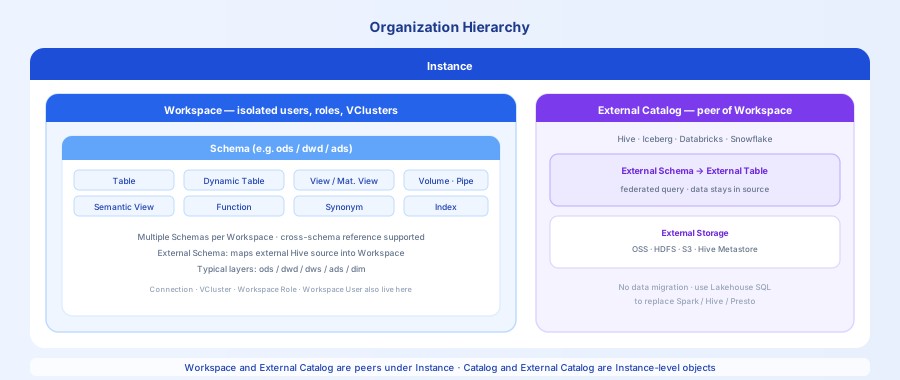
Tier Descriptions
| Tier | Description | Reference |
|---|---|---|
| Instance | The top-level resource unit, corresponding to one Singdata Lakehouse instance. Instance-level configuration is shared across all Workspaces. | Managing Instances |
| Workspace | The resource isolation unit within an instance, essentially an internal Catalog. Contains independent users, permissions, compute clusters, and data objects. Different Workspaces are invisible to each other by default. | Workspace |
| External Catalog | An external data catalog at the same level as a Workspace, mapping external data systems such as Hive, Databricks, and Snowflake for federated queries. | External Catalog |
| Schema | The namespace within a Workspace, used to organize data objects by business domain or data layer (e.g., ods, dwd, ads). | Schema |
| External Schema | A special Schema within a Workspace that maps an external Hive data source, enabling direct queries without data migration. | External Schema |
Recommendations
When to create multiple Workspaces:
- Isolating development, test, and production environments
- Different business teams need independent permissions and compute resources
- Business units that require separate billing
When to create multiple Schemas:
- Dividing by data layer within the same team (ODS / DWD / ADS)
- Dividing by business domain within the same Workspace (orders, users, products)
- Granting permissions to different data collections as a whole
When to use External Catalog vs. External Schema:
| Scenario | Recommendation |
|---|---|
| Querying external systems such as Hive, Databricks, or Snowflake | External Catalog |
Mounting an external Hive database into the current Workspace for direct schema.table references | External Schema |
| Federated queries across platforms without data migration | External Catalog |
In-place data lake acceleration: Data stays in the original object storage (OSS/COS/S3/HDFS). Connect it to Lakehouse via External Catalog or External Schema, then use Lakehouse directly as a replacement for Spark/Hive for ETL processing, or as a replacement for Presto/Trino for ad-hoc queries — no data migration required, and you immediately gain Lakehouse's performance and SQL capabilities.
Related Documentation
- Workspace — Create, manage members, configure roles
- Schema — Create, switch, cross-Schema references
- External Catalog — Federated queries on external data systems
- External Schema — Map external Hive data sources
- In-Place Data Lake Acceleration Implementation Guide — Rapid POC validation, replace Spark/Hive and Presto/Trino without moving data