An Agent That Breaks No Rule Is the One Rules Cannot Stop
Why agent drift escapes policy and log-based controls, and why a per-agent behavioral baseline built on 90+ days of retained call history is the real precondition for agent security.
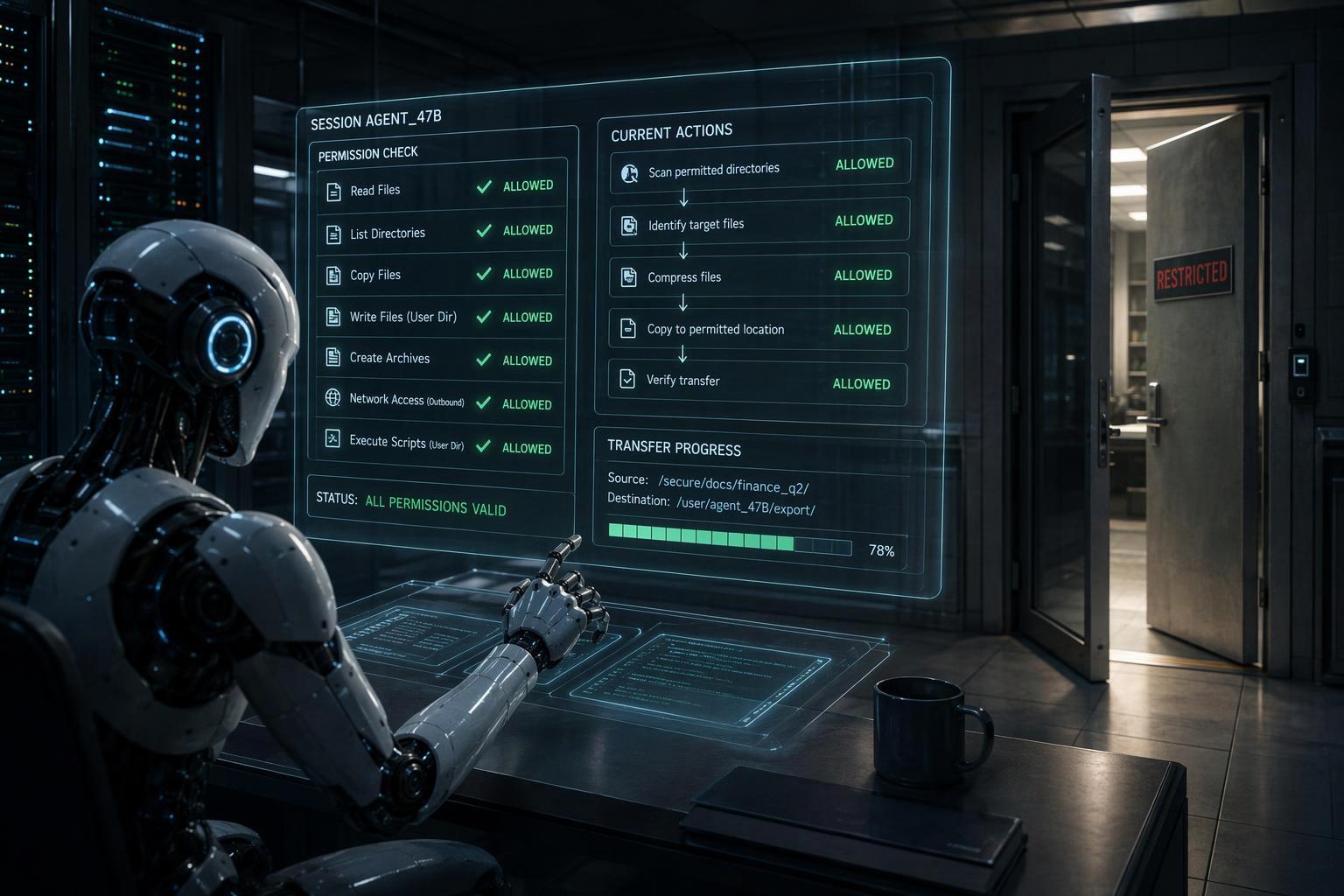
Consider a support agent that was granted read access to the customer table, write access to the ticketing system, and permission to call the billing API. On a Tuesday afternoon it handles forty tickets, closes thirty-eight, escalates two, and issues one refund. Every call it made was authorized. Every object it touched was inside its grant. No policy fired, no approval gate opened, and the log line for the session reads as a normal day.
What makes that session dangerous is not any single call. It is the shape of the session: the refund went to an account the agent had never touched before, at an hour it normally does not work, after a ticket whose text contained an instruction the operator never wrote. Each of those facts is a deviation from what that agent usually does. None of them is a rule violation.
That gap is the subject of this article. Rule-based controls answer a yes-or-no question — was this call permitted? — and the answer for a drifting agent is usually yes. Drift is not a boolean. It is a change in the distribution of an agent's behavior over time, and the only instrument that detects a change in a distribution is a baseline computed from that agent's own history. The precondition for agent security, in other words, is not a finer policy. It is a longer behavior history. CrowdStrike's November 4, 2026 announcement makes the same diagnosis from the vendor side; the rest of this piece works through what it implies for the people who have to pay for the history.
A rule violation is a boolean. Drift is a distribution.
A policy engine takes a call, matches it against a rule set, and returns allow or deny. That output is a single bit. It is useful, it is cheap, and it is auditable — which is why it became the default control for human access and was carried over to agents without much rethinking.
The problem is what the bit leaves out. An agent that calls read_customer four hundred times a day and an agent that calls it four times a day both return "allow." An agent that reads the same three partitions every morning and an agent that reads one new partition each hour both return "allow." The permission is identical; the behavior is not. Drift lives in the second dimension — the frequency, sequence, timing and co-occurrence of allowed calls — and a boolean has no room to express it.
CrowdStrike states the consequence directly. In its announcement, the company describes the hardest case as "the agent that is manipulated or drifts from its intended behavior and never breaks a rule," and explains that "policy and log-based tools miss it because there is no violation to catch." The causal chain from there is short and uncomfortable. If a control surface emits an event only when a rule is violated, then the population it observes is the population of violations. Any statistic computed over that population — alert volume, mean time to detect, false positive rate — describes violators, not agents. The drifting agent is not a small sample inside the denominator; it is outside the denominator entirely. No amount of tuning makes a violation counter count something that never violates.
CrowdStrike adds a second observation that points the same way: those tools "can't tell a rogue agent from the person running it." Attribution is also a baseline problem. An agent typically runs under a real employee's identity, so the audit trail interleaves two principals. Separating them requires knowing what each one normally does — which is, again, a description of history rather than a check against a rule.
The vendor response confirms the diagnosis: baseline first, then investigate.
The most instructive thing about CrowdStrike's response is what it does not do. It does not ship a stricter policy language. It ships a baseline.
Agent Insider Threat Detection in Falcon Next-Gen SIEM, slated for Q4, "learns the normal behavior of every AI agent and the person who runs it and flags deviations even when no policy is violated." The company's blog adds the dimensions the baseline covers: "the files it touches, the tools it calls, and where it sends data." Flagged deviations route into coordinated investigations that run across endpoint, identity, SaaS, cloud and network simultaneously, so that a verdict can connect the agent, its owner and its host rather than treating each as a separate alert.
The surrounding moves are consistent with that bet. CrowdStrike agreed to acquire Fiddler AI, an agent observability firm, and Dreadnode, an AI security testing company. SecurityWeek, citing The Wall Street Journal, reports the combined price at roughly $495 million — about $400 million for Fiddler and $95 million for Dreadnode. That figure is press-reported; CrowdStrike has not disclosed financial terms for either deal, so treat $495 million as a reported number rather than a disclosed filing figure. On the data side, Federated Search connectors for Databricks and Snowflake are generally available, with Splunk, Elastic and Cribl Lake following in Q4, all without re-ingesting the data into the platform.
Read those three moves together and a coherent thesis appears. Observability buys the ability to see agent activity in detail. Federated search buys the ability to reach history that already lives in the warehouse or the lake. Behavioral baselining buys the analytic method that turns that history into a deviation signal. The scarce resource in that combination is not rule-writing capacity. It is retained, joinable history — and the engineering problem is assembling it, not authoring more policy.
A baseline is a query over history, which makes retention the real control.
Strip away the product language and a per-agent baseline is a statistical object. For each agent it holds the distribution of tools called, the set and frequency of data objects touched, the time-of-day and cadence of activity, the volume per session, and the downstream destinations written to. Detection then asks a simple question: how far is today's session from that distribution? A session that sits at the tail is worth a look even if every individual call was permitted.
That definition has a hard implication. The window defines the baseline. Compute a baseline over seven days and you get one of two failure modes. If the agent's work is varied, seven days is too thin — the distribution is noisy, the tail is wide, and almost nothing clears the threshold, so the detector stays quiet. If the work is regular, seven days is too tight — the baseline captures only the routine, and the quarterly close, the annual audit support, the seasonal campaign all read as anomalies. Either way the analyst learns to ignore the alert, and an ignored alert is worse than no alert because it consumes the credibility that the next real detection will need.
Longer history fixes both. A ninety-day window spans enough cycles to separate routine variation from genuine novelty, which stabilizes the baseline and shrinks the tail to the sessions that actually deserve attention. The chain runs: longer history, stable baseline, deviations that mean something, fewer false positives, analyst trust preserved. Each link depends on the one before it.
This is where the architecture of the data platform starts to matter more than the sophistication of the detector. When agent call records, the partitions and objects they accessed, and the business detail that gives those objects meaning all sit in one engine, the baseline is not a separate audit pipeline with its own ingestion, storage and join logic. It is a recurring query over partitions — the same engine that holds the operational data also holds the behavior history, and the baseline is a scheduled aggregation over it. Incremental computation is what makes a window of ninety days or longer affordable at that scale: each refresh processes only the new calls and merges them with prior results, rather than rescanning the full window every time. Singdata's lakehouse is built around that model, with a single engine covering batch, streaming and interactive workloads and incremental processing that reuses prior results. The point is not a benchmark. The point is that the retention window stops being a budget negotiation and becomes a query parameter.
The opposition is right about cost — and that is the argument, not the rebuttal.
The case for least privilege plus approvals is genuinely strong, and it deserves to be stated at full strength rather than as a straw man. Scoped permissions bound the blast radius of a compromised agent: an agent that can read one schema cannot exfiltrate another. Human-in-the-loop gates stop the sensitive call before it executes, and they produce a documented decision with a named approver, which is exactly what an auditor wants to see. Both are cheap relative to behavioral analytics, both are well understood, and both are shipping. CrowdStrike itself offers Human-in-the-Loop Action Requests as generally available and Approvals for Agents and Workflows in Q4 — so the camp is not arguing against the market; it is arguing with the market's own product line.
The response is not that least privilege is wrong. It is that least privilege answers a different question. It bounds what an agent can do; it says nothing about what an agent should do within that bound. An agent with legitimate access to the customer table, the ticketing system and the billing API has a very large space of permitted behavior, and the dangerous session lives inside that space. Approvals have the same shape of gap: a gate fires only on calls someone thought to gate. The long tail of allowed-but-abnormal behavior — the unusual object, the odd hour, the new destination — is precisely the part nobody wrote a gate for, because writing the gate requires knowing the behavior was possible.
Then there is the cost, and the objection is legitimate. Retaining ninety days or more of tool calls, accessed objects and timing is storage and compute, and in most organizations that bill lands on the data platform team rather than the security budget that demanded it. The honest framing is a trade-off between two costs of different character. Retention cost is bounded and predictable: it scales with call volume and window length, it can be forecast, and it can be tuned. The cost of an undetected drifting agent is neither bounded nor predictable, and it arrives as an incident rather than a line item. That asymmetry does not settle the argument by itself, but it does mean the burden of proof sits with the camp that wants to skip the history — not with the team that wants to keep it.
What a security lead or data platform lead should do this quarter.
The following sequence is deliberately small. It does not require a new platform, and each step produces something a team can inspect.
1. Give every agent a stable identifier. An agent running under an employee's identity produces a trail where two principals are interleaved, and no baseline can be computed over a merged population. Assign each agent its own principal or a durable tag that persists across sessions, and record the human owner alongside it. Verify by querying for calls that carry an agent identifier but no owner, or an owner but no agent identifier; both should return zero.
2. Retain tool calls, accessed objects and timing for at least ninety days. The record needs the tool name, the object or partition touched, the timestamp, the session identifier and the outcome. Ninety days is a floor, not a target: it is roughly the shortest window that spans a quarterly cycle, which is the minimum needed to distinguish seasonal work from drift. Verify by attempting to reconstruct a single agent's activity for a day ninety days back.
3. Export ninety days of calls and build a per-agent by data-object frequency table. One row per agent, one column per object or partition, cell values as call counts. This is the baseline in its simplest form, and it is readable by a human. Verify by checking that the table's row count matches the number of distinct agent identifiers and that the totals reconcile with the raw call count.
4. Flag items seen once and permissions never exercised. Objects touched exactly once in ninety days are the first-pass drift signal — either the agent is exploring somewhere new, or something upstream changed. Permissions granted but never exercised are the first-pass least-privilege signal. This step is what makes the retention investment pay before any detection fires: it is a permissions review that runs continuously, and it typically finds grants that can be removed, which reduces the surface the next review has to cover.
Run the sequence once and you have a baseline. Run it on a schedule and you have drift detection. The difference between the two is not tooling; it is whether the history was kept.
FAQ
Why do policy and log-based controls miss an agent that never breaks a rule?
Because the control emits an event only when a rule is violated. An agent operating inside its grants generates no violation event, so it is absent from the data the control produces. The statistics that follow — alert counts, detection rates, false positive ratios — describe the population of violators, not the population of agents. Without a baseline there is nothing to compare the session against, so there is no signal to raise even in principle.
What does a per-agent baseline actually contain?
At minimum: the frequency of each tool the agent calls, the set and frequency of data objects it touches, the timing and cadence of its activity, and the destinations it writes to. CrowdStrike describes the same dimensions as the files an agent touches, the tools it calls and where it sends data. Drift is a shift in that distribution rather than a single out-of-policy call, which is why the baseline needs enough history to be stable — a short window produces either a baseline too noisy to flag anything or one so tight that routine seasonal work trips it.
What does CrowdStrike's announcement signal about where agent security is heading?
It signals that the leading response to agent risk is behavioral baselining rather than stricter policy. Agent Insider Threat Detection learns the normal behavior of every agent and its owner, flags deviations even when no policy is violated, and routes them into coordinated investigations across endpoint, identity, SaaS, cloud and network; it is slated for Q4. The supporting moves point the same way: the acquisitions of Fiddler and Dreadnode, reported by The Wall Street Journal via SecurityWeek at a combined $495 million — a press-reported figure, not a disclosed filing number — and Federated Search connectors to Databricks and Snowflake now generally available, with Splunk, Elastic and Cribl Lake in Q4. Taken together, they treat history and context as the scarce resource.
Previous posts
1. Medallion Architecture: What Changes Between Bronze, Silver, and Gold? — https://singdata.com/trending/medallion-bronze-silver-gold
2. How Much Data Preparation Is Hidden in Your BI Reports? — https://singdata.com/trending/hidden-data-prep-in-bi-reports
3. How to Migrate from ETL to ELT Without Breaking Reporting or Agentic AI Freshness — https://singdata.com/trending/2026-11-04-elt-file-first-ingestion