


Minimalist Architecture in Practice: Full-Stack Real-Time Transformation and Efficiency Upgrade for a Classic CRM Reporting Scenario

Overview
As a leading full-stack intelligent marketing management service provider in China, Tanglang serves over 5,000 enterprises—including New Oriental and Hujiang NetSchool—with end-to-end solutions spanning customer acquisition to customer operations. As the customer base continued to grow, the existing architecture built on Alibaba Cloud’s MaxCompute + DataWorks + ADB “three-component stack” faced mounting challenges: fragmented components, high costs, and complex operations.
Seizing the opportunity of a cloud migration from Alibaba Cloud to Tencent Cloud, Tanglang adopted Singdata Lakehouse as the core of their next-generation data platform, achieving a unified replacement and architectural upgrade of the original three-component stack.
After migration, the Tanglang technical team enabled real-time writes of data from tens of thousands of source tables into the lakehouse, compressing data visibility latency from the day level down to 10 seconds, keeping P99 query response within 1 second, improving all performance metrics, while reducing overall costs by 30% and operational overhead by 30%—providing strong performance support for efficient generation of analytical decision reports.
This article details the technical decisions and implementation practices behind this architectural upgrade.
Background: A Pioneer in Full-Stack Intelligent Marketing
Beijing Tanglang Technology Co., Ltd. was founded in 2016 and is a leading full-stack intelligent marketing management service provider in China. Tanglang’s core product portfolio includes Marketing Cloud, AI Online Customer Service, CRM Customer Relationship Management System, and SCRM Private Domain Live Streaming Operations Management System.
As a data-driven SaaS provider, one of Tanglang’s core competencies is delivering accurate, timely business insights to its customers. In CRM reporting scenarios, the platform needs to provide personalized data reports to business personnel across different roles—supervisors, salespeople, agents, and marketing staff.
Migration Background and Pain Points: The “Architecture Challenge” in Cross-Cloud Migration
As the customer base continued to grow and data volumes expanded rapidly, enabling real-time data visibility while ensuring high-concurrency query performance became a key challenge for the technical team.
The Rigid Demand for Strategic Migration
Driven by considerations of overall cost optimization and strategic positioning, Tanglang decided to migrate part of its business from Alibaba Cloud to Tencent Cloud. This was a systematic migration involving the entire business chain, with CRM data and reporting workloads—being data-intensive applications—facing particularly high migration complexity. The existing architecture was deeply coupled to Alibaba Cloud’s big data ecosystem, making it critical to find an equivalent or superior alternative on Tencent Cloud.
The Three-Fold Dilemma of the Legacy Architecture
On Alibaba Cloud, Tanglang’s CRM reporting business relied on a typical big data “three-component” combination: MaxCompute for large-scale data storage and offline computation, DataWorks for data development and task scheduling, and ADB for MySQL as the analytical database powering final report query services. While this architecture met basic needs in the early stages, its inherent structural issues became increasingly apparent as data scale and business complexity grew.
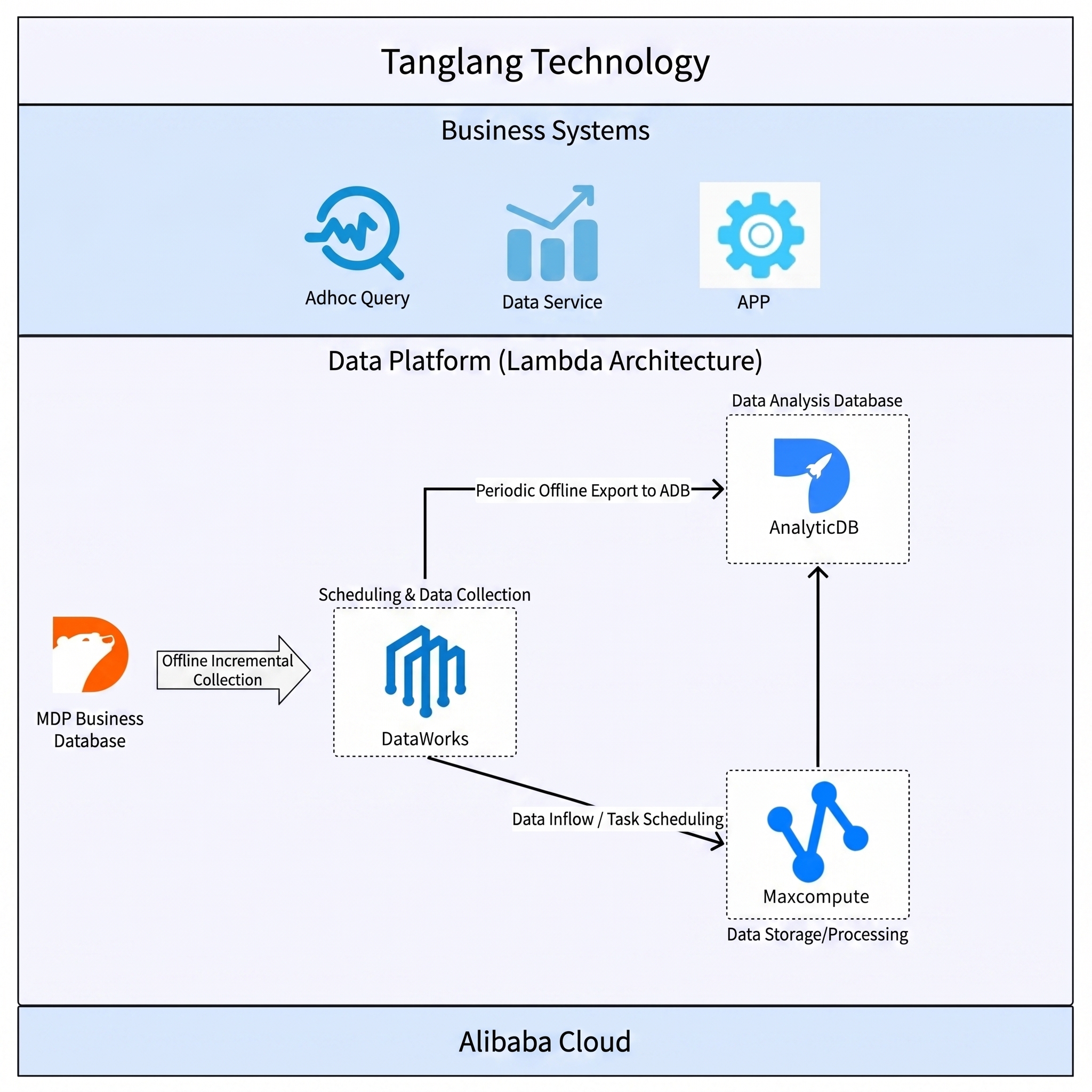
Fragmented components, lengthy pipelines. Moving data from the business database to the final report required multiple extract, transform, and load steps. Data was first extracted from the business database into MaxCompute via DataX (integrated in DataWorks), then cleaned and processed into intermediate layers within MaxCompute, then exported to ADB for MySQL, and finally queried by the reporting system from ADB. The entire pipeline involved data shuttling across three independent components, increasing data freshness latency and creating substantial pipeline maintenance work.
High costs, redundant resources. Multiple components meant multiple storage and compute expenditures. MaxCompute stored a full copy of the data warehouse, while ADB required another redundant copy of result data for query use, significantly amplifying storage costs. More critically, ADB as a dedicated analytical database carried relatively high instance costs, requiring fixed resource provisioning even during off-peak hours.
Operational pressure, accumulating risk. Maintaining the stable operation of three heterogeneous systems placed a sustained burden on the operations team. Data synchronization between components could be delayed or fail due to network fluctuations, scheduling conflicts, or other issues—any single failure could render downstream report data unavailable. The complexity of multi-system coordination made problem diagnosis and fault recovery difficult.
Why Singdata
Facing the rigid requirements of cross-cloud migration, Tanglang’s technical team defined clear selection criteria for the new architecture: find a unified platform on Tencent Cloud that could simultaneously handle offline data processing, high-performance analytical queries, and directly serve report workloads—replacing or outperforming the original “three-component” stack.
Three Key Evaluation Factors
After evaluating multiple candidate solutions, Tanglang ultimately selected Singdata Lakehouse as the core of their next-generation data platform, based on three key considerations.
Comprehensive functional coverage. Singdata Lakehouse fully replicated and replaced the core capabilities of MaxCompute and DataWorks. At the storage layer, it provides unified storage of large-scale data based on an open Lakehouse architecture. At the compute layer, it delivers powerful offline batch processing and interactive query capabilities. At the development layer, Singdata Studio provides a fully featured data development and task scheduling environment, enabling a smooth transition of existing DataWorks business logic.
A critical breakthrough in serving capability. Compared to traditional data warehouse solutions, Singdata Lakehouse’s most differentiated advantage lies in its powerful data serving capability. The platform natively supports the MySQL JDBC protocol, meaning downstream reporting systems can directly access Lakehouse data via standard database connections—without deploying a standalone ADB instance as a serving layer. This capability directly addresses the “last-mile” pain point that ADB represented in the legacy architecture.
Natural fit for multi-cloud deployment. Singdata Lakehouse natively supports multi-cloud deployment, running seamlessly on Tencent Cloud infrastructure. This means Tanglang can fully leverage the infrastructure benefits of Tencent Cloud without facing new cloud vendor lock-in risks, preserving flexibility for future architectural evolution.
In summary, this decision represented both an infrastructure migration adapting to a multi-cloud environment, and an upgrade in architectural philosophy—moving from a Lambda architecture to a unified Kappa architecture.
Solution: Singdata Lakehouse’s “Unified” Replacement
Implementation: Rebuilding the CRM Reporting System
Based on Singdata Lakehouse, Tanglang completed the full migration of its CRM reporting system, achieving an end-to-end upgrade spanning data ingestion, storage and compute, and external serving.
Architectural simplification: eliminating ADB. In the new architecture, ADB has been entirely removed as an independent component. The reporting system connects directly to Singdata Lakehouse via the MySQL JDBC protocol, and all query requests are processed and returned within the Lakehouse. Data no longer needs to be exported from the data warehouse to a dedicated analytical database, eliminating both redundant data storage and data synchronization latency.
Unified development experience with Singdata Studio. Existing data development and scheduling tasks from DataWorks were smoothly migrated to the Singdata Studio environment. Developers now complete data modeling, ETL logic authoring, and task scheduling configuration within a single unified IDE, with no need to switch between multiple platforms. Studio’s visual task monitoring and log analysis capabilities have also significantly improved development and operations efficiency.
Real-time ingestion from tens of thousands of source tables. Leveraging Singdata Lakehouse’s real-time data ingestion capability, data from tens of thousands of business source tables is written into the lakehouse in near real time. The latency from data generation to query-ready visibility has been compressed to the 10-second level, enabling business personnel to see up-to-the-moment CRM status in their reports and make more timely business decisions.
Architecture Evolution: Before and After
Tanglang’s CRM reporting architectural upgrade can be summarized as a shift from “component stacking” to “platform unification.” The diagram below illustrates the architectural changes before and after migration.
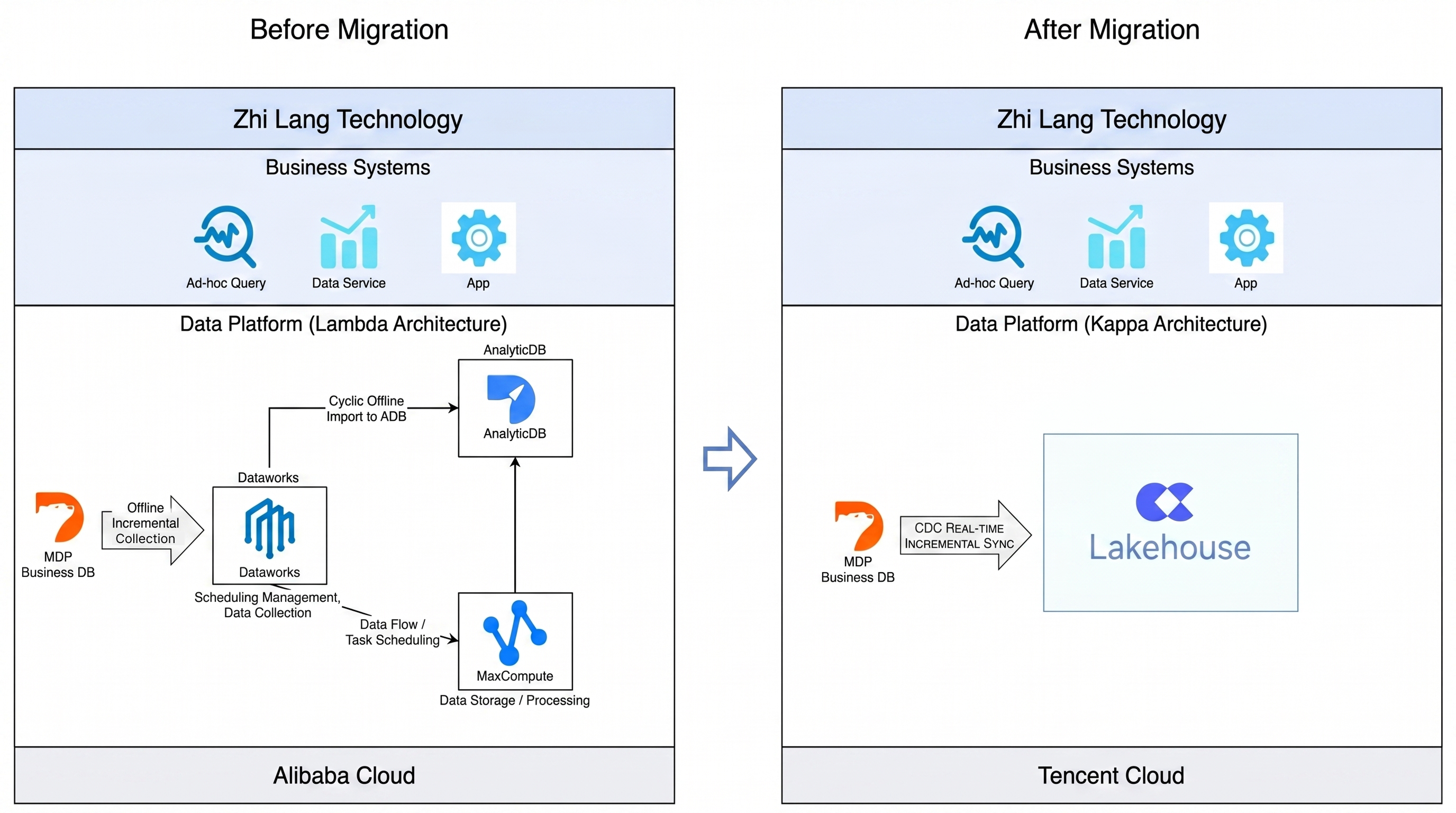
Before Migration: The “Assembly-Style” Architecture on Alibaba Cloud
The MC + DW + ADB assembly approach required data shuttling between the data platform and the reporting system, resulting in multiple copies of stored data and reliance on ADB for “last-mile” query acceleration. Every data transfer meant additional compute overhead and synchronization latency, with the freshness of the entire pipeline limited by its slowest link.
After Migration: Unified Lakehouse Architecture on Tencent Cloud + Singdata
The new architecture is deployed in Tencent Cloud’s Shanghai region, running on Tencent Cloud infrastructure. Compared to the legacy architecture, the most visible changes are a dramatic reduction in the number of components and a significant shortening of the data pipeline.
Advantage 1: Unified Lakehouse Architecture. Singdata Lakehouse implements a unified design for real-time and offline data warehousing based on SingleEngine technology. At the storage and compute layer, Singdata Lakehouse serves as a unified data platform, simultaneously fulfilling the data warehouse storage and offline compute functions of the original MaxCompute, as well as the ad-hoc query and external serving functions of the original ADB—truly achieving “one architecture for all scenarios.” Developers complete all data development and scheduling tasks in Singdata Studio, replacing the original DataWorks.
Advantage 2: Real-Time Ingestion from Tens of Thousands of Source Tables. At the data ingestion layer, business databases establish a secure channel to Singdata Lakehouse via PrivateLink private networking. Singdata Lakehouse’s powerful real-time write capabilities support direct ingestion of data from tens of thousands of source tables into the lakehouse in real time, without any intermediate synchronization components, dramatically simplifying the data pipeline.
Compatibility Advantage: Zero-Modification Integration. At the data serving layer, the reporting system connects directly to Singdata Lakehouse via standard MySQL JDBC protocol through a fully private network channel built on PrivateLink. This design requires no language compatibility modifications to existing business systems—connection is achieved through the original MySQL protocol. This “fully internal network access” model not only ensures data security—with no public network exposure along the entire pipeline—but also further reduces network latency and improves report response speed.
From an architectural perspective, this represents a transformation from a complex “multi-component pipeline” to a clean, unified architecture. The original three independent components—DataWorks, MaxCompute, and ADB—have been replaced by two tightly integrated modules: Singdata Studio and the Lakehouse, exposing a single unified service endpoint.
Business Value and Measured Results
Following a smooth migration and sustained production operation, Singdata Lakehouse has delivered quantifiable gains for Tanglang across multiple dimensions.
Operational Cost Reduction: From Complexity to Simplicity
30% reduction in operational overhead. Moving from maintaining multiple components to operating a single unified platform significantly reduces failure points. In the legacy architecture, DataWorks task scheduling, MaxCompute compute resources, and ADB instance health all required independent monitoring and maintenance—any anomaly could interrupt the downstream pipeline. Under the new architecture, the operations team only needs to monitor the health of Singdata Lakehouse, dramatically improving issue diagnosis and fault recovery efficiency.
Full architectural decoupling. Data no longer needs to be repeatedly shuttled and synchronized between different systems, eliminating the effort of cross-system data consistency validation and avoiding data inconsistency risks caused by synchronization task failures.
Financial Cost Reduction: Real Savings
30% reduction in overall costs. Cost savings come from three areas: first, resource costs shifted from reserved capacity to pay-as-you-go, while maintaining query performance better than before; second, data no longer needs to be redundantly stored in both MaxCompute and ADB, significantly reducing storage costs; third, eliminating the need to maintain multiple system components reduced both hardware/software costs and personnel costs.
Performance Improvement: Speed and Freshness Together
Faster query response. P99 queries all return within 1 second. This is attributable to Singdata Lakehouse’s accumulated technical expertise in storage layout and query optimization, as well as pipeline improvements from eliminating cross-system data transfers.
Fresher data. Data from tens of thousands of source tables is written into the lakehouse in real time, compressing the latency from data generation to report visibility down to the 10-second level. Business personnel viewing CRM reports now see near-real-time customer status and sales progress, enabling more timely business decisions.
Conclusion
This architectural upgrade is a case of “optimization through migration.” The rigid requirement of cross-cloud migration became the catalyst for Tanglang’s technical team to re-examine their existing architecture and pursue a superior solution. With its unified storage, compute, and serving capabilities—and native support for multi-cloud environments—Singdata Lakehouse seamlessly absorbed all the functions of the original Alibaba Cloud big data “three-component stack,” while delivering the compounded benefits of architectural simplification, cost reduction, and performance improvement.
We hope this practice provides a valuable reference for enterprises facing similar challenges—whether planning a cross-cloud migration or struggling with the maintenance complexity of multiple data components.
