


Changan Automobile × Singdata Lakehouse: Building a Leading Edge in the Era of Intelligent Connectivity
📌 Introduction:
Changan Automobile and Singdata jointly built an industry-leading big data platform for intelligent connected vehicles at the tens-of-millions scale. Through its “Single-Engine” architecture, the platform reduced development, operations, storage, and computing costs while improving query performance. The innovative use of incremental computing eliminated the pressure of full-dataset computation. The platform was among the first to support real-time processing at the ten-million-vehicle scale, improving query performance and business decision-making efficiency.
Changan Automobile’s Intelligent Research Institute is an R&D organization under China Changan Automobile Group Co., Ltd. dedicated to research and innovation in intelligent-vehicle technologies. Its vision is to advance intelligent driving, connected vehicles, and intelligent transportation through continuous innovation and technological breakthroughs; deliver safer, more convenient, and smarter mobility experiences; and become a leader in China’s intelligent-vehicle sector.
Intelligence represents a fundamental redefinition of automotive functionality after nearly a century of industry development. It uses digital technologies such as big data, artificial intelligence, cloud computing, and the Internet of Things to comprehensively sense, analyze, decide upon, and control the operating status of vehicle equipment and systems, thereby improving vehicle safety, comfort, convenience, and energy efficiency. For automakers, one key prerequisite for vehicle intelligence is a stable and efficient data platform capable of ingesting and making use of massive volumes of connected-vehicle data.
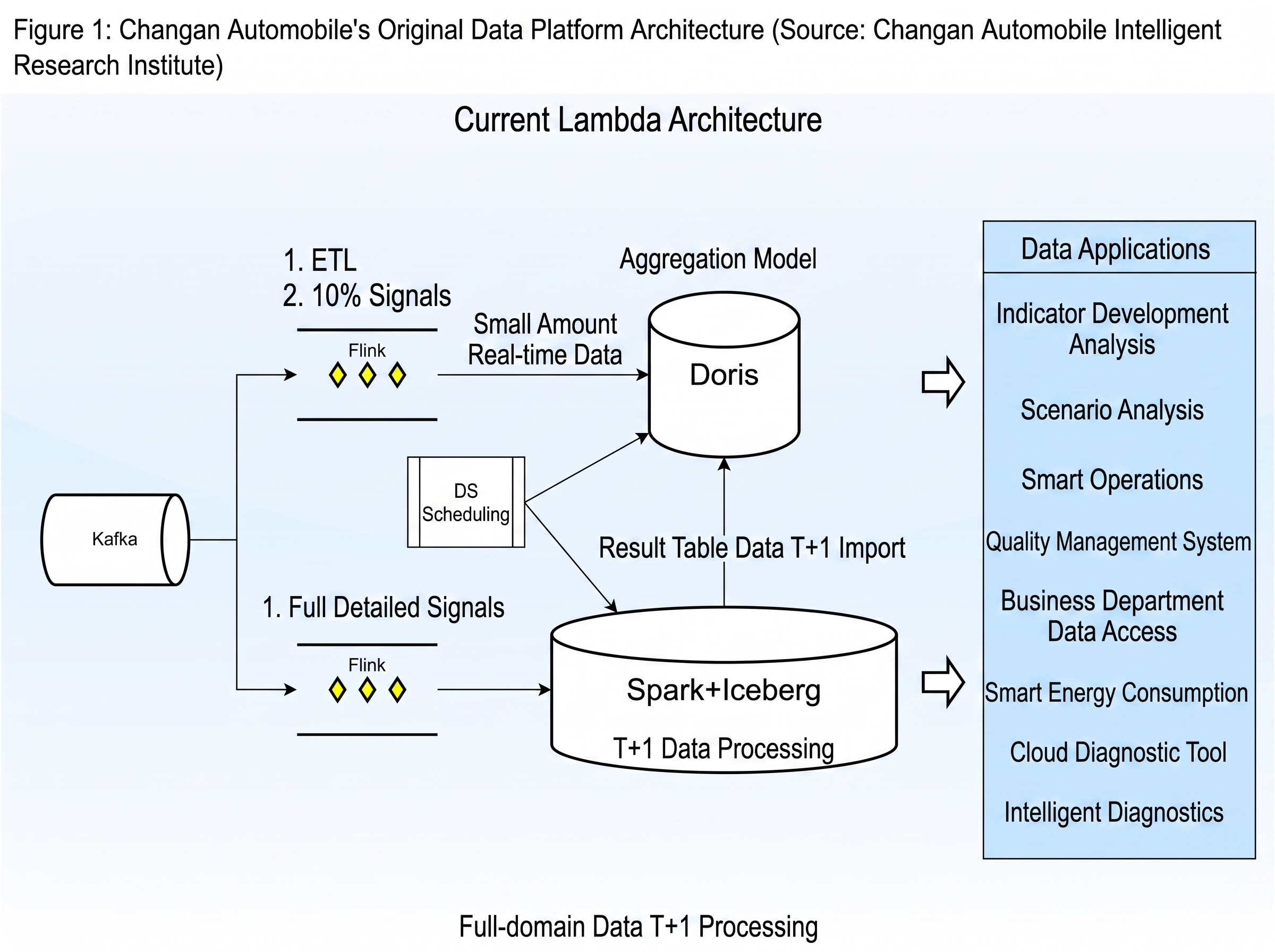
Changan Automobile’s Intelligent Research Institute is responsible for aggregating, processing, and applying connected-vehicle data across the entire Changan Automobile Group. It has already implemented data applications in key scenarios such as business-metric analysis, quality-management systems, intelligent energy consumption, intelligent diagnostics, and intelligent operations. These applications were previously supported by a Lambda-based data platform assembled from multiple open-source big data components, including Flink, Hive, Iceberg, and Doris. Spark processed offline data, Doris handled real-time queries, and Iceberg served as the data lake for large-scale writes. Two independent pipelines supported offline processing and real-time services. This mainstream industry architecture had long underpinned Changan Automobile’s digital and intelligent development.
However, amid rapid vehicle-sales growth and steadily increasing vehicle intelligence in recent years, Changan Automobile’s original data platform gradually became unable to keep pace with the rapidly expanding volume of connected-vehicle data. Its main challenges were as follows:
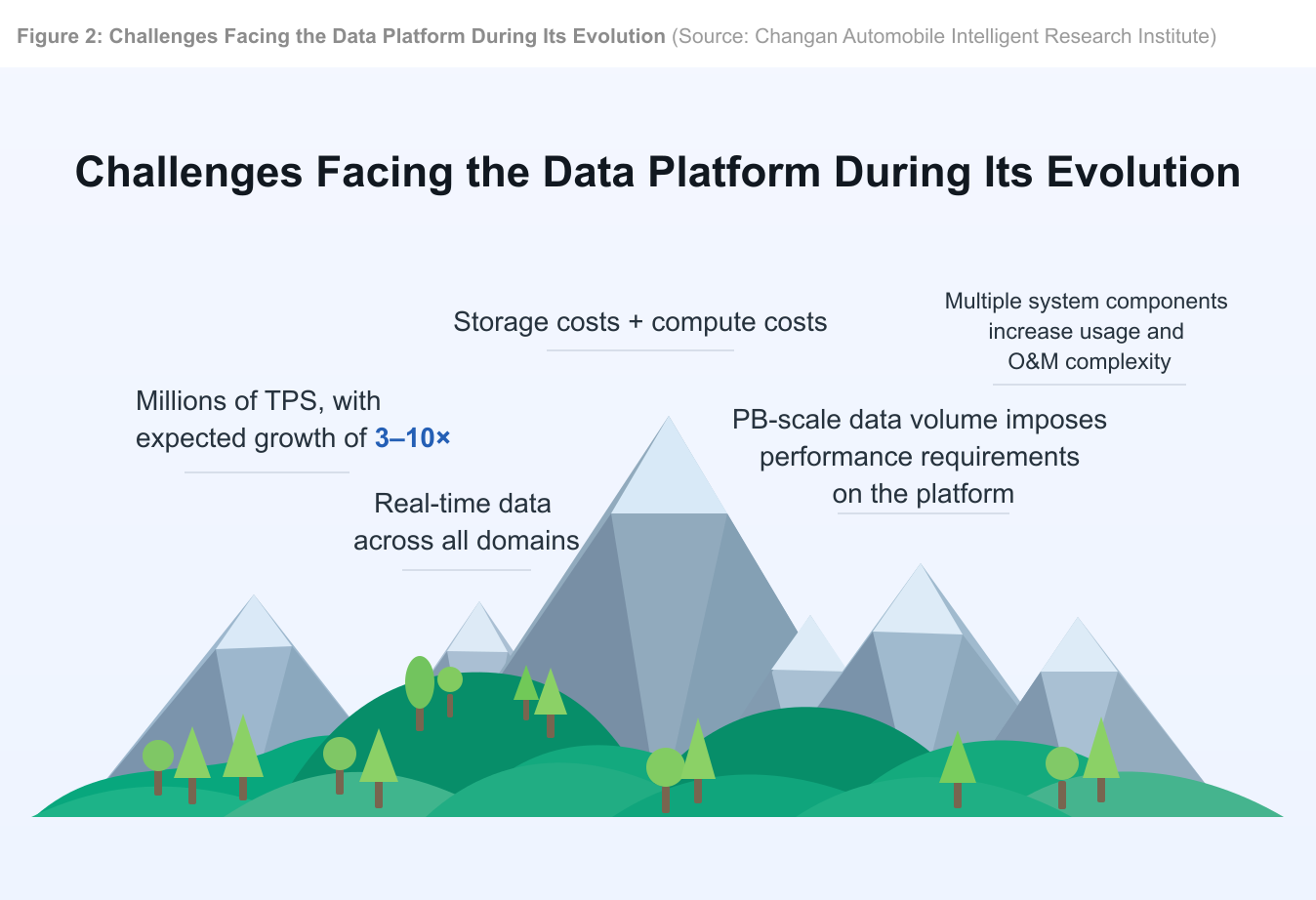
- Difficulty supporting high-throughput, large-scale real-time data ingestion and processing. Vehicles contain large numbers of sensors in components such as doors, seats, and brakes. Each sensor collects one or more types of signal data, which are then aggregated and processed. Changan Automobile currently needs to process thousands of signal types, and that number is expected to reach tens of thousands as vehicle intelligence advances. Its platform already needs to support connections from 4 million vehicles and was expected to connect more than 10 million vehicles by 2025.
The rapid growth in signal types and vehicle population, combined with the high collection density of connected-vehicle data, created a major ingestion challenge. Throughput had already reached several million TPS and was expected soon to reach tens of millions of TPS. The company was also generating tens of terabytes of connected-vehicle data per day, with future daily volumes potentially several times higher.
The original platform addressed lakehouse ingestion by combining products into complex processing chains such as Kafka–Flink–Iceberg/HDFS. This approach lacked sufficient real-time performance and required extensive precomputation and processing. In both system capability and resource consumption, the platform was already struggling with writes at the current scale, let alone future growth of several times that volume.
- Difficulty supporting accurate and timely data queries and analytics. In connected-vehicle applications, rapidly producing analytical results is essential to effective service delivery. In intelligent diagnostics, for example, automakers need to collect relevant signal data in near real time and quickly identify the causes of faults. Connected-vehicle data has many unique characteristics, however, and the original platform could not meet higher query and analytics requirements at an acceptable level of performance and cost:
- The Doris pipeline is generally suitable only for real-time processing of a limited number of signal-data columns. Using Doris to analyze all connected-vehicle signal data would be prohibitively expensive.
- Connected-vehicle data is often delayed. In areas with poor connectivity, such as underground parking garages, transmission may lag, requiring historical data within a certain time window to be rescanned, written, and updated. Frequent delayed-data updates on the original platform incurred substantial additional costs.
- As the number of sensors increases, the signal types written and processed continue to change, causing the schema to evolve. The original platform could not handle variable signal columns flexibly and efficiently.
- When vehicles are stationary or device states remain unchanged, the platform collects large volumes of duplicate signal data. Computing over this data degrades performance and wastes resources.
- Difficulty absorbing continuously rising storage and computing costs. Rapid data growth and increasing requirements to ingest and compute over full datasets drove up costs. The original platform could not effectively optimize around the characteristics of connected-vehicle data:
- It stored connected-vehicle data in JSON format, preventing effective compression and limiting reductions in storage and computing costs.
- Data was transferred and synchronized across multiple engines, creating redundant storage, additional ETL jobs, and extra computing costs.
- Its tightly coupled storage-and-compute architecture prevented independent elastic scaling of storage and computing resources.
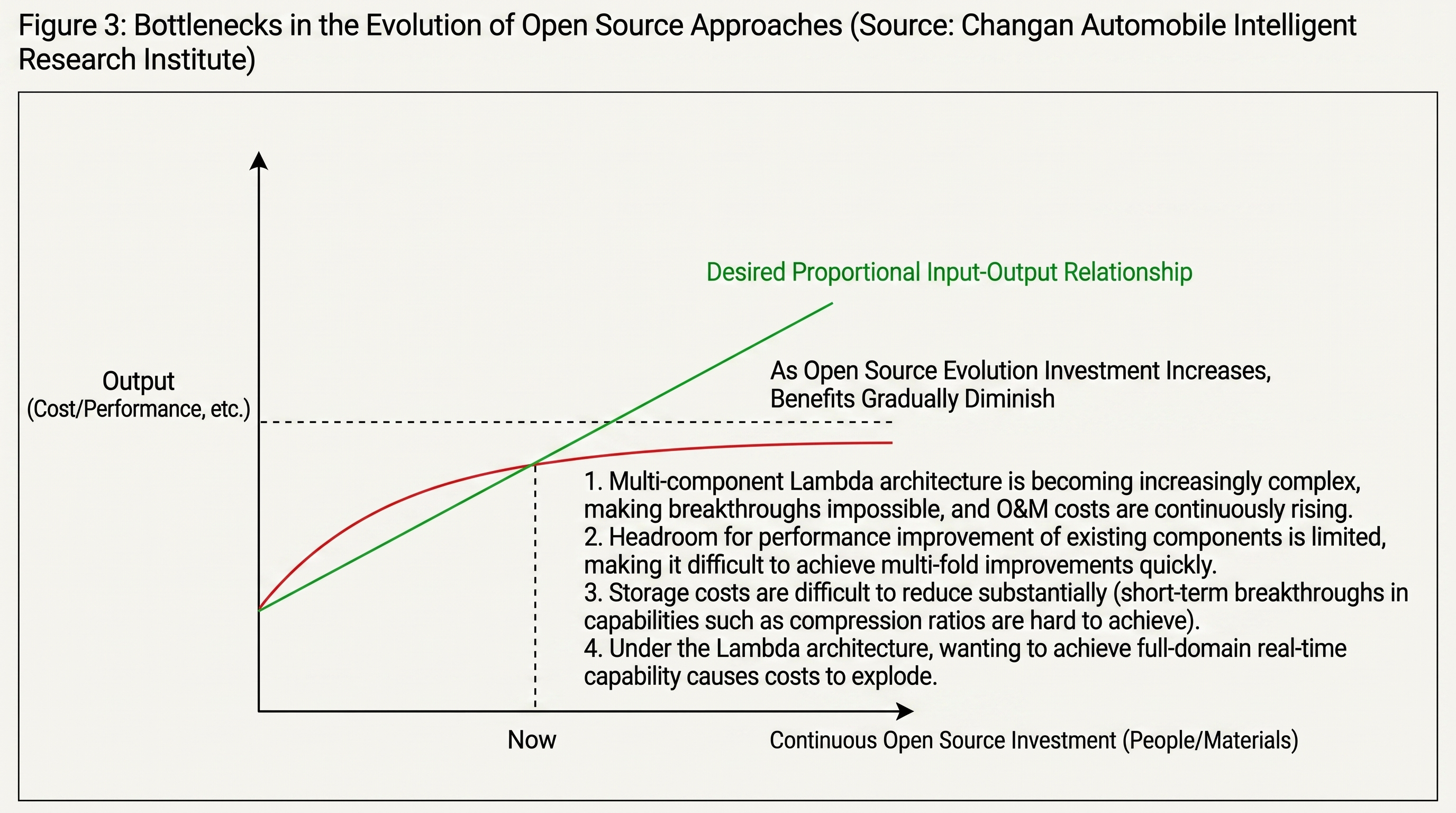
- Difficulty managing the usage and operational complexity created by multiple components. Changan Automobile’s Intelligent Research Institute had introduced additional big data components into the original architecture to patch existing problems. The continuing accumulation of components, however, made the platform extremely complex to use and operate. Each engine was developed and operated independently and could follow a different optimization direction. Adjusting configurations across engines—for example, to rebalance data freshness, performance, and cost—required complex modifications and repeated development work. This lengthened architecture-adjustment cycles and made it difficult to respond to rapidly changing business requirements.
Building a Unified Lakehouse Data Platform to Optimize Timeliness, Performance, Cost, and Ease of Use
To support massive connected-vehicle datasets while improving timeliness, performance, cost, and ease of use, Changan Automobile’s Intelligent Research Institute conducted repeated discussions and validation exercises. It concluded that continuing along the open-source path and patching the original platform could not fundamentally resolve these problems. A new architecture and technology stack designed for IoT data processing was urgently needed. The institute ultimately found the best solution in Singdata’s self-developed unified Lakehouse data platform.
Founded in 2021, Singdata provides multi-cloud and unified data platforms. Its team consists primarily of senior technical professionals from leading cloud-computing and big data companies, including Alibaba Cloud, ByteDance, Microsoft, and Oracle. Singdata’s self-developed unified Lakehouse platform makes data-platform architectures simpler, data more open, and analytics more flexible.
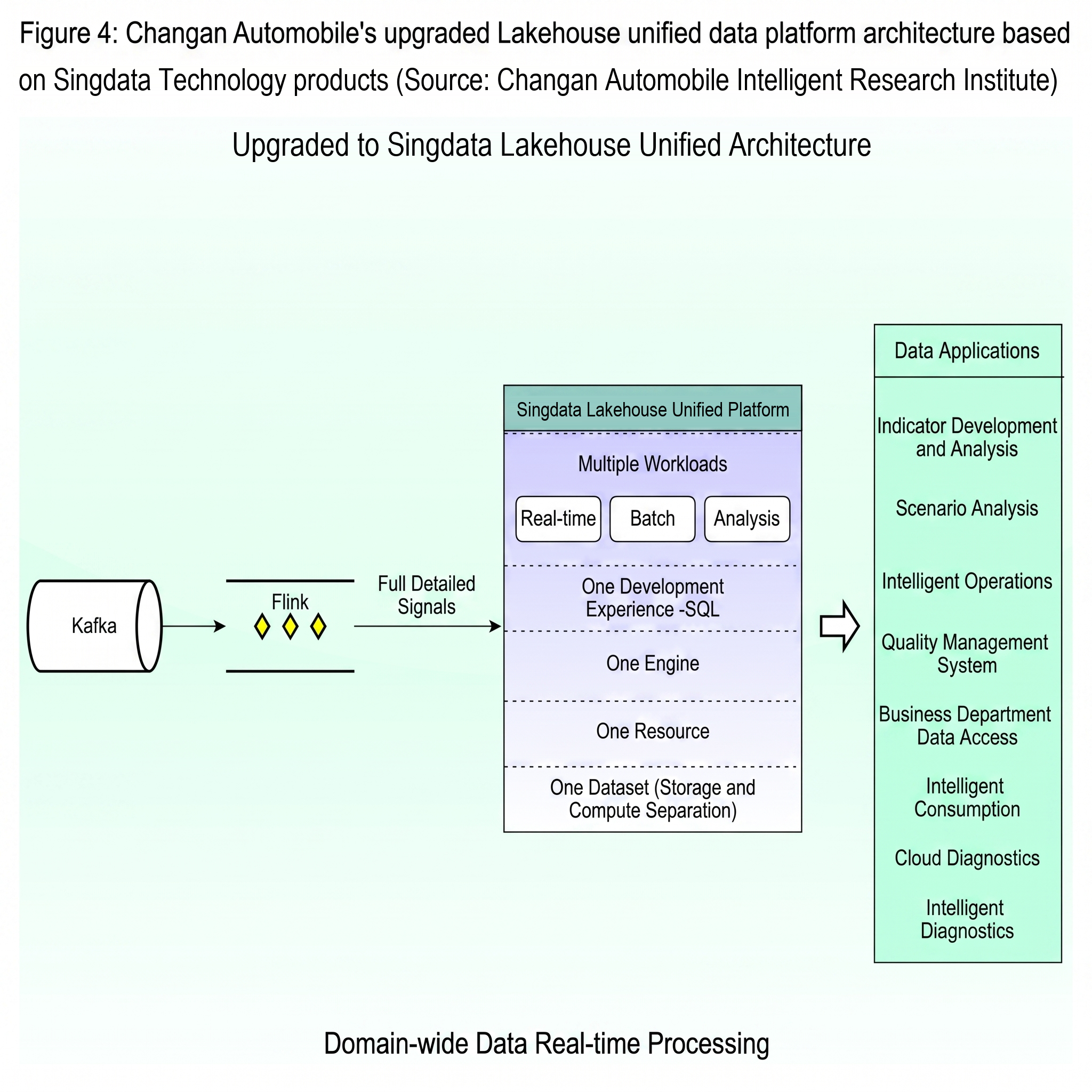
After upgrading with Singdata’s product, Changan Automobile’s data platform adopted a unified architecture and an innovative full-pipeline, real-time incremental-computing model. Combined with multiple technical optimizations, this enabled real-time ingestion and timely analysis of ultra-large-scale data at lower cost. The new platform introduced the following major innovations.
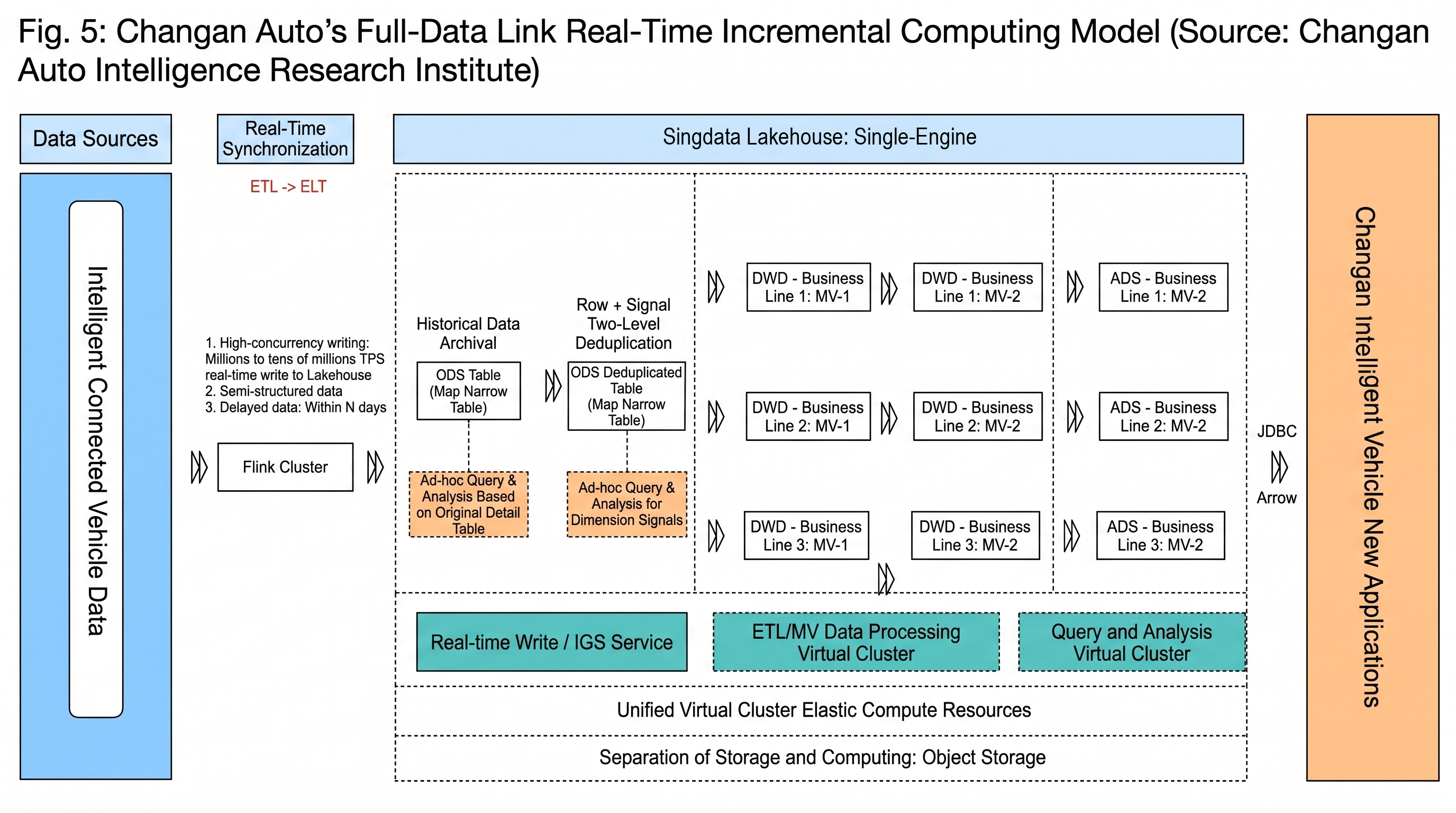
-
Unified architecture. A single engine unifies offline, real-time, and interactive analytics, along with data storage and management, data development, and data services. Changan Automobile can develop real-time, offline, and multidimensional analytics tasks with one set of SQL in a unified data-warehouse architecture. This reduces development difficulty and operations costs while minimizing data redundancy and inconsistency.
-
Incremental computing. The platform divides a day’s connected-vehicle data into small batches. For example, it writes and processes incremental data every five minutes, avoiding the load created by full-dataset computation. Filtering rules select only incremental data relevant to a particular analytical requirement, avoiding the time and cost of scanning the entire dataset during updates. This delivered:
- Significantly improved performance for large-scale data computation;
- Rapid, low-cost updating of delayed data;
- Flexible handling of variable signal columns when combined with the self-developed Map storage format.
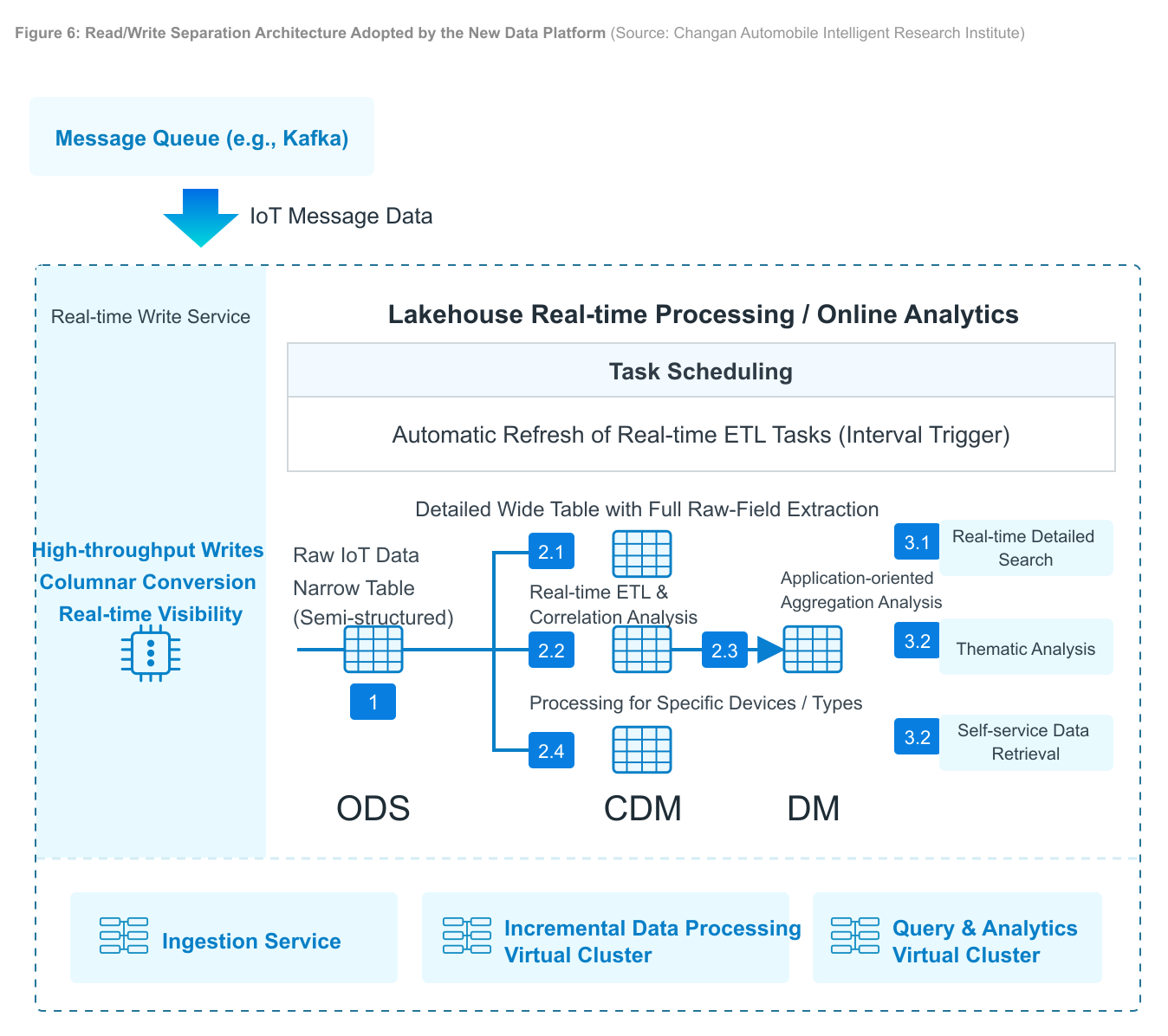
- High-concurrency writes. The platform uses a read/write separation architecture supporting high-throughput upserts, rapid identification of incremental data after lakehouse ingestion, and automated update processing. To ensure real-time ingestion at tens of millions of TPS, Singdata introduced these optimizations:
- A standalone real-time Ingestion Service assigns dedicated computing resources to data writes, giving the platform high-throughput ingestion capabilities;
- The platform automatically merges small files and supports streaming API writes;
- The new Map storage format compresses raw data, while multiple indexing and file-organization technologies optimize storage;
- Incoming and previously written data are managed under a unified model, but only incremental objects are computed, using idle cluster resources for data consolidation.
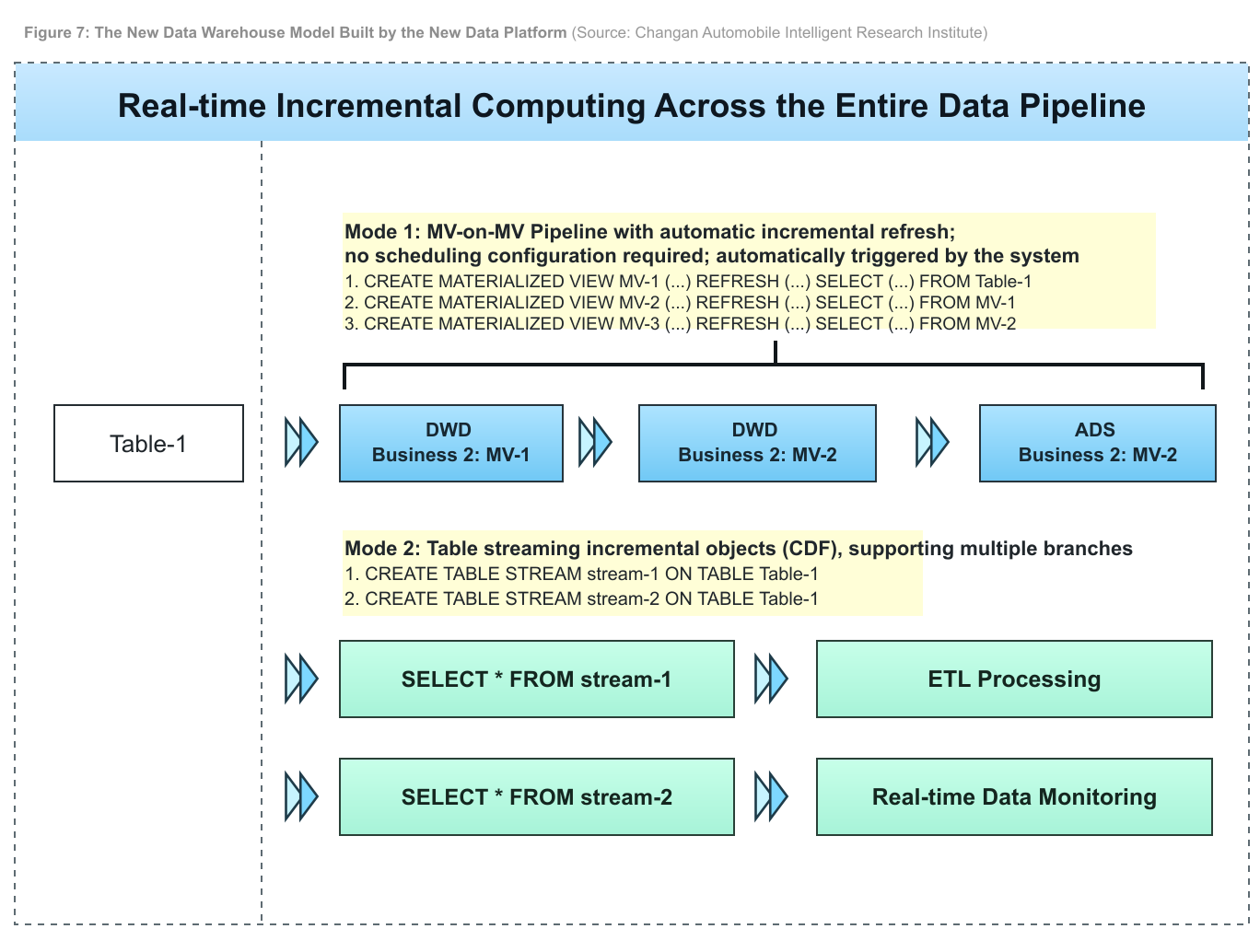
- A new data-warehouse model combining MV on MV and Table Stream. The platform builds materialized views on top of other materialized views—MV on MV—to create a new warehouse model. It supports one-click creation of data-processing pipelines and automatically processes newly added data, substantially reducing development effort and improving efficiency. Its main characteristics include:
- Data warehouses can be defined directly in SQL, which combines with other computing scripts to form a unified programming language;
- MVs are managed and maintained automatically without scheduling configuration. The system triggers them when data is added and can use SQL optimization techniques to queue or rerun newly submitted data;
- There is no need to maintain time-partitioned and time-triggered scheduled tasks; data refreshes and computing triggers occur automatically;
- All resources use unified scheduling. Task and job scheduling share one resource pool, avoiding inconsistencies caused by separate schedulers.
In some scenarios, MV on MV can produce very complex SQL, while full-data processing logic may lack flexibility. The platform therefore provides Table Stream, or the Table streaming incremental object (CDF) model. Users can create a Table Stream for each table to process a category of incremental data on a schedule. Table Stream also supports multi-branch consumption, allowing one incremental dataset to serve multiple pipelines such as ETL processing and quality monitoring. This greatly improves flexibility and timeliness.
-
Data deduplication. Singdata introduced optimizations for the large volumes of duplicate data in connected-vehicle scenarios. Row-level deduplication first removes duplicate rows generated while device states remain unchanged. Signal-level deduplication then removes repeated signal types across rows. This substantially improves downstream computing performance and conserves resources.
-
Query optimization. To improve ad hoc query response times, Singdata implemented query-plan optimization, a shared-everything architecture to improve read/write performance, operator optimization, and vectorized execution, delivering substantial query-performance gains.
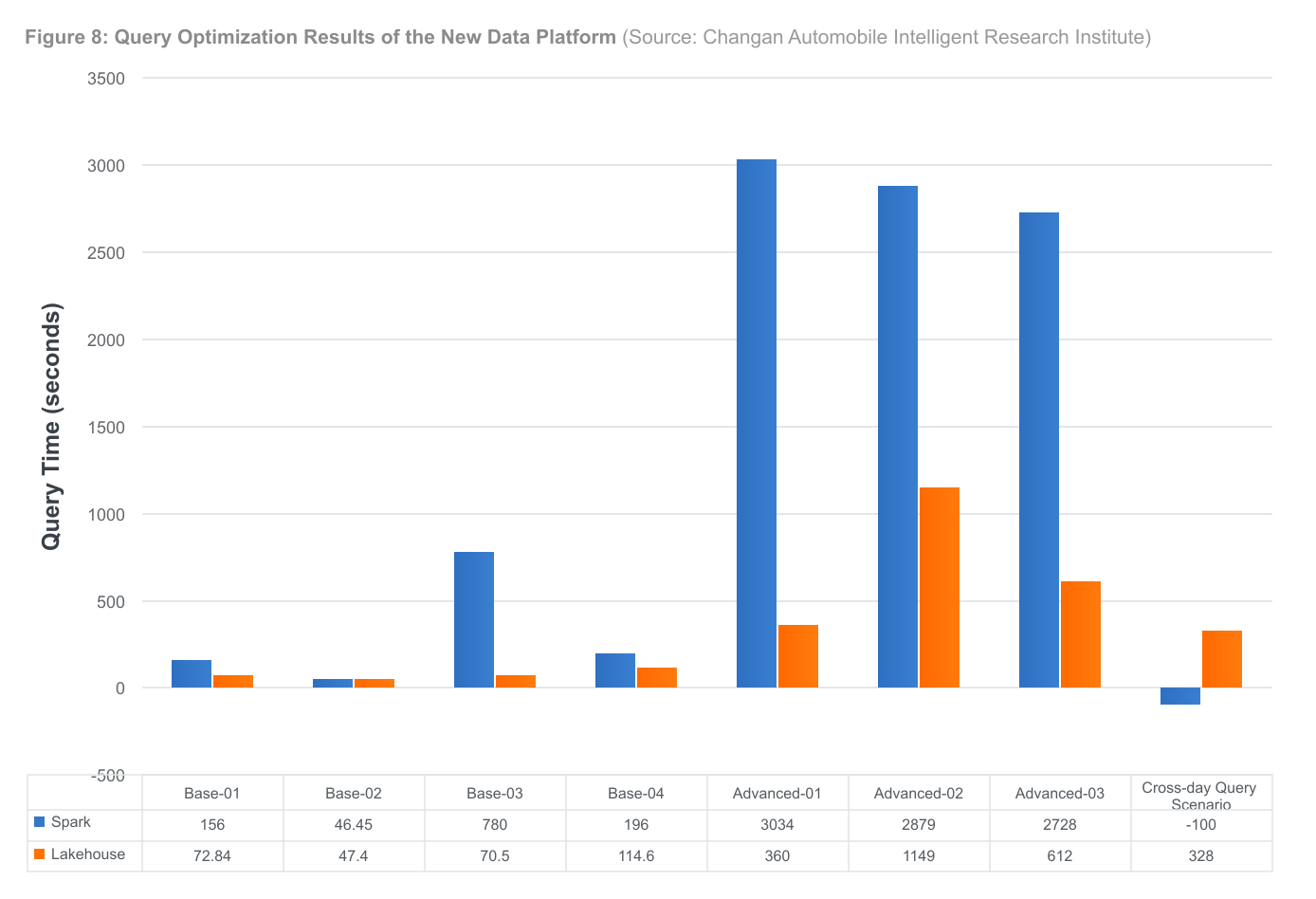
The platform’s architectural and technical innovations substantially reduced Changan Automobile’s storage, computing, and operations costs while minimizing resource waste:
- The self-developed Map format achieves better compression than JSON. Combined with encoding optimizations for Parquet storage, it substantially compresses data;
- The unified architecture eliminates data redundancy and operational complexity;
- Incremental computing prevents delayed-data updates from triggering computation over the full dataset;
- Computing on deduplicated tables improves performance, while raw tables can be moved to cold storage;
- Storage and compute are separated, allowing each to scale elastically according to demand.
Results and Value After the Data-Platform Upgrade
To establish a leading position in the era of intelligent vehicles and deliver a better ownership experience, Changan Automobile’s Intelligent Research Institute explored a new platform capable of supporting rapidly growing connected-vehicle data at low cost. By adopting Singdata’s unified Lakehouse data platform, it achieved the following results:
-
The system gained the capacity to process ultra-large-scale data and accommodate further growth. The unified architecture and incremental computing effectively support high-concurrency, large-scale ingestion and processing. Changan Automobile can handle rapid future growth and support its goal of connecting data from more than 10 million vehicles by 2025.
-
Multiple technical bottlenecks were overcome, ensuring timely queries and analytics. Building on the unified architecture and incremental computing, innovations such as MV on MV, data deduplication, and query optimization overcame bottlenecks involving instant queries over ultra-large datasets, delayed-data processing, and variable signal columns. This meets real-time query needs, enabling more complete services and faster responses.
-
Development efficiency improved and the barrier to use was lowered. The unified architecture eliminated the need to maintain a complex collection of big data components. Users can develop workloads with one set of SQL, while MV on MV automatically refreshes processing pipelines. This simplifies development, improves collaboration, and expands analytical capabilities.
-
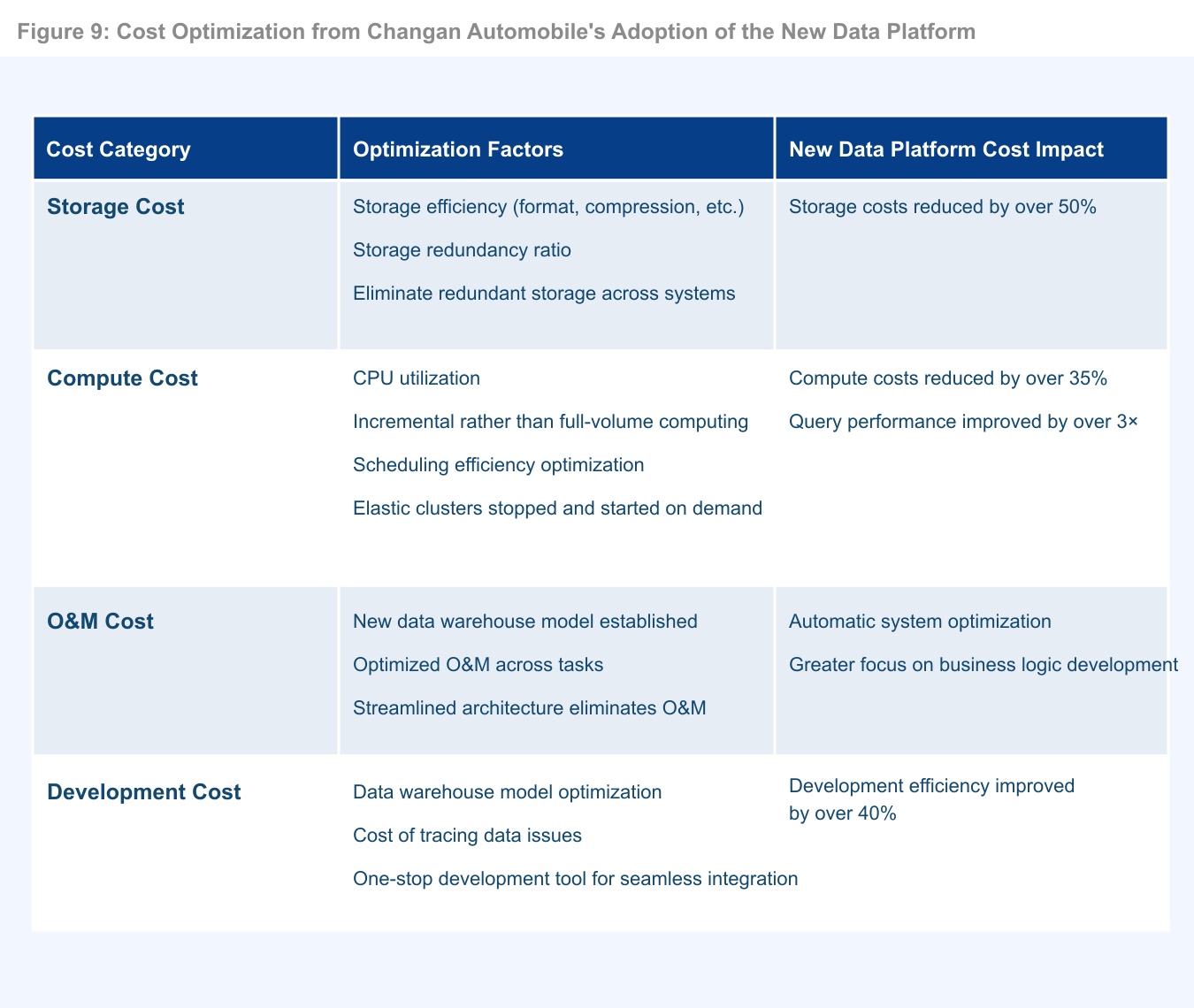
Storage and computing costs fell substantially. Efficient storage methods and compression algorithms, unified management to reduce redundancy, and the separation of storage and compute lowered storage costs by more than 50%. The optimized architecture and processing solution reduced computing costs by more than 35%. Automation also reduced development and operations costs. Multiple query optimizations improved performance by more than 3×, saving computing resources and processing time.
Project Experience Summary
Looking back at the evolution of big data technology, the industry has consistently sought better solutions in architecture, functionality, performance, and cost as application scenarios, data types, and scale have changed. The Hadoop ecosystem, which emerged around 2005, gave enterprises the ability to process large-scale internet data efficiently and at low cost during the internet era.
In the coming IoT era, however, IoT data—especially the massive volumes of connected-vehicle data generated by vehicle intelligence—has characteristics that differ significantly from earlier data types. Connected-vehicle data is highly concurrent, ultra-large in scale, and low in value density, while business scenarios require rapid ingestion and full-data computation. It is also affected by delays, variable signal columns, and oversized raw tables, while applications require immediate queries and analytics over complex data.
The pioneering experience of the joint Changan Automobile–Singdata project team demonstrates that traditional architectures and technologies cannot fundamentally solve these problems for ever-growing connected-vehicle datasets. They also create extremely high processing costs and will soon constrain business growth. Automakers must therefore embrace new architectures and technologies—including unified architectures and incremental computing—to improve scalability, elasticity, performance, and cost efficiency and confidently address the data-processing challenges of connected vehicles.

 日本語 / Japan